‘I will be a friend to you, and you shall take care of my linen’ – those words, uttered by Mr B. to the beautiful and innocent maid at the beginning of Samuel Richardson’s famous work have been igniting readers’ imagination for almost three hundred years. Pamela, or Virtue Rewarded was published in 1740. Richardson, writing his debut epistolary novel, considered today to be the first mature novel in English literature, also proved to be the precursor of eighteenth-century ‘conduct books’ – guides to the intricacies of binding social norms. Yet the exceptional nature of Pamela lies not just in the masterful penmanship, but also in the bravura play of contrasts: virtue clashes with lasciviousness, ideal with reality, piety with primitive instinct. Richardson’s book became the first bestseller, in the present-day sense of the word, read with flushed cheeks by maids and gentlefolk alike, in equal measure praised from the pulpit and accused of veiled pornography. Not without reason, judging from the excerpt quoted above. A few dozen pages later, Pamela, hearing suspicious noises coming from Mrs. Jervis’ closet, first undresses before opening the door, through which falls her employer, dressed in nothing but a silk dressing gown. Yet she maintains her chastity until the day of her marriage to Mr B., which for some was proof of her remarkable attributes and for others of her exceptional manipulative skills in seeking the desired goal, namely, social advancement through marriage to a partner of incomparably higher status.
The popularity of Pamela surpassed all conception. The novel sold in hundreds of copies across the whole of Europe, and in 1742 it reached America, where it was published by Benjamin Franklin, one of the future founding fathers of the United States. It inspired artists and launched a fashion for the outfits described in the novel and their attendant ‘gadgets’. It was the object of numerous imitations and adaptations, including the comedy La Pamela, o sia La virtù premiata, from 1750, in which Carlo Goldoni transferred the action to Venice and turned the titular heroine into the unrecognised daughter of a Scottish aristocrat. Later, under the pseudonym Polisseno Fegejo, he turned his play into the libretto La Cecchina, o sia la buona figliuola, in which the maid becomes the gardener Cecchina, the lost offspring of a colonel with the Prussian cuirassiers. Among the composers to turn to Goldoni’s libretto were Egidio Duni and Salvatore Perillo, but their operas met with a rather cool reception in Italy.
The text only found a composer of commensurate talent in the person of Niccolò Piccinni, a Bari-born thirty-two-year-old subject of the Kingdom of Naples. La Cecchina, staged in 1760 at the Teatro delle Dame in Rome, was Piccinni’s fifteenth opera and proved a turning point in his career. First it opened to him the doors of all the major theatres in Italy, and then it set off to conquer Europe. In 1765 it came to Warsaw, where, just twenty years later, it enjoyed spectacular success in Wojciech Bogusławski’s Polish adaptation (Czekina, albo cnotliwa panienka). During the 1770s it apparently reached Beijing, staged at the imperial court by a company of Italian Jesuits.
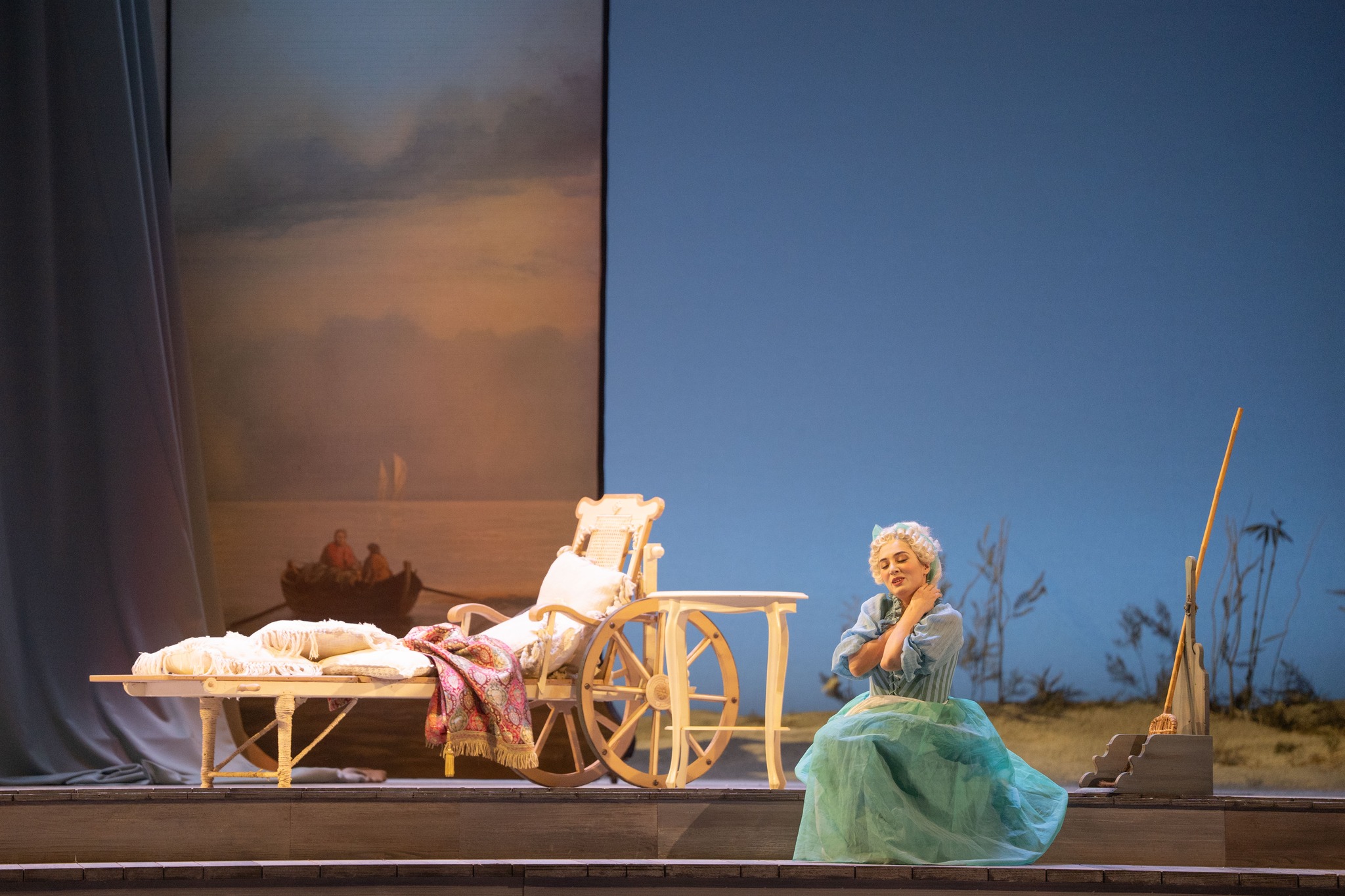
Francesca Aspromonte (Cecchina). Photo: Clarissa Lapolla
A hundred years later, Verdi, who was already setting about Falstaff, called La Cecchina ‘the first true comic opera’, without which the masterworks of Mozart and Rossini would never have been written. Yet among most present-day music lovers, Piccinni’s name fails to trigger any musical associations. If anything, historical circumstances are evoked, linked to his journey to Paris in 1776, when the composer was drawn into one of the first episodes in the ‘war’ of the Gluckists and Piccinnists – a conflict between advocates of reformed French opera and supporters of Italian opera. The Parisians, who loved a good quarrel, paying no heed to the mutual respect between the two composers, who had no wish to compete with one another, triggered an aesthetic war lasting several years, which occasionally spilled over into fisticuffs. They clashed wherever the opportunity arose: on the streets, in cafes, in private homes, theatres and schools. The dispute rumbled on even after Gluck returned to Vienna in 1780. During its final phase, it assumed the quite grotesque form of a war between the Piccinnists and devotees of Antonio Sacchini, newly arrived from Italy, who with time went from being another representative of the Neapolitan school into a moderate imitator of Gluck.
And then it all fell quiet. La Cecchina disappeared from stages shortly after Piccinni’s death in 1800 – along with more than a hundred other operas of his. Over the next two centuries, it was staged sporadically, mostly in Italy. In 1928 a production was put on in Bari, to mark the bicentenary of the composer’s birth. And it returned to the composer’s home town almost a hundred years later, in January 2026, as part of the preparations for the next jubilee.
I could not pass up such a chance. I travelled to the Apulian capital not just on account of the work, but also for the carefully selected soloists and the conductor, Stefano Montanari, who has been music director of the Teatro Petruzzelli for almost three years. I was curious to see how this collector’s piece would fare in the hands of the Italian actor, screenwriter and film director Daniele Luchetti, familiar to Polish film buffs thanks partly to the drama Lacci, shown at the opening of the Venice Film Festival in 2020.
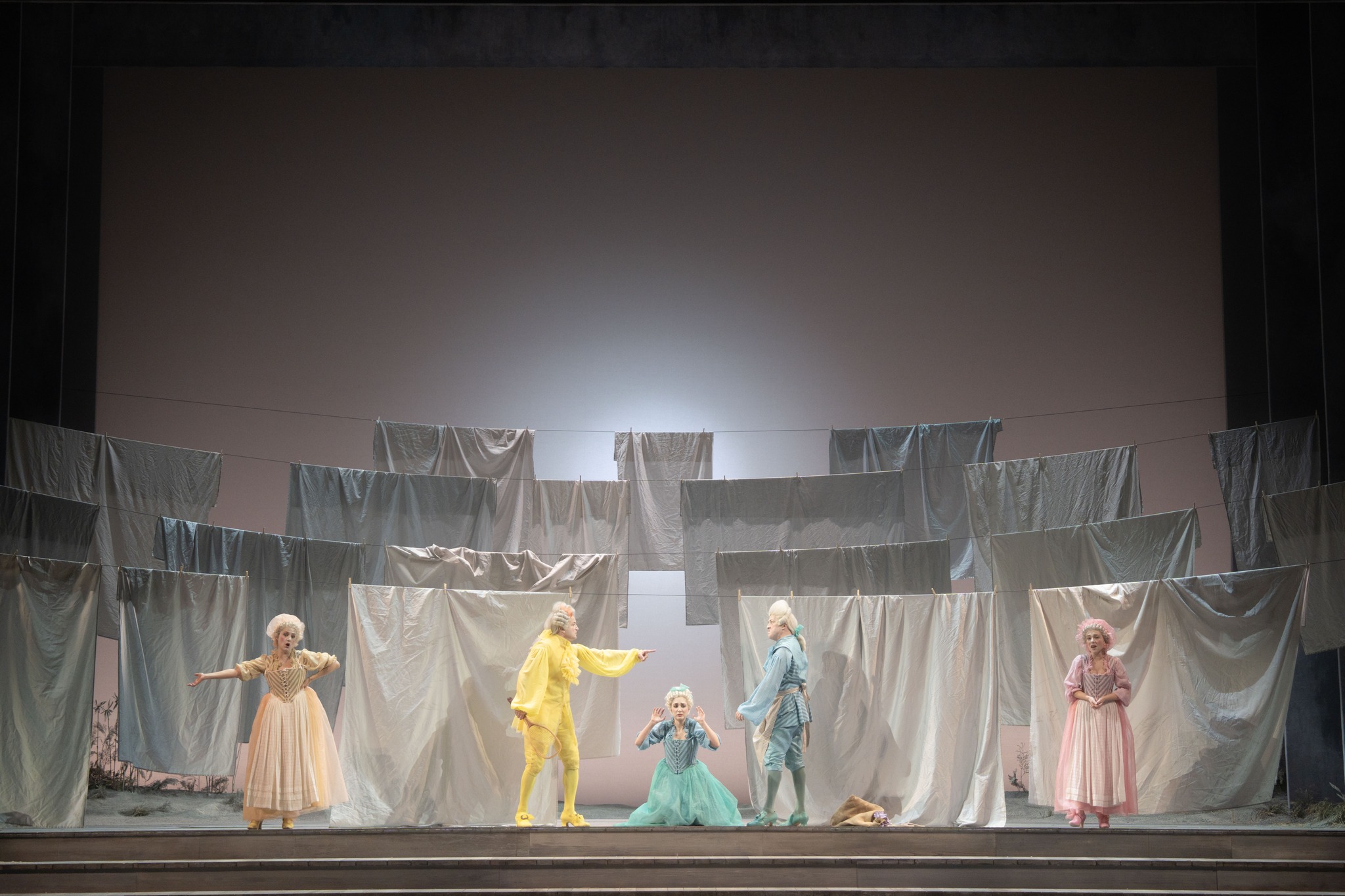
Paola Gardina (Paoluccia), Krystian Adam (Marquis della Conchiglia), Francesca Aspromonte, Christian Senn (Mengotto), and Michela Antenucci (Sandrina). Photo: Clarissa Lapolla
Well, it fared quite splendidly. Luchetti forged an irresistibly funny spectacle which at the same time takes up an intelligent dialogue with both the convention of the epoch and the output of the most outstanding specialists in the staging of pre-Romantic operas, to mention but Jean-Pierre Ponnelle and his assistant Jean-Louis Martinoty. At first glance, he remained faithful to all of the stage directions contained in the libretto. In reality, he wittily ‘translated’ them for the sensibilities of a contemporary audience, adding anachronistic props to the settings or arranging them in a way that triggered utterly unexpected associations. The band of servants tasked with tending to the physical fitness of the Chevalier Armidoro resembles a company of circus strongmen lifted straight out of Fellini’s La Strada; the Marquis della Conchiglia sets off in pursuit of Cecchina on a comical scooter adorned with rococo tassels; the bravura finale of Act I, amidst bedsheets strung up across the stage, reminds one of the Neapolitan lineage of Piccinni’s opera; every so often, elements from the most famous productions of Britten’s Death in Venice burst into the Venetian landscape of Goldoni’s adaptation. Yet in spite of all these ‘diversions’, Luchetti’s production remains a moving tribute to eighteenth-century theatre: with a subtle play of lights and shadows, intricately painted vedute and proscenium borders (stage design by Alessandro Camera, beautifully illuminated by Marco Filibeck) and remarkably beautiful costumes (Massimo Cantini Parrini) of captivating lightness and finesse and a palette of colours worthy of the greatest Italian masters of the Italian Settecento.
Equally convincing was the musical side of the show, prepared by Montanari with genuine expertise in mature buffo style and a characteristic blend of comical and sentimental elements with the totally ‘serious’, the latter bringing deeper reflection on human nature. There are soubrettes in this opera, as well as the figure of the soldier Tagliaferro, derived from the commedia dell’arte tradition. There are lovers wracked by doubt and also a typical mezzo carattere, in the person of the Marquis, in love with the titular heroine. It is also worth mentioning that the Roman premiere of La Cecchina was performed solely by men – in connection with the still binding edict issued by Pope Sixtus that banned women from performing in theatres in the Papal States. In subsequent performances given during Piccinni’s lifetime, the singers appeared in a great variety of configurations, from mixed casts, in which the soprano and mezzo-soprano parts were sung by castrati arm-in-arm with women, to ‘natural’ casts with a single travesti role (Armidoro).
That only enhances my admiration for the choice of soloists for the Bari show – in a cast consisting entirely of artists experienced in such repertoire and fully aware of the historical context of the first performances of La Cecchina. The titular figure of the buona figliuola was successfully embodied by Francesca Aspromonte, endowed with a warm, soft soprano, highly expressive, though a little dull in the middle range. Taking nothing away from the young Italian singer’s abilities, I must admit that the show was stolen from her by the phenomenal Ana Maria Labin in the part of Lucinda, boasting a soprano voice with an exquisite, silvery timbre, perfectly set and balanced across the registers, which, despite its charming delicacy, carries remarkably well (including in the ethereal pianos of the aria ‘So che fedel m’adora’ from Act III). Contrasting marvellously with the parts of the two female protagonists was the energetic and fruity-sounding soprano of Francesca Benitez in the trousered role of Armidoro. Michela Antenucci and Paola Gardina formed a bravura pair of the malicious maids Sandrina and Paoluccia, investing their parts with so much vis comica that at times I was doubled up with laughter.
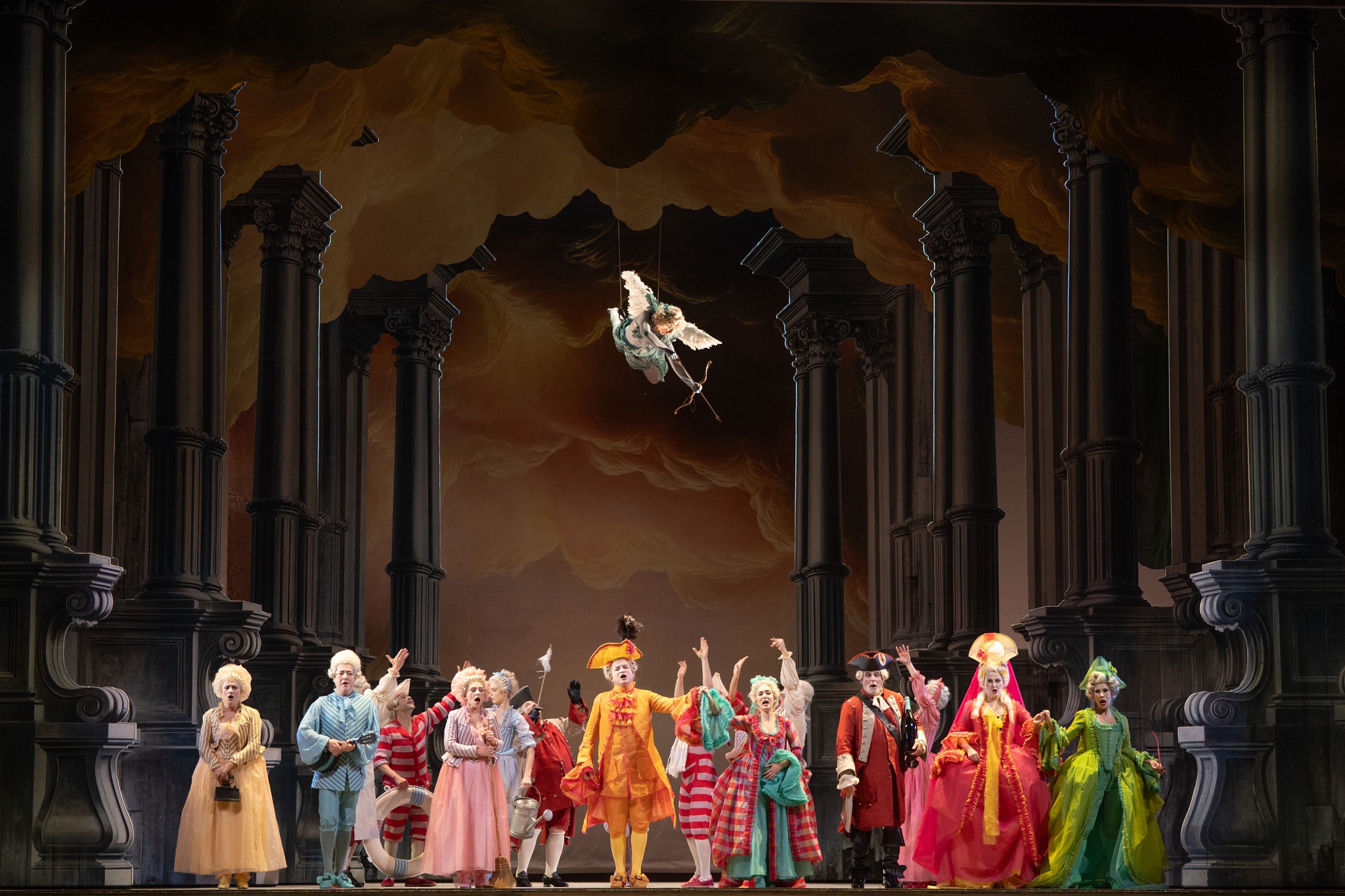
Act III, Finale. Photo: Clarissa Lapolla
Just as much joy was conveyed by Krystian Adam in the tenor role of the Marquis della Conciglia, demanding candid lyricism and vocal buffoonery in alternation. In both aspects, he came across splendidly, thanks not just to the beauty of his voice and his exquisite technique, but also to the well-judged ideas of Luchetti, who led this protagonist all the way from being a sweet scallywag, through a gallant disorientated by his nascent feelings, to a man ready for true love. In the casting of the two baritone parts – the poor Mengotto, wooing Cecchina in vain, and the hilarious cuirassier Tagliaferro, who brings news of her real family origins – the contrast between the two characters was judiciously brought out. The mature beauty of Pietro Spagnoli’s voice was ideally suited to the character of the battle-hardened Tagliaferro, while the less seasoned, though equally suggestive, baritone of Christian Senn excellently conveyed the quandary of the miserable Mengotto.
Montanari led the whole performance – with an ensemble of musicians from the local orchestra – with verve, a flair for the idiom and a hint of delicious insouciance. All the more worthy of underlining is that he conducted from the instrument on which he also accompanied the soloists in the elaborate secco recitatives. I feel it my duty as a reviewer to note that it was an eighteenth-century Italian fortepiano (or a copy thereof), ideally suited to the circumstances – an instrument to which it would have been worth devoting at least a few words in the programme book, which was otherwise impeccably prepared.
There are still two years to go until the tercentenary of Piccinni’s birth. The Bari theatre has given us a wonderful foretaste of the approaching jubilee of its native son. It is high time we took an interest in his unjustly forgotten work and perhaps reassessed it against the background of the output of the epoch. Verdi did so a long time ago and, as usual, he was right.
Translated by: John Comber