Around the same time that Peter Sellars was working on his staging of the Matthew Passion at the Berlin Philharmonic – that is, in early 2010 – Romeo Castellucci, l’enfant terrible of Italian theatre, created one of the most provocative works of his entire career. The production Sul concetto di volto nel figlio di Dio, featuring a fragment of Antonello da Messina’s painting dominating the stage, an image of the Saviour of the World silently watching the agony of the ailing Father, went out into the world after its premiere at the Romaeuropa Festival labelled as the director’s profession of faith. It was admired in Rome, and provoked violent riots in Paris and Avignon. Less than six years later, when Sellars was already coming up with the first sketches for La clemenza di Tito at the Salzburger Festspiele, Castellucci decided on Matthäus-Passion for the opening of the Musikfest Hamburg. Had he been able to implement his original concept, this might have resulted in a production straight from the spirit of Sul concetto di volto. There were some technical obstacles, however: the production was planned in the vast Deichtorhallen, a former market hall without theatrical facilities that has been transformed into a museum of contemporary art. The idea of illustrating Bach’s work with a series of live images reminiscent of Italian Renaissance paintings was, therefore, replaced by Castellucci with a series of installations and performances bringing to mind loose, often disturbing associations with the passion of Jesus and forcing the spectators to engage in difficult reflections on the meaning of human suffering.
In 2016 the staging was received favourably, but without much enthusiasm. Castellucci all too soon came up against the legend of Sellars’ production, prompting comparisons all the more so given that Simon Rattle, who conducted the Berlin Passion, and Kent Nagano, who conducted the work in Hamburg – both well known to German audiences – represented radically different musical worlds. Sellar’s pared-down and yet emotionally charged concept was a perfect match for Rattle’s temperament and thus proved to be more accessible. Castellucci’s abstract theatre, using symbol and metaphor, worked perfectly with Nagano’s clear, slightly distanced interpretative style, requiring much more attention and concentration from the listener.
For nearly a decade the Hamburg Passion – although, in retrospect, it proved to be a landmark work in the Italian director’s oeuvre – was preserved only in the memories of audiences present at the three performances at Deichtorhallen and in a video recording that does not convey its many nuances. Over two years after the failed attempt to revive it in Rome, it finally arrived at the Teatro del Maggio Musicale in Florence with the same conductor and the same Evangelist (Ian Bostridge) – for two of the three scheduled performances, as the premiere coincided with a strike of the local trade unions.
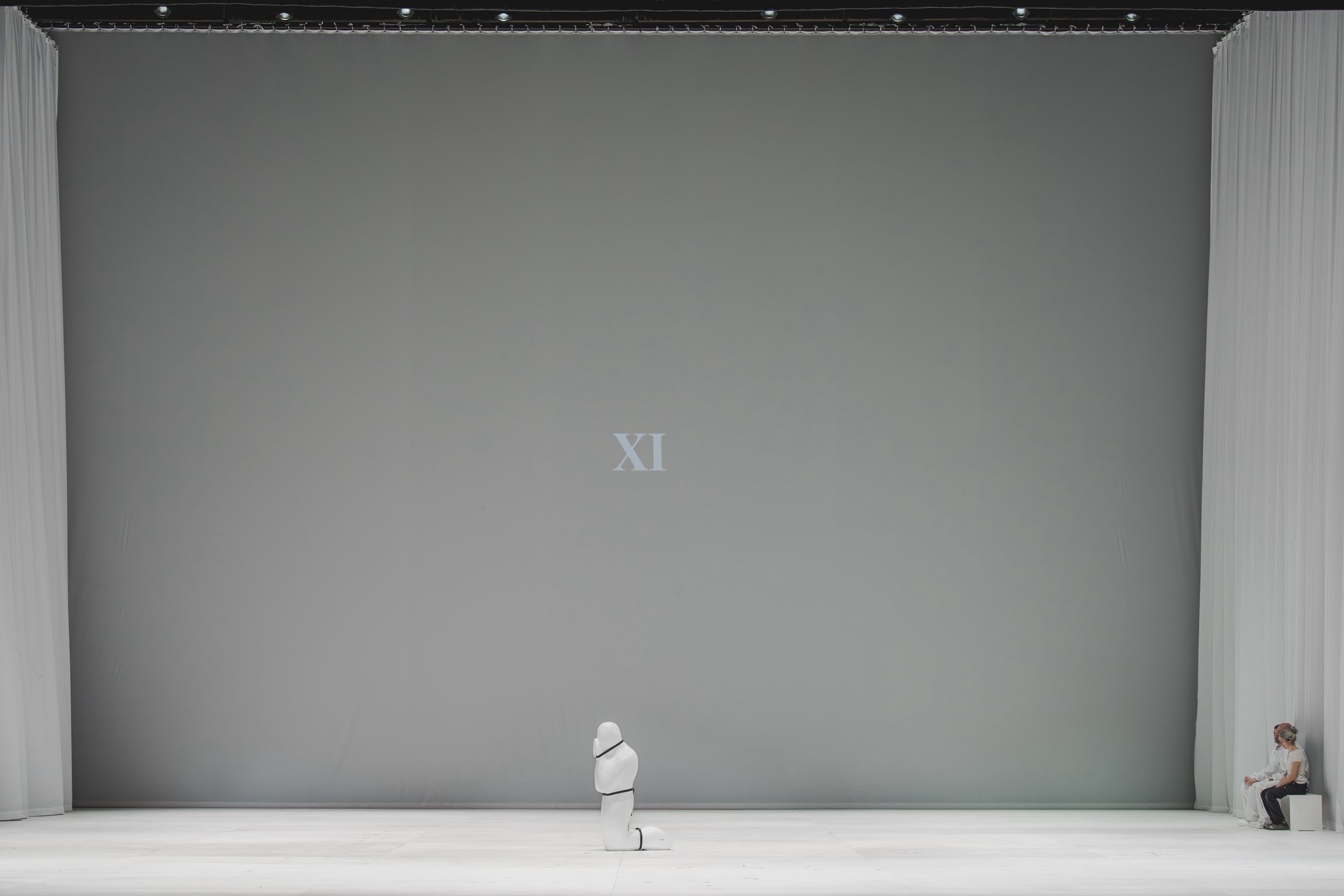
Photo: Michele Monasta
Fortunately, I made it to the second and last performance to find out once against that Castellucci was, indeed, a provocateur, but by no means a scandalist. If he is, it is, as he himself repeatedly emphasised, in the New Testament sense of the word σκάνδαλον, the Greek equivalent of michshol, or “stumbling block” from the Book of Leviticus, an obstacle “you shall not put before the blind”. In the New Testament it is above all a “stone of offence”, a metaphor for going astray, inciting evil. Castellucci throws this stumbling block at our feet as if before the blind, transforms it into a silent cry to the deaf. He throws us off balance with a succession of seemingly inappropriate, iconoclastic associations the meaning of which either eludes us or reaches us when we least expect it.
The director leads the audience down the wrong path already at the very beginning of the performance, when white-clad Nagano steps onto the snow-white stage and washes his hands in a bowl brought in by two actors dressed in white. This is not a gesture of Pilate; this is a gesture of purity of heart, made by a priest who will soon descend into the orchestra pit to begin a ritual involving musicians in white costumes. Blinding white is a feature in many of Castellucci’s stagings, but in the Passion it is omnipresent and ambiguous: as a symbol of holiness and truth, but also of emptiness, loneliness and mourning. The director will stage nineteen memorable episodes in this white setting, in which every object, every substance, every tree, every person, and even their absence, will be treated conscientiously and with extraordinary tenderness by the athletes, police officers, doctors, lab technicians, cleaners and “ordinary” Florentines participating in the performance, and silently telling their own and other people’s stories. In the Judas’ betrayal episode they will use the real skull of a thief caught red-handed and killed by a shot to the head. They will take the last supper of a recently deceased patient out of a fridge, they will put sheets stained by the umbilical cord blood of a real newborn in a washing machine. In the Crucifixion scene a group of volunteers – children, young and old people – will attempt to hold the position of Jesus nailed to the cross by clinging with their hands to a suspended bar. No one will last more than a minute. The director will turn water into blood and vice versa, by alternately colouring and neutralising a solution of phenolphthalein in transparent tubes.
All these actions are meticulously described by Castellucci in a separate booklet accompanying the programme book. We stumble over them as if stumbling over stones even without his explanations. All aspects of the last days of Christ acquire a completely different dimension when linked to the ordinary experience of the beginning and end, pain and comfort, hope and despair. I will remember that “my” newborn baby (the director linked a different baby to each performance) is a girl called Anna, who has just turned one month. I will not forget that the fir tree cut down before my performance and stripped of its branches before my eyes was thirty-nine years old. I will remember the story of the illness of the Florentine goldsmith Maurizio, who came on stage on prostheses and left it on stumps of legs that would not have had to be amputated, if it had not been for the chaos in the pandemic-stricken hospitals.
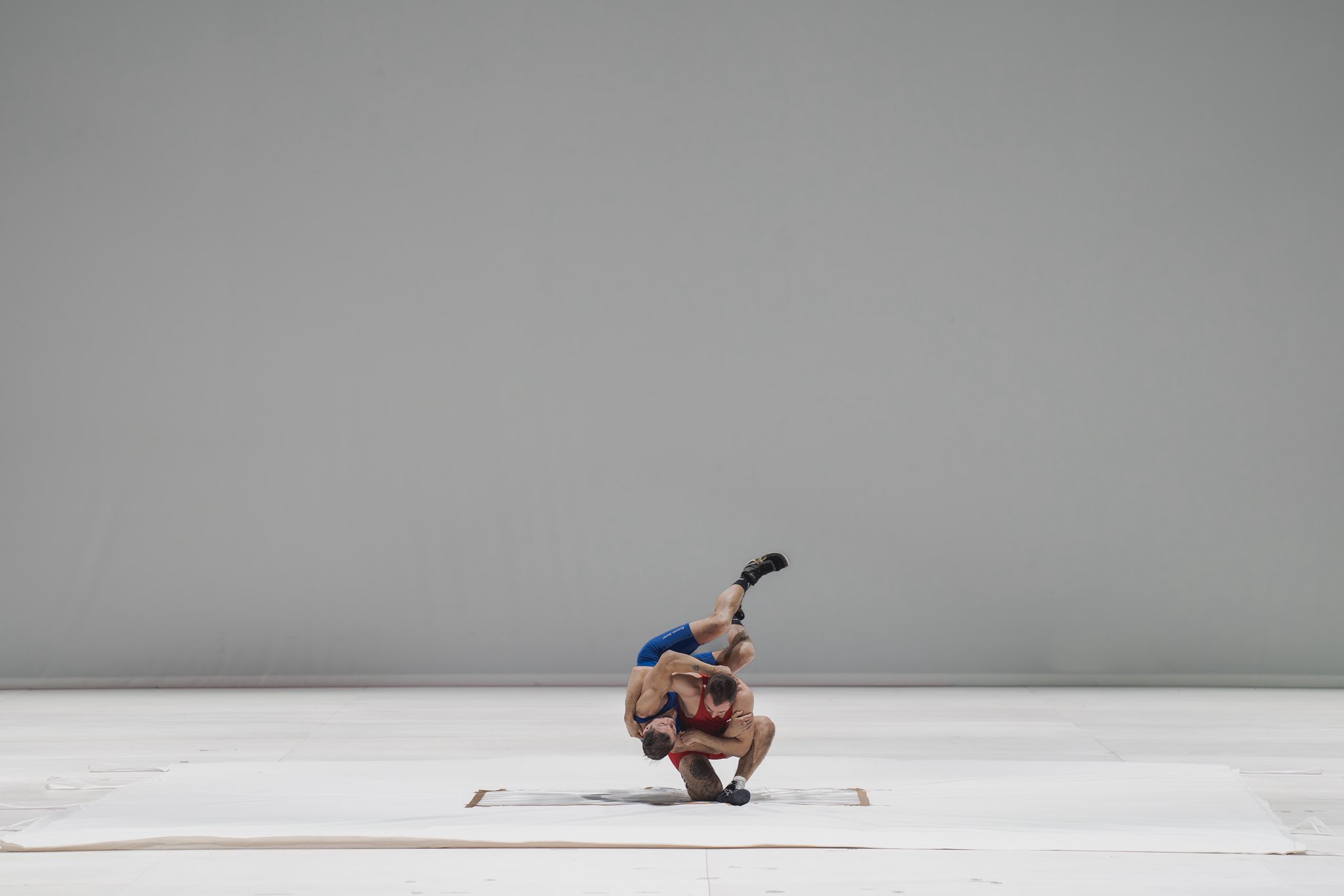
Photo: Michele Monasta
Some episodes proved less, some even more vivid. Many factors influence the degree to which they are perceived as consistent with doctrine and with Bach’s text, factors ranging from personal sensitivity to the experiences of a particular community. The Italians read these codes as intended by the director, as was evidenced not only by the thunderous ovation after the performance, but also – and perhaps above all – by the reaction at the beginning of that mystery play, when no one burst into applause after Nagano’s entrance, recognising that theatre was already happening. However, in comparison with the Hamburg performances, the distance between the musicians and performers on stage has grown. At Deichtorhallen all the action took place in the space between the audience and the performers: yes, it could throw the musicians off balance at times, but at the same time it encouraged them to empathise.
Another thing was that the soloists and members of the Teatro del Maggio Musicale Fiorentino ensembles, safely hidden in the cocoon of the orchestra pit, focused entirely on their tasks. With a truly youthful passion, which is not surprising because, as Castellucci meticulously points out, the orchestra features a violinist who has just turned twenty-one and the oldest singer in the chorus is in his sixties. This is exactly how Bach should sound when performed by artists normally associated with opera: light, airy, with no attempts to ape Baroque articulation on modern instruments, but with respect for Bach’s musical rhetoric – which is especially true of the chorus members, prepared by Lorenzo Fratini and Sara Matteucci, who impressed with their excellent diction, understanding of the text and full commitment to their collective characters.
Particularly worthy of praise among the soloists were Edwin Crossley-Mercer as Jesus – captivating with his phrasing and the melancholic tone of his beautiful bass, perhaps a little too “smoky” in the middle; the excellent Anna El-Khashem, with her crystal-clear, subtle soprano voice and excellent breath control; the ever reliable Krystian Adam, who possesses a rare ability among tenors to combine a stylish interpretation with a great deal of emotion; and Iurii Iushkevich, singing with a surprisingly colourful, calm, almost girlish-sounding countertenor. Decent though not particularly spectacular performances came from the soprano Suji Kwon, and basses Thomas Tatzi and Gonzalo Godoy Sepúlveda. Ian Bostridge was, unfortunately, disappointing as the Evangelist: his interpretation was too expressive, at times even hysterical already in Hamburg. A decade later the technical shortcomings became apparent: Bostridge was not the only one to struggle in this performance with the 442 Hz pitch, awkward for the “early musickers”, but he was the only one to be defeated in this struggle, shifting between registers with visible effort and losing control of his larynx on several occasions. All the more praise for the highly efficient and singer-friendly continuo group (the organist Cristiano Gaudio, the theorbo player Elisa La Marca and the gambist Mario Filippini).
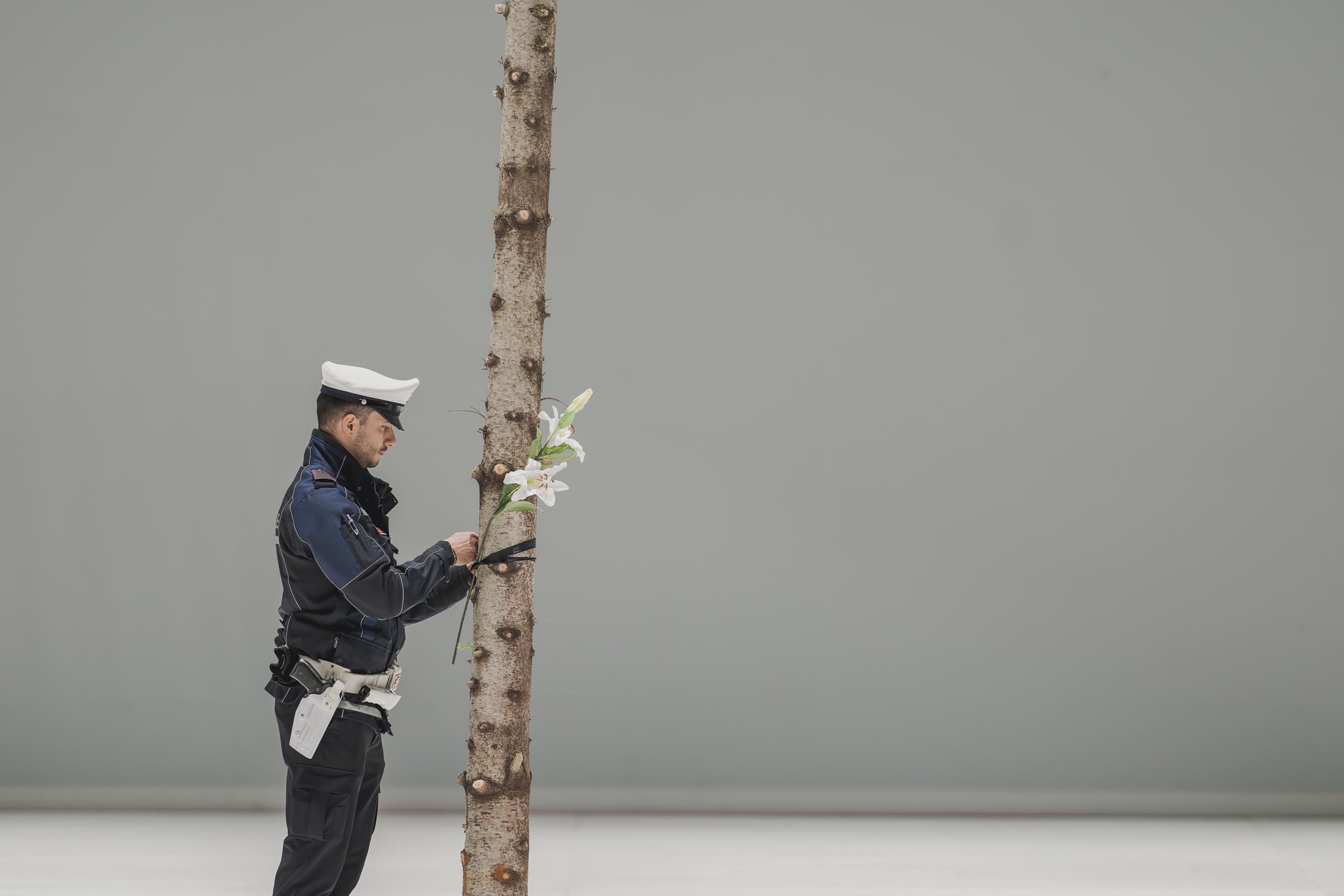
Photo: Michele Monasta
I was not disappointed by Kent Nagano, a conductor for whom I have had a weak spot for years: for his versatility, for his eminently intellectual and, at the same time, very human approach to the musical matter, for his attention to textural detail and for his innate aversion to flamboyance. In today’s world of extremes Nagano represents the commendable attitude of a tireless seeker of the golden mean – an artist with whom not only a musician, but also an ordinary listener can simply feel safe.
Which is important in the case of a work that grips our imagination so powerfully. Castellucci put a stone before me. Nagano got me on the right path. I think that both got to the crux of Bach’s message. This is exactly what the Matthew Passion is all about.
Translated by: Anna Kijak