My return to the Cam riverside to take part in the Autumn Series of the Cambridge Music Festival took place in special circumstances: shortly after the title of Doctor of the Church was conferred on the most eminent leader of Anglo-Catholicism, John Henry Newman, beatified fifteen years ago by Benedict XVI and canonised by Francis nine years later. The catalogue of Catholic saints is quite long. Yet among the Doctors of the Church – beginning in 1298, when Boniface VIII authenticated the list presented nearly six hundred years earlier by Venerable Bede, who included in it Ambrose of Milan, Augustine of Hippo, Jerome of Stridon and Pope Gregory the Great – there are just 38 individuals. Bede, an Anglo-Saxon Benedictine monk, who once had “a wife in the lustful passion of desire” and then had intercourse with her in the name of true love of Christ, was proclaimed Doctor of the Church only in 1899, nearly a decade after Newman’s death. John Henry, an alumnus of Oxford’s Trinity College, converted to Catholicism in his forties: after a period of intense activity in the so-called Oxford Movement, representatives of which – advocates of a radical reform of Anglicanism – called for a return to the early Christian idea of a “primitive church”.
In many respects Newman was a tragic figure. The Catholics distrusted him, the Anglicans treated him as a renegade. His rich written legacy, which is still regarded as one of the pinnacles of Victorian literature, was discovered for Poles by Stanisław Brzozowski, author of Legenda Młodej Polski (Legend of Young Poland). In 1937 Zofia Bastgenówna asked in her excellent essay “The mystery of Newman”: “What do we, Poles, know about this outstanding personality of the previous century, who so perfectly and originally illustrates the era of the so-called modernism and brings together the peculiarly English features of Catholicism in an individually profound experience of an internal transformation?”. She observed at the same time that “with the exception of theologians and historians of literature, no Englishman is any longer familiar with this great figure whose fame associated with the Oxford Movement was accepted more than a century ago once and for all, without objection, and has never been considered in its essence since”.
The Dream of Gerontius, Newman’s 1865 poem or, rather, poetic drama, is in its essence a large-scale depiction of Purgatory. In 1900 it was used as the basis for a work that Elgar, for good reason, did not allow to be referred to as “oratorio”. The composer used this tale of dilemmas of the soul – leaving the body and setting out into the unknown – as an answer to the questions about death, meaning of suffering, existence of God and of the beyond, questions that troubled Victorian England. The Anglican clergy did not like the references to saints and the Virgin Mary, while musicians were not enamoured of the references to Wagner’s oeuvre, especially Parsifal. And yet Elgar’s score was equally strongly influenced by the style of Dvořák (who, incidentally, himself toyed with the idea of writing a work to Newman’s poem) as well as nineteenth-century French composers, not to mention the fact that The Dream of Gerontius proved to be, on the whole, such a distinct and innovative work that its premiere at the Birmingham Music Festival came close to becoming a disaster. The chorus failed to cope with its part and the tenor Edward Lloyd, experienced in the oratorio repertoire, paced himself badly and barely made it through to the end of the concert.
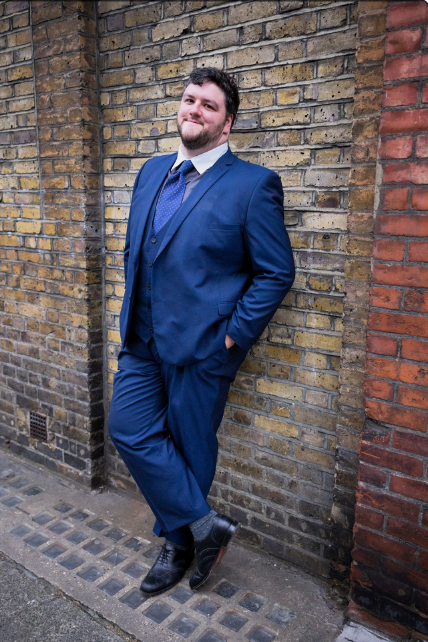
Stuart Jackson. Photo: Gerard Collett
Fortunately, history did justice to the work while the composer was still alive. However, the time of its greatest popularity, is now behind it – also in Britain, where it once occupied as prominent a place in the repertoires of choral societies as Handel’s Messiah. Performances outside the composer’s homeland are a rarity and rarely meet the expectations of the admirers of Elgar’s work, yours truly included. This is why out of the six concerts in the autumn instalment of the Cambridge Music Festival I chose without a second thought The Dream of Gerontius at King’s College Chapel, featuring soloists, the BBC Concert Orchestra, the BBC Singers and the King’s College Choir conducted by Daniel Hyde, the current Director of Music at King’s College. The whole thing seemed all the more interesting to me because in the sumptuous yet intimate interior of the Gothic chapel, the piece was to be heard in a version by Iain Farrington, pianist, organist and composer, author of dozens of arrangements of symphonies, operas and oratorios – including works by Mahler, Brahms, Sibelius and Wagner – for smaller ensembles.
Farrington has orchestrated The Dream of Gerontius for an ensemble of about thirty musicians, almost three times smaller than the large late Romantic orchestra envisaged by Elgar. And yet he has managed to preserve the colour palette and richness of texture of the original, giving the soloists much more room to shine and balancing the proportions between orchestra and chorus, the Achilles’ heel of most contemporary conductors, who unwittingly fall into the trap of monumentalism that is inappropriate in this work. Hyde conducted the whole thing in rather brisk tempi, highlighting perhaps the most significant peculiarity of this score – the already mentioned affinity with Wagner’s Parsifal, in which the music flows in an almost uninterrupted stream, with melodies and leitmotifs emerging from one into another. Singificantly, after a brief interval between the first and the second part the conductor managed to completely change the mood of the story – from a timid prayer full of suffering to an ecstatic, Dantean journey into Purgatory, culminating in the harrowing “Take me away” and finding release in the long farewell song of the Angel and the chorus.
The most experienced among the soloists was James Platt, a typical English bass, with an ease of articulation and an extraordinary expressive voice, which, however, had too much vibrato at times, a trait that was particularly evident in the first part, in the essentially baritone role of the Priest. The eponymous Gerontius definitely benefitted from Farrington’s chamber version: Stuart Jackson’s handsome tenor is agile and technically impeccable, but its volume is not large, which in this version the singer more than made up for with an intelligent Lieder-like phrasing and ability to differentiate the emotions contained in the prosody. The best among the three was Claire Barnett-Jones as the Angel. Hers is a pure, excellently placed and well controlled mezzo-soprano, which, if necessary, would certainly cut through a much larger orchestra. I must emphasise, however, that despite the soloists’ efforts and the disciplined playing of the orchestra, the real protagonists of the performance were the choirs: attentive, expressive, diverse not only with regard to the nature of the characters they portrayed, but also in terms of timbre and voice production. The apt and heterogeneous juxtaposition of female and boy sopranos, altos and countertenors, tenors and basses – sounding different in the BBC Singers ensemble and different in the King’s Chapel choir – further emphasised the drama of the composition, which, according to musicologists, bears more hallmarks of an opera rather than of any variety of oratorio.
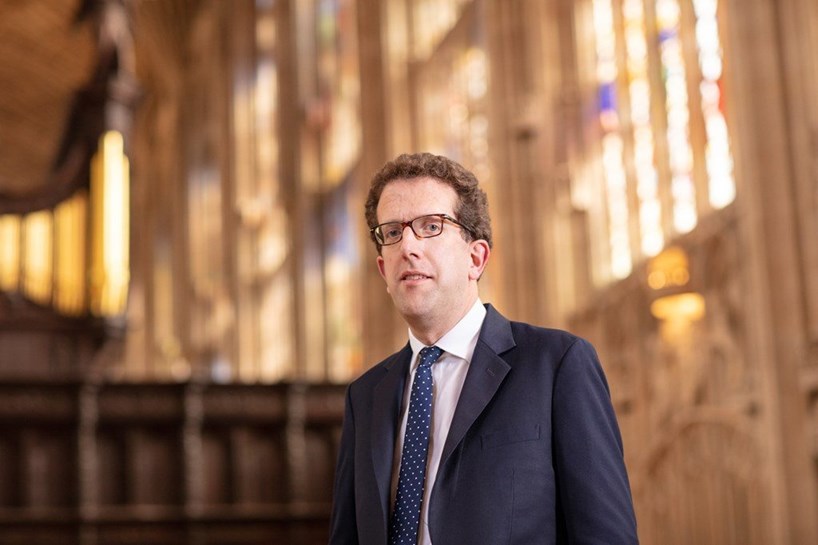
Daniel Hyde. Photo: Leon Hargreaves
Six days before the concert Leo XIV, proclaiming Newman Doctor of the Church, named him Doctor Amicitiae, Doctor of Friendship. Newman was inveterately celibate and introverted by nature, but he engaged in friendships with his whole being, seeing them as the most effective way of communicating the message of faith to loved ones. This may have been the reason why the interpretation of The Dream of Gerontius at King’s College Chapel appealed so powerfully to my agnostic imagination. Since that evening I have been coming back again and again to the story of Newman’s relationship with another convert, Ambrose St John, believed to be the prototype of the Angel from the poem. The two men lived together for over thirty years. After his friend’s death Newman experienced such a strong sense of loss that he compared it to mourning a deceased spouse. He asked to be buried with St John in one grave.
In 2008, when the grave was opened to move Newman’s remains elsewhere in view of his expected canonisation, it turned out that the body had completely decomposed. It had simply vanished. As if the Angel had really plunged it into the penal waters. I think, however, that even without knowing this story I would have remembered the Cambridge performance as the most tender depiction of Gerontius’ journey through death I have encountered to date.
Translated by: Anna Kijak