It is not a new staging, but in many respect it is memorable. Don Giovanni, directed by John Fulljames, with sets by Dick Bird, costumes by Annemarie Woods and lighting by Fabiana Piccioli, was to be the Greek National Opera’s first new production at the Stavros Niarchos Foundation Centre in the 2020/21 season – announced with great hype, along with a revival of Madama Butterfly and the ballet premiere of Don Quixote, already in August 2020, when everything seemed to suggest that Greece had overcome the pandemic. Fate had other plans. The pandemic struck again, the restrictions were reinstated, but the company was not about to give up. The production, which was scheduled to open in December, was premiered without an audience, was filmed by means of eight cameras, and state-of-the-art video and audio broadcasting technology, and soon proved to be one of the hits of the GNO TV streaming service, which was launched at that difficult time. What contributed to the success of the venture was not only the excellent cast, led by Tassis Christoyannis in the title role, but also the professional editing with lots of close-ups, quick cuts and beautifully framed shots. When the production finally hit the stage – first in Athens, then in Gothenburg and Copenhagen – it was received much more coldly by the critics.
Primarily because it is not very innovative. Many artists before Fulljames, including Sven-Erich Bechtolf and Keith Warner, had come with the idea of setting the action of Don Giovanni in a hotel – a clever idea, it has to be said, as the “democratised” space of contemporary hotel chains helps to resolve the dilemma of the sharp social divisions outlined in the work. However, it reduces the eponymous character to the one-dimensional role of a sexual predator, someone like Harvey Weinstein or Jeffrey Epstein – types found in many new stagings of operas, not just those of Mozart. It strips Don Giovanni of the aura of mystery, the “unsolvable enigma” that even some of the greatest theatre directors were afraid to tackle. On the other hand, Fulljames plays with this convention quite skilfully, with a good dose of uniquely British humour. He introduces into the staging a dozen or so extras, brilliantly directed by the choreographer Maxina Braham. They are members of the hotel staff who, with grotesque indifference, ignore the excesses of the guests, remove the traces of lewd orgies and meticulously restore the rooms to sterile order. Fulljames winks at the audience, showing them, instead of the statue of the Commendatore, his frozen corpse in a cold store full of butchered carcasses of pigs (another borrowing, this time from Warlikowski). In the sadomasochistic party scene he plays with drag, dressing Don Ottavio, Donna Anna and Donna Elvira in identical ball gowns.
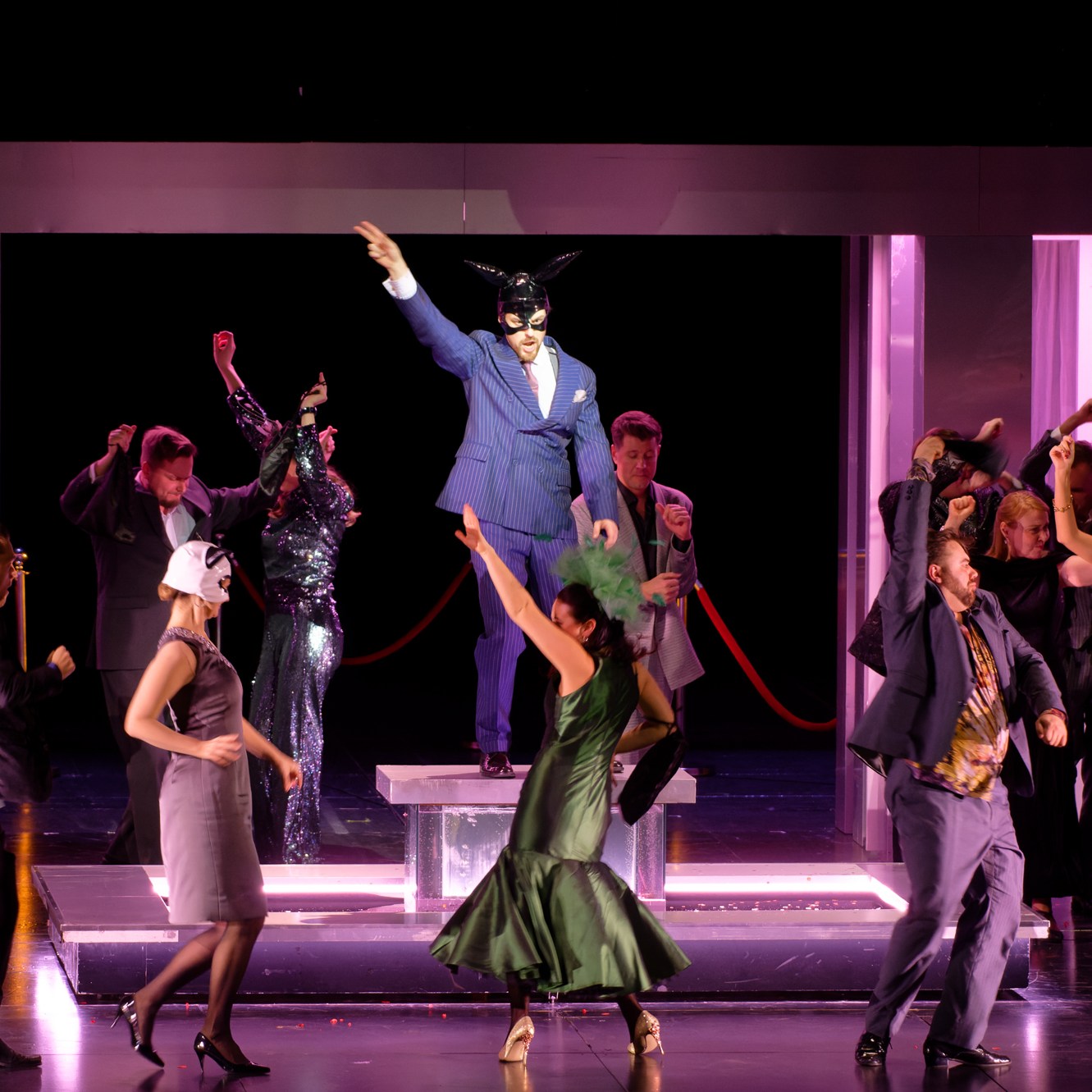
Photo: Martynas Aleksa
He is less successful in characterising the various protagonists, especially Donna Elvira, who resembles a stalker possessed by unrequited love rather than a proud, betrayed woman. The duel scene in Act I resembles a chaotic skirmish in which Don Giovanni kills the Commendatore by accident. Equally unconvincing is the changing of clothes with Leporello, in which the main role is played by a particularly hideous red wig. Fulljames’ staging, however, undeniably has rhythm and pace, as well as some really strong points, primarily an overwhelming sense of the fleeting nature of all of Don Giovanni’s vile deeds: even their victims do not have time to realise what has actually happened: the door slams shut in front of them, the lift disappears, the light comes on in another room, the staff quickly change the sheets, wipe the table and fluff the cushions.
I came to Vilnius, wondering how this production would fare in the extraordinary building of the Lithuanian National Opera, itself an “unsolvable enigma” of Soviet architecture. The design competition for the building, launched in 1960, was won by Elena Nijolė Bučiūtė, a very young Lithuanian architect, who presented a model of the theatre that anticipated the ideas of many German post-war modernists. Fourteen years passed between the design and the construction, many of Bučiūtė’s novel ideas were lost, but some were kept – they included the bright foyer space, the spectacular decor details of red brick, yellow glass and brass, and the magnificent auditorium with nearly a thousand seats, still the largest stage in Lithuania. The largest, yet still giving a sense of intimacy in experiencing the work – not least thanks to the very good acoustics, in which the singers do not have to try to outshout the orchestra and the conductor can easily balance the sound between the stage and the pit.
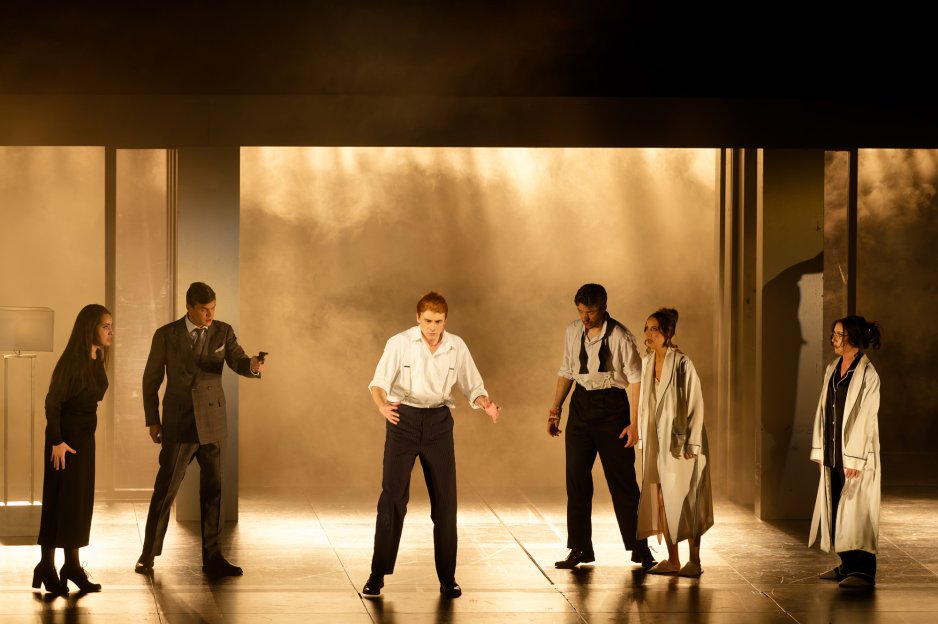
Photo: Martynas Aleksa
Fulljames’ Don Giovanni was premiered here in March. I managed to see one of the performances after the autumn revival, conducted by Vilmantas Kaliūnas, a Lithuanian oboist who has been working in Germany for more than thirty years and who has recently taken up conducting as well. And the result is not bad: he conducted the whole thing at reasonable, singer-friendly tempi, the orchestra’s sound, a little thin at first, gradually gained depth, the musicians reacted attentively to his instructions, generally playing with a clean, nicely rounded sound.
The cast was dominated by Lithuanians, led by Modestas Sedlevičius in the title role, a singer with a not very large but exceptionally handsome baritone, beautifully balanced across the registers and phrasing in an old-fashioned, truly Lieder-like style. Leporello was sung by the experienced Tadas Girininkas, whose a bass has an expansive but well-controlled volume, is sonorous, if sometimes a little dull in the middle. Liudas Norvaišas did well in the short role of the Commendatore, while the young baritone Mindaugas Tomas Miškinis fared slightly worse, not quite managing to control his emotions as Masetto, which is by no means an easy role. The only foreigner among the soloists, the Polish tenor Krystian Adam, as usual infused his character with a lot of passion, a feat that is all the more noteworthy given that few singers know how to create a memorable Don Ottavio. Adam managed to do just that: with a voice that is lyrical, but at the same manly in its sound, beautifully developed in the lower register and open at the top, supported by excellent diction and a feel for the idiom. Of the ladies, the one I found the most convincing was Ona Kolobovaitė as Donna Anna. Despite her young age, she is a very mature singer with a wonderfully soft and supple soprano as well as extraordinary acting skills. I was less taken by Gabrielė Bukinė, whose voice is denser, almost like a mezzo-soprano, at times too heavy for the role of Donna Elvira and, above all, rather hysterical, for which – unfortunately – the misguided directorial concept was largely responsible. Lina Dambrauskaitė was more impressive, with her graceful and light soprano, combined with a great sense of comedy, perfect for the role of Zerlina.
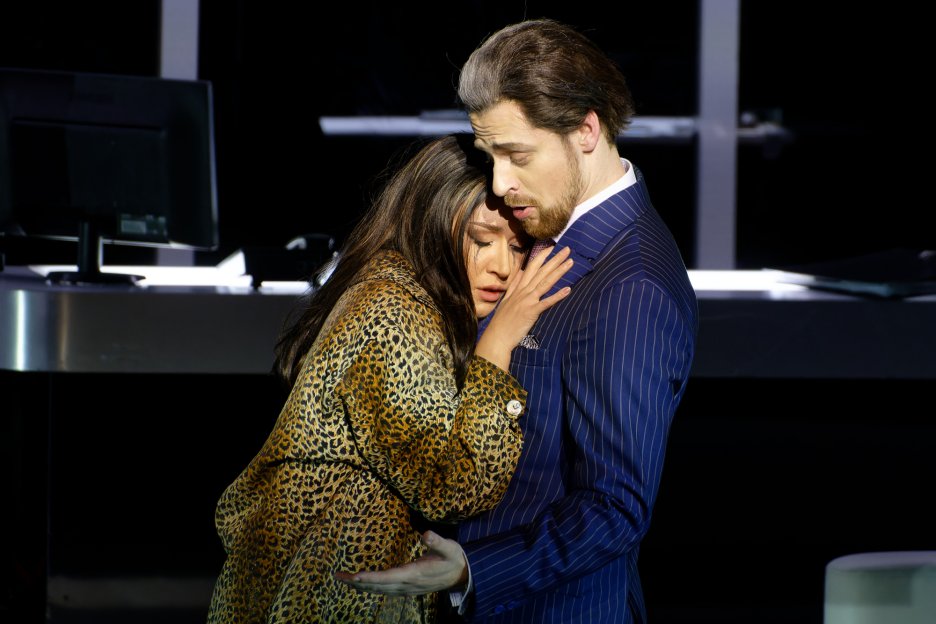
Photo: Martynas Aleksa
I don’t know if I would like to see this staging again. I know that in the Lithuanian National Opera building, radiating light and warmth from within, it revealed all its strengths and made it possible to turn a critical eye away from its undeniable flaws. It did not solve the enigma of Don Giovanni. But it certainly did not discourage further efforts to unravel it.
Translated by: Anna Kijak