It sometimes happens that a future opera critic becomes acquainted with a work from a wholly unexpected angle. That is precisely what occurred with me – a sickly child who killed time spent at home by listening to records from her parents’ collection. No one selected this music for me. My attention was drawn to the 7 inch vinyl with orchestral excerpts from Aida primarily by the intriguing cover and no less intriguing description, in a completely incomprehensible language. Many years passed before I realised that recorded on that disc was a 1959 performance by the Budapest Philharmonic Orchestra conducted by Miklós Erdélyi, who was then associated with the Hungarian State Opera. Thus my acquaintance with Verdi’s Aida began with the overture and three ballet extracts from the second act – in a surprisingly subtle interpretation, shimmering with the softness of the quasi-oriental orchestral textures.
Soon after, I encountered my first Aida at the Teatr Wielki in Warsaw. Again in unusual circumstances – from the wings. Jan Marcin Szancer’s huge sets could not be housed in any of the store rooms, so they were kept in the side-stages. The statue of the pharaoh, several storeys high, was passed by participants in all the Warsaw productions, from Bizet’s Carmen to Wagner’s Tannhäuser. The children of the chorus were dumbstruck with awe. The soloists, meanwhile, experienced growing irritation at the fact that the stage designers were producing creations which, instead of helping the singers, only hindered them in their struggles with the unfriendly acoustics of what was one of the biggest theatres in the world.
Since the time of that production, which was premiered exactly sixty years ago, the Warsaw Opera has tackled Aida just twice. Each time without success. Progressive elements tore their hair out, while the conservative Józef Kański summed up Marek Grzesiński’s 1986 production with the quip ‘And what? And nothing!’ and furnished Robert Lagana Manoli’s concept, from nineteen years later, with the telling title ‘The trumpets sounded beautiful…’
As the years passed, I too became discouraged about Aida, particularly since the greatest titans of music theatre had sought a key to interpreting this masterwork – compared to Verdi’s earlier experiments, an opera almost classical in form, composed to a conventional and exceptionally clear libretto based on a drama of duty – in vain. Some fruitlessly tried to settle scores with nineteenth-century colonialism, some set the narrative in the realities of contemporary conflicts, while others removed Aida from all context, producing incohesive spectacles in motley costumes.
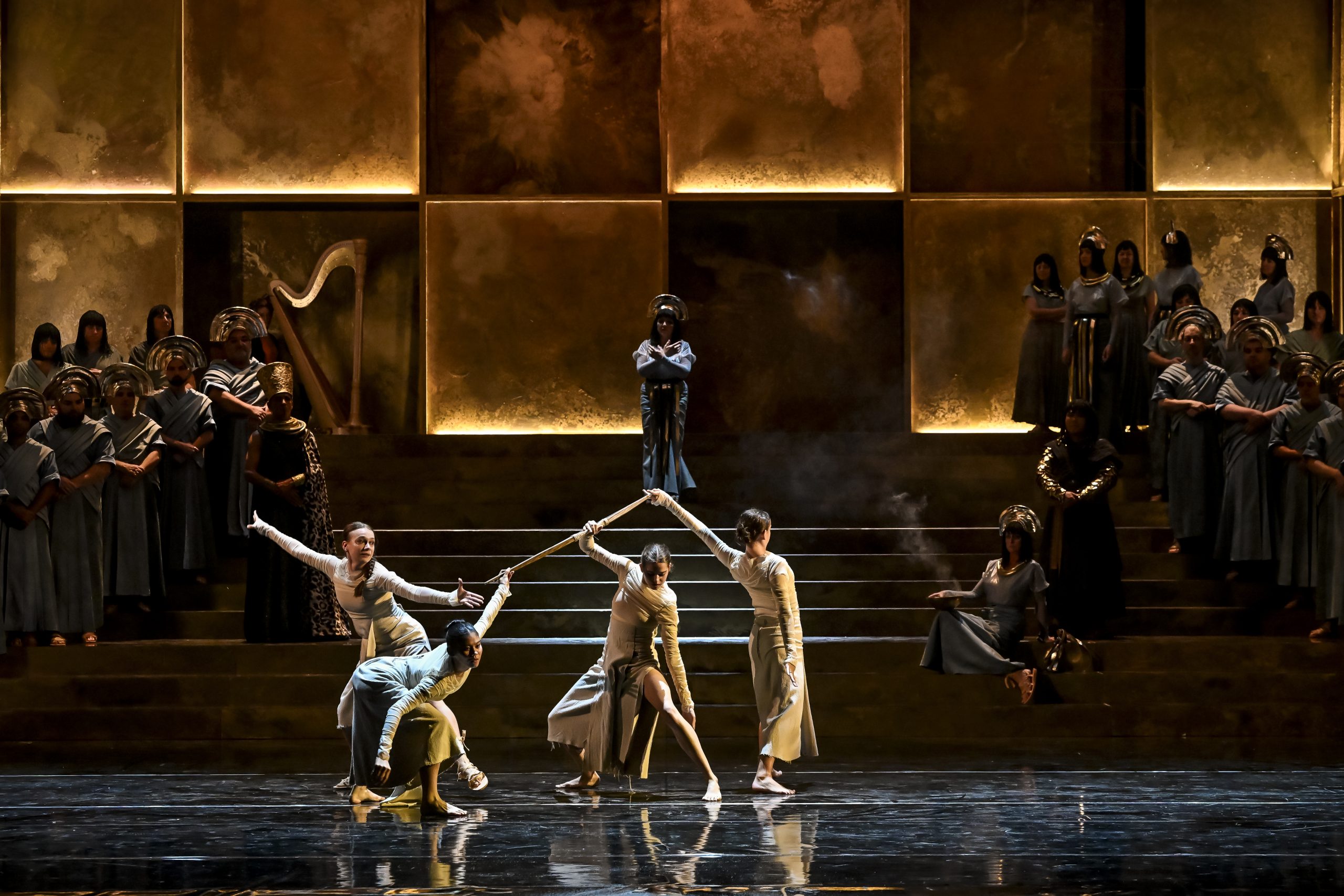
Photo: Marek Olbrzymek
Hence I decided to reignite my old love for Verdi’s Egyptian opera at the Janáčkovo divadlo, which for several seasons now has been for me a haven of good theatre: pared back, clean of form, employing metaphorical signs, allusions and mental shortcuts. And at the same time meeting the expectations of the local audience – as a tool for building a community and a space for reflection and dialogue. And only now has it dawned on me that the vision of operatic theatre realised in the building on Rooseveltova Street is so close to my heart because it is a modernist vision, perfectly at one with the atmosphere of Brno.
I think we still don’t really appreciate the modernistic potential of the Moravian capital – a city whose history was entangled for almost half a century with the fortunes of Bohuslav Fuchs, an urban planner, designer and architecture theorist who raised several generations of Czech architects. His legendary buildings – including the Avion Hotel, squeezed into a narrow, eight-metre-wide plot between two houses on Česka Street – proved to be the perfect example of a modernist game with resistant matter and space. Fuchs brought to Brno a host of visionaries from Czechoslovakia and designers from abroad, among them Ludwig Mies van der Rohe, who created the plans for the functionalist Villa Tugendhat. It was thanks to Fuchs that Brno became one of the most important centres for modernism in Europe; also because, unlike other cities, it did not have to rise from the ruins after the war. It etched its name in the history books not just as a herald, but also as a continuator of the ‘new tradition’: unsullied, unbroken, distinctly reflected in architectural thought, design, literature, everyday life and, last but not least, opera.
The new production of Aida, premiered in September last year, is not perhaps an outstanding spectacle, but it was certainly conceived in such a way as to hold its place in the repertoire of the Janáčkovo divadlo for many seasons. Marek Cpil, a graduate of the JAMU in Brno, associated for a while with the Divadlo Na zábradlí in Prague, designed sets which – in my opinion – would have been greeted just as favourably in Moravia a hundred years ago as they were received at the end of the first quarter-century of the new millennium: minimalistic, highly geometricised, in a palette of gold, red, black and blue, referring to the Egypt from the common preconceptions of audiences and perfectly highlighted by the lighting designer Přemysl Janda. Aptly corresponding to Cpil’s vision were the costumes designed by Linda Boráros, distinctly emphasising the contrast between the colourful presence of the Nubians and the hieratical convention in the way the Egyptians are depicted, reflecting the ancient power structures and social divisions (taken to the brink of caricature in the costume of the Pharaoh, the only truly monumental element of the staging – in the form of a towering construction, rolled onto the stage, sparkling with golden scales, out of which emerges only the head of the singer). Director Magdalena Švecová coupled that scenery with quite static action, inspired by symbolic gestures, poses and patterns of robes from Egyptian painting. More energy was breathed into the production by choreographer Marek Svobodnik, who enlivened the temple frescos and bas-reliefs in the ballet scenes with the participation of dancers from the NdB2 junior ballet company.
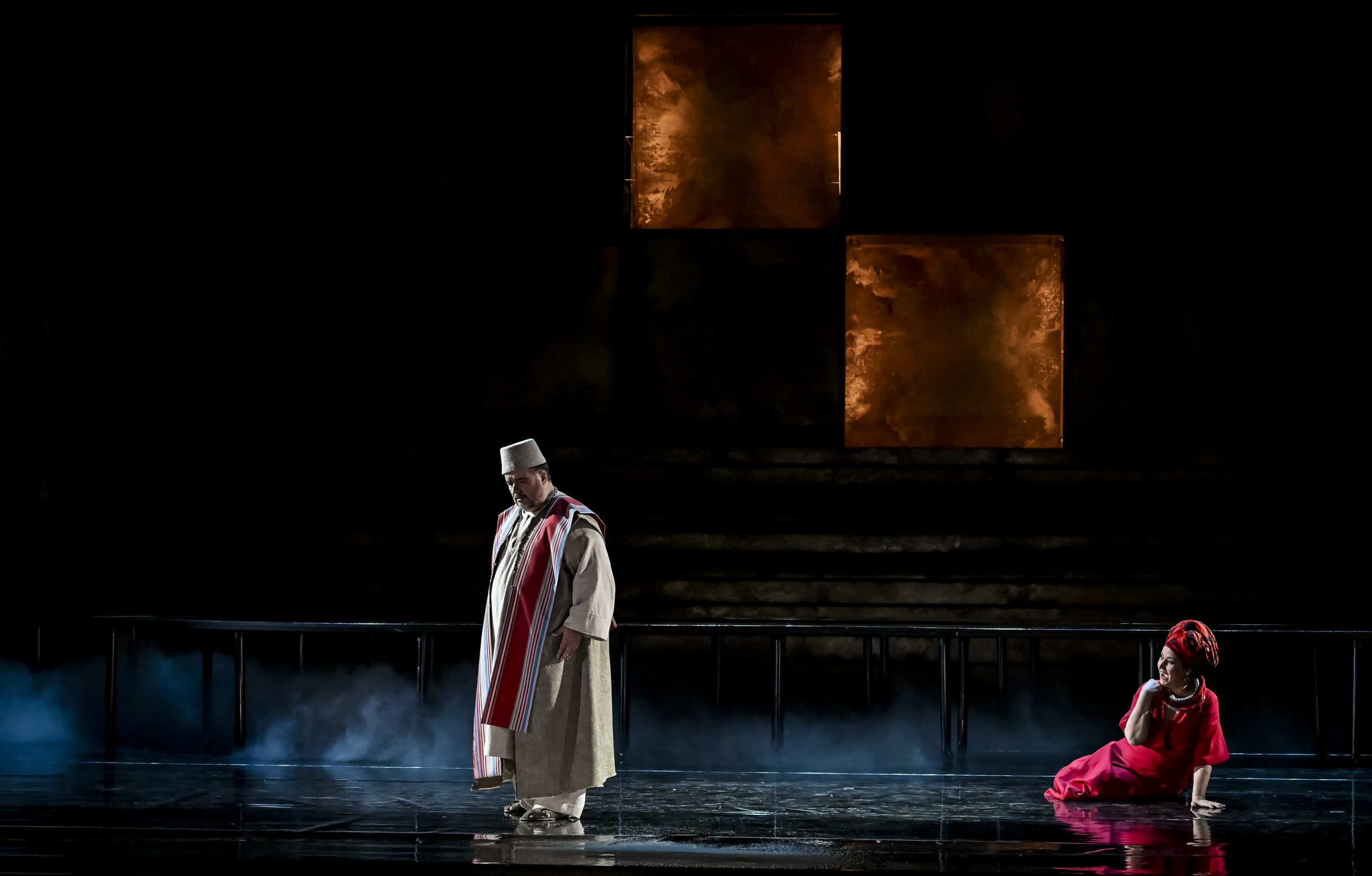
Photo: Marek Olbrzymek
I caught the last December performances, in which the titular role of Aida – as in the premiere – was incarnated by a former resident of the Janáčkovo divadlo, the Hungarian Csilla Boross. As usual, her voice took a long time to warm up: her supple, rich soprano, at first not open enough in the top part of the scale, only showed its full quality in Act III, in a remarkably subtle rendering of the aria ‘O patria mia’, the warm lyricism of which was ideally counterbalanced later by the final duet of the protagonists. This time, the role of Radames was taken by Eduard Martyniuk, a Ukrainian tenor endowed with a voice of exceptional beauty, backed by fine bel canto technique – unfortunately, too light for this part, and consequently more and more forced as the narrative unfolded. Happily, I could at least relish his gentle cantilena, led in ‘old-fashioned’ style, in ‘Celeste Aida’.
Anastasia Martyniuk fared much better as Amneris. Her rich mezzo-soprano, a riot of colours, is ideally suited to this part: beautifully open at the top, balanced across the registers, thanks to her intelligence and musicality, convincingly split between anger and despair, which the young Ukrainian underscored with very good acting. Paling in comparison was the Slovakian baritone Aleš Jenis (Amonasro), blessed with a voice of interesting timbre, but not particularly sonorous and essentially devoid of expression. The role of the Pharaoh was successfully filled by Jan Šťáva, one of the pillars of the Brno theatre, boasting a typically ‘Czech’ bass with a wonderful bottom range and beautifully nurtured middle. The remaining parts were well within the capabilities of Daniela Straková (High Priestess), Jan Hnyk (Ramfis) and Petr Levíček (Messenger). The choruses – children’s and mixed – also came across quite well, under the direction of Martin Buchta, though at times they lacked energy and fullness of sound.
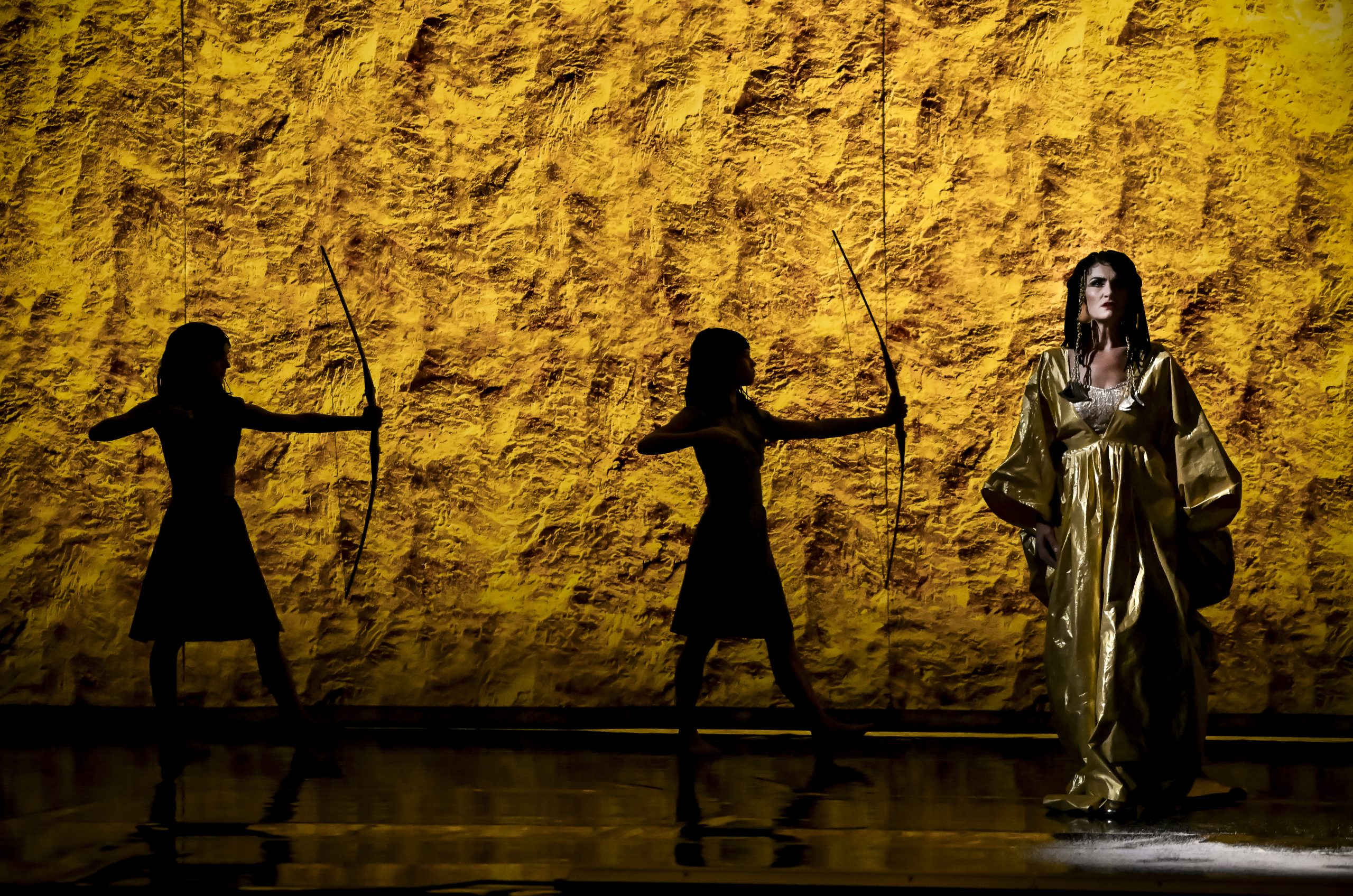
Photo: Marek Olbrzymek
Quite phenomenal, meanwhile, was the sound of the orchestra, under the baton of Jakub Klecker, who once again demonstrated how much a choirmaster’s experience can bring to the role of an opera conductor. He directed throughout with a sensitive hand, meticulously differentiating the shades of the instruments (especially the strings), taking care to ensure a lyrical quality to the cantilenas, beautiful harmonic details and the specific exoticism of Verdi’s score. He forged an interpretation that was surprisingly intimate, far from the monumentalism and pathos that have effectively turned many a music lover away from Aida.
In Brno, even the trumpets sounded beautiful. And contrary to the review of my former master, there is not a hint of irony in that assertion. For the needs of this production, the Janáčkovo divadlo brought in a set of ‘trombe egiziane’, designed by Verdi specially to perform the triumphal march in the second act. The trumpets were displayed to the audience before the premiere, on the square in front of the theatre. They will certainly serve for many a year. I anticipate that the new Brno Aida – modest, imperfect, quite simply human – will not depart the scene any time soon. It is through such shows that children acquire a love of opera. To such shows they return when they’re old. That is how a theatre community is built.
Translated by: John Comber