The world never ceases to surprise me. In 2014, when I became a freelancer and set off on my first reviewing journey to Llandudno – to review the autumn season of Welsh National Opera on tour – almost no one on the Old Continent took the Brexit warnings seriously. After the defeat of the Scottish independence advocates, the support for an independent Wales felt to an unprecedented low of three per cent. The country was ruled by Welsh Labour, and whilst the pro-independence Plaid Cymru, which came second, called for respect for the distinctiveness of the local traditions and culture, it did declare its willingness to build a national community based on equality, irrespective of race, gender, sexual orientation, religion or background.
In this year’s election Labour suffered a crushing defeat. For the first time since the establishment of the regional parliament Wales was to be led by Plaid Cymru. In September in Cardiff the leaders of Wales, Scotland and Northern Ireland signed a joint declaration on independence and leaving the United Kingdom. Heledd Fychan, the new minister for culture, announced radical remedial measures, also in the severely underfunded field of music, which, in her opinion, constituted the very foundation of the Welsh people’s national identity. The crisis hit WNO already in 2024, when the organisation lost more than a third of its funding from the Arts Council of England and more than a tenth from the Arts Council of Wales. One of the best opera companies in the British Isles faced drastic budget cuts. In 2025 Adele Thomas and Sarah Crabtree took over as WNO’s general directors, determined to change its future and involve the whole community in the process. So far they have managed to avoid mass layoffs and painful pay cuts; however, they have had to make some difficult repertoire decisions and cancel several time-honoured stops on the company’s tour.
Thus WNO’s eightieth anniversary is currently celebrated in a rather modest fashion and during an artistic interregnum to boot – since Tomáš Hanus’ departure, the position of music director has remained vacant. The autumn programme featured just two items: the only full- length opera this season (the 2022 Glyndebourne production of La Bohème) and a double bill of Bartók’s Bluebeard’s Castle and Stravinsky’s Oedipus Rex, in which only the latter can be regarded as a new production and with some reservations at that. Yet we can hardly complain about this. Rather, we should admire an institution which – suddenly deprived of nearly half of its funding – instead of spending the rest of the money on its anniversary celebrations and going under in a spectacular fashion, put the welfare of the company first and gave everybody hope that things would be better from now on.
I got myself accredited for both productions in Cardiff, although I have to admit to being more intrigued by the double bill. The Polish premieres of both Stravinsky’s oratorio-opera and Bartók’s one-act work took place over sixty years ago and became legends of European theatre. They were conducted by Bohdan Wodiczko, the new director of the Warsaw Opera, with Tadeusz Kantor and Konrad Swinarski joining the creative teams. Since then Oedipus Rex has been staged in Poland only once. The stagings of Bluebeard’s Castle can be counted on the fingers of one hand: the last one disappeared from the repertoire over a decade ago.
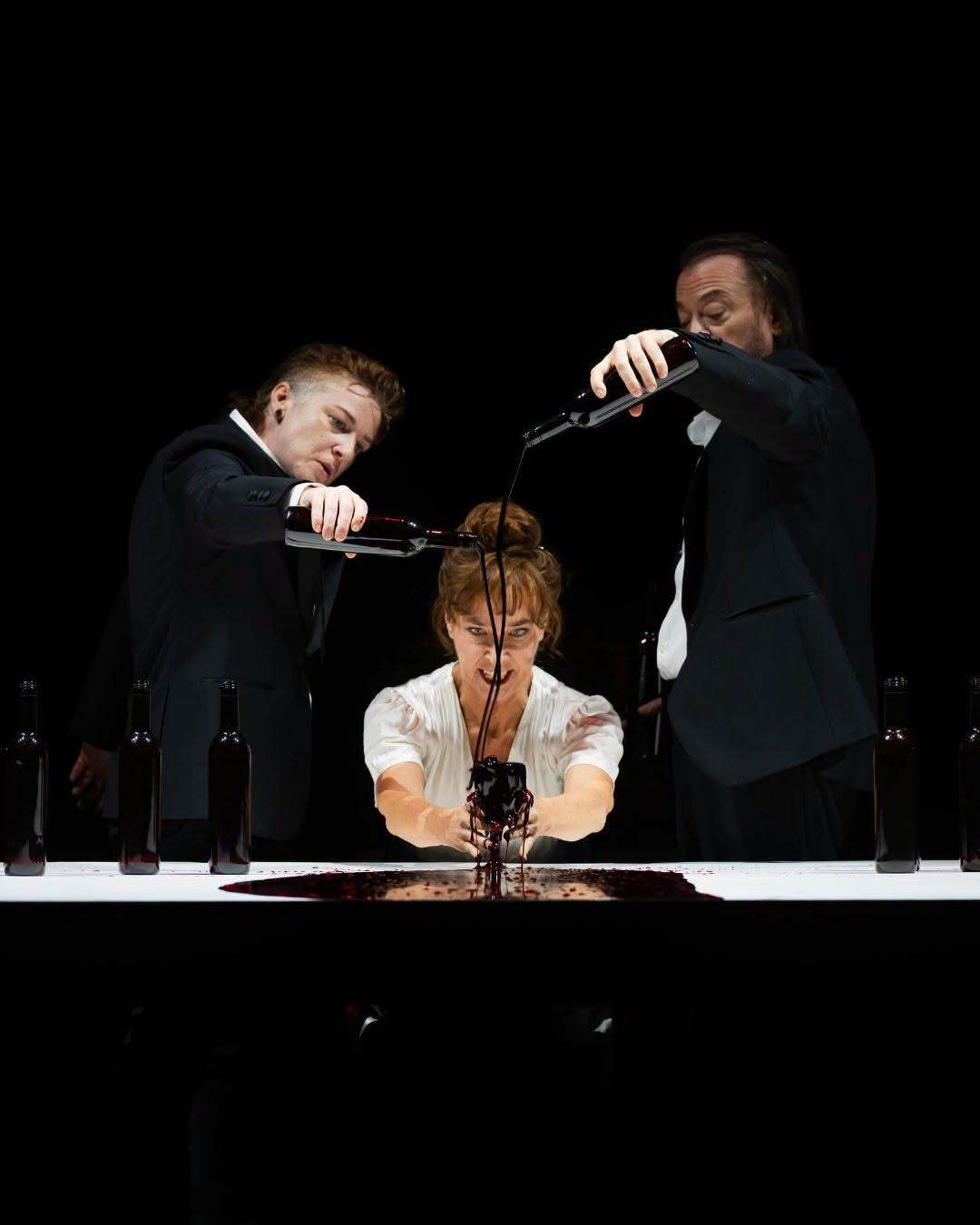
Bluebeard’s Castle. LJ Parkinson (Bard), Christine Rice (Judith), and Nathan Berg (Bluebard). Photo: Daffyd Owen
The director Joe Hill-Gibbins brought to WNO his English National Opera production of Bluebeard’s Castle, which was nominated after its 2024 premiere for the Olivier Award. I have no idea why it was referred to at the time as a semi-staging, as in this drama of emptiness and misunderstanding – in which Bartók masterfully builds a sense of suspense – the stage really requires nothing more than a long table, a few chairs and some symbolic props (set design by Mill Clarke), as well as evocative lighting (Jack Knowles). The producers have rightly retained the Bard’s spoken prologue, which immediately puts the story in brackets and gives it the air of a folk ballad. This is important, because the author of the libretto, Béla Balázs, drew on Charles Perrault’s tale, Maurice Maeterlick’s play Pelléas et Mélisande and above all on the Transylvanian song of Anna Molnár, which features similar literary topos, though with much more room for interpreting the events described in it. In Perrault’s story Bluebeard is a serial killer of his wives who is exposed by the last, inquisitive wife and is murdered by her brothers. Anna from the ballad is in a relationship with a mysterious man whom she suspects of having killed the previous brides and whom she asks a number of “forbidden” questions, like Elsa from Lohengrin. Judith from Bluebeard’s Castle makes a conscious choice. She leaves her parents’ splendid home to marry a man plunged into strange sadness. Terrified by the gloom of the castle, she begins to explore its various nooks and crannies. She demands explanations from the prince, ignores his pleading of “love me and be silent” and in the end brings a disaster upon both of them.
Hill-Gibbins’ production kept me on the edge of my seat right up to the sixth chamber. Everything was done properly: a hysterical Judith and Bluebeard, distraught by her inquisitiveness, a snow-white table emerging from the darkness – a symbolic space of the constant shortening and lengthening of the distance between the characters, torn by their dilemmas – and the silent Bard, who, after the end of the prologue, joins the action in the guise of a figure who is neither a footman nor a butler, and who reveals to Judith the secrets of the successive chambers (brilliant movement direction by Emma Woods). The wine, poured out in streams, turns into the red of the torture chamber. The armoury glows with the disturbing sheen of knives. Golden confetti serves as an attribute of the treasury. Armfuls of flowers – a metaphor of the garden. The bluish shapes looming in the background – a highland landscape of the prince’s estates. A fitting darkness descends upon the still lake of tears. And suddenly the magic is gone. From the depths of the stage there emerges a crowd of ghostly female apparitions. Half-alive or dead, and far more numerous than Balázs’ three magnificent beings, symbolising the three stages of a man’s life: three women to whom Bluebeard owes everything he has experienced so far. An ambiguous parable about the consequences of both excessive secrecy in relationships and a lack of respect for the boundaries set by one’s partner has been turned into a banal tale about toxic masculinity.
The problem is that Hill-Gibbins – like Judith – sees blood everywhere and there is no doubt that behind the seventh door there are the bodies of the murdered wives. This is also suggested by the decision to precede Bluebeard’s Castle with two works by Hildegard von Bingen, both of which share the motif of blood: the antiphon “O rubor sanguinis” and the responsory “Rex noster promptus est”, performed in almost complete darkness by a female chorus, which would later make its silent presence felt in the opera’s finale. It is a pity, because until this disappointing conclusion I felt I was experiencing one of the most brilliant and the most moving interpretations of Bartók’s masterpiece in my career as a critic.
Unfortunately, in Oedipus Rex the director completely missed the essence of the work, the dramatic effect of which is to be found, after all, in the subtle characterisation of the protagonists set against the hieratic simplicity of the overall structure of the score. The static nature of the music – like in a Greek tragedy – is not a flaw, but a conscious decision on the part of the composer, a sonic ritual enhancing the katharsis. Yet in Hill-Gibbons’ production the chorus, instead of halting the action, speeds it up to the limits. The main characters of the tragedy, lost among the frantic Thebans, do not establish any relationships with one another. The theatrical chaos overwhelms both Creon’s majesty and Tiresias’ tenacity; Jocasta’s plea for reason in the face of the plague and her harrowing duet with Oedipus.
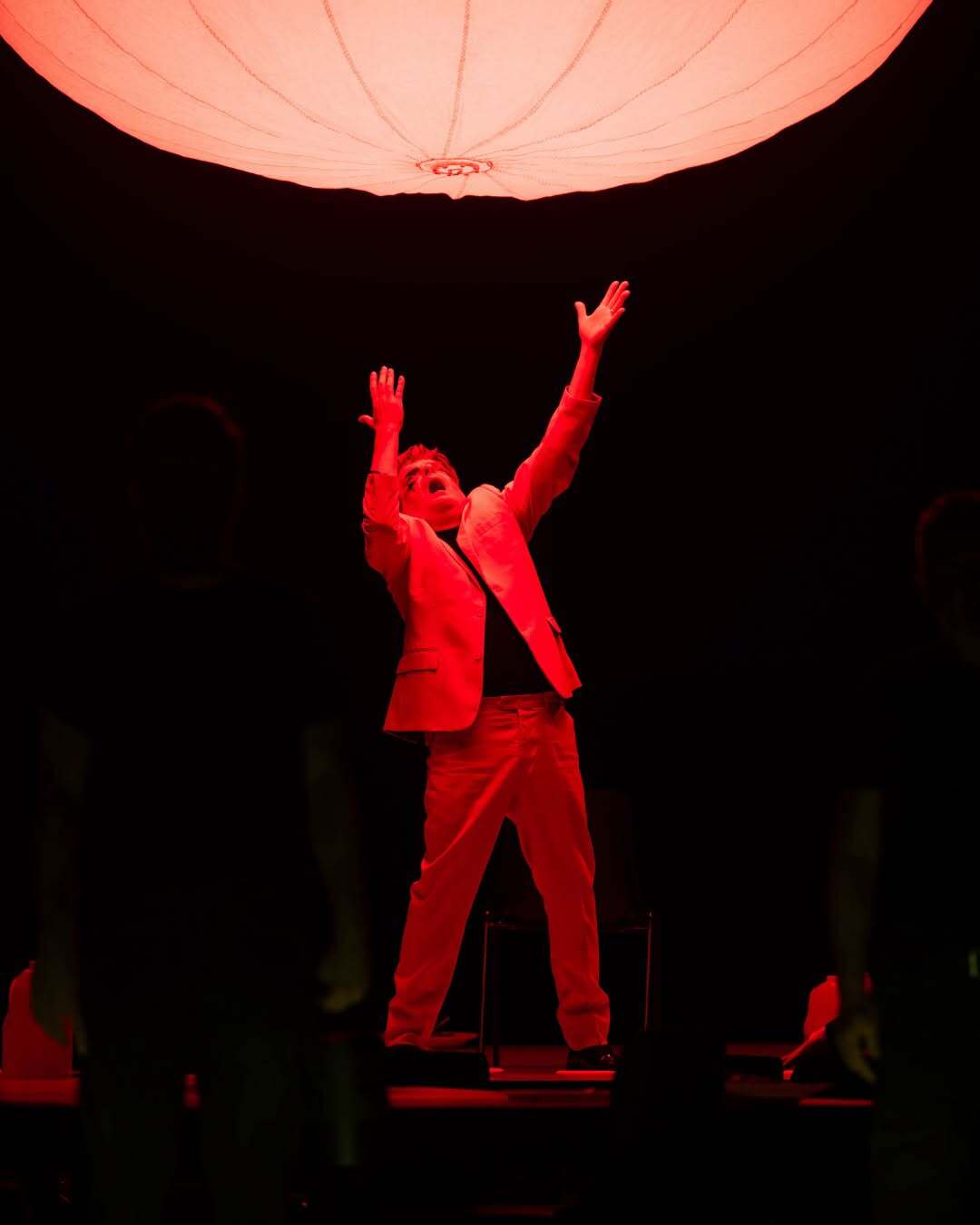
Oedipus Rex. Peter Hoare (Oedipus). Photo: Daffyd Owen
The long table from Bluebeard is also used in Oedipus – with the set being complemented by, among other things, a huge spit on which a sacrificial goat the size of a fine ox is roasted. The black from the first part of the evening gradually gives way to a bright red, emphasised by a dazzling white light from a pendant lamp placed in the flies. This time, however, the colour was flat, it did not pulsate with hues that stirred the imagination, like it did in Bartók’s piece. I found this production rather tiresome; Hill-Gibbins drew in it too heavily on his own ideas from his otherwise excellent staging of Turnage’s opera Greek – instead of approaching the work with deeper reflection and a more open mind.
Nevertheless, the uneven double bill proved rather satisfying in musical terms. The WNO ensembles – especially the choruses – gave exemplary performances under the subtle but assured and precise baton of Lidiya Yankovskaya. The mezzo-soprano Christine Rice, whom I have praised on numerous occasions in the Wagnerian repertoire, created a convincing portrayal of Judith, although her voice was at times lost in the vastness of the open stage; she demonstrated the full extent of her abilities only as Jocasta, primarily in the magnificent aria “Nonn’ erubescite, reges”. I was very impressed by Nathan Berg, a singer with a soft, velvety, slightly “smoky” bass-baritone, perfect for the role of Bluebeard, slightly less convincing as Tiresias. Among the other soloists in Oedipus Rex the best performance came from Peter Hoare in the title role: his rough tenor is by no means beautiful, but the singer knows how to make up for this with his musicality and fine acting. Special praise – albeit only in Bluebeard’s Castle – should go to LJ Parkinson, a non-binary performer in the role of the Bard, who right from the start brought a sense of unease with their evident though by no means obvious androgyny: feminine agility of movement, masculine facial expressions and an electrifying gaze in which the traits of both genders were mixed. However, the same model of acting did not work in the role of Narrator in Oedipus Rex.
But the following day came rapture, which I could have expected, in fact, for Floris Visser’s La Bohème was enthusiastically received already in Glyndebourne. I do not think, however, that the decision to revive two stagings based on the black-red-and-white contrast at WNO was accidental. Visser closed the modest autumn season with a production faithful to Puccini’s idea and, at the same time, meeting the seemingly conflicting expectations of traditionalists and modernists. All four acts take place in the same space: in a cobbled street flanked by straight walls, a street rising slightly towards the back of the stage before dropping away into an undefined, dark abyss. An image taken straight from French avant-garde films, like the monochrome setting loosely referring to the first quarter of the twentieth century (set design by Dieuweke van Rijn, costumes by Jon Morrell, lighting by Alex Brok).
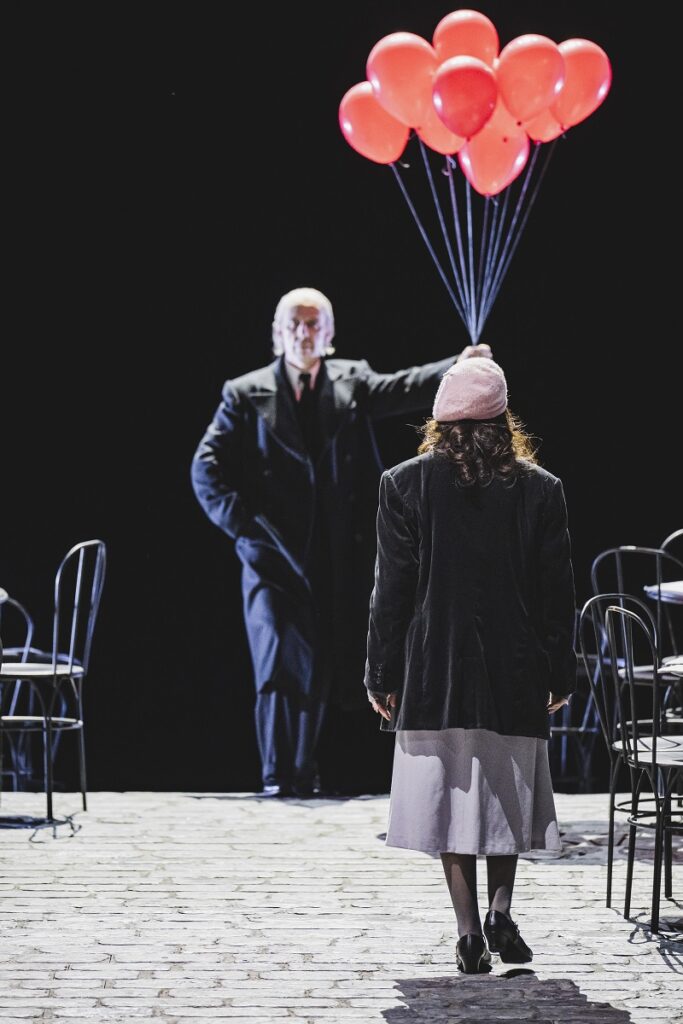
La Bohème. Christopher Lemmings (Death/Parpignol) and Alexia Voulgaridou (Mimi). Photo: Kirsten McTernan
If any colour does appear, it is hazy, like in the imagination of old cinema regulars. The only exception is red: in Act One, on Marcello’s abstract canvas, as he attempts to paint the Crossing of the Red Sea, then in the Quartier Latin, when the children gather around Parpignol, who is holding in his hand a bunch of red balloons (another cinematic reference, this time to Albert Lamorisse’s famous short film from 1956). However, the same character appears earlier and accompanies Mimi throughout the narrative. In the end he takes her by the hand, leads her up and then down the cobbled backstreet until both disappear from view.
Visser’s idea to discreetly bring Death onto the stage – and in the person of the toy seller, so beloved by the children – makes the opera’s tragic finale unreal on the one hand and even more harrowing on the other. During the last few bars it is not only Rodolfo, but also some audience members who are crying. Upset like a child whose red balloon has been popped by a hooligan using a slingshot. Distraught like a someone who has lost a love one.
Like in Glyndebourne, Death/Parpignol was portrayed by Christopher Lemmings, who gave an excellent performance both as an actor and as a singer. I found his portrayal the most memorable of all, although there really were no weak links in the cast – perhaps with the exception of Alexia Voulgaridou as Mimi with her intonation problems. With his full-bodied, luminous tenor Carlos Cardoso proved to be a fine Rodolfo; I was particularly taken by Navasard Hakobyan’s expressive interpretation of Marcello; and I will certainly be listening out for the exceptionally handsome baritone of the very young Owain Rowlands, who sang Schaunard. The orchestra once again gave it their best, this time under the competent baton of Corinne Niemeyer. Special acknowledgement should go to the chorus master Frederick Brown and the répétiteurs of the fourteen young choristers singing with confidence and assurance, projecting their voices like children should.
Winter is still a long way off. The company has some more performances in its touring schedule: in Oxford and Plymouth. If this is supposed to be a season for three pennies and one smile, I am not worried about the future of Welsh Opera.
Translated by: Anna Kijak