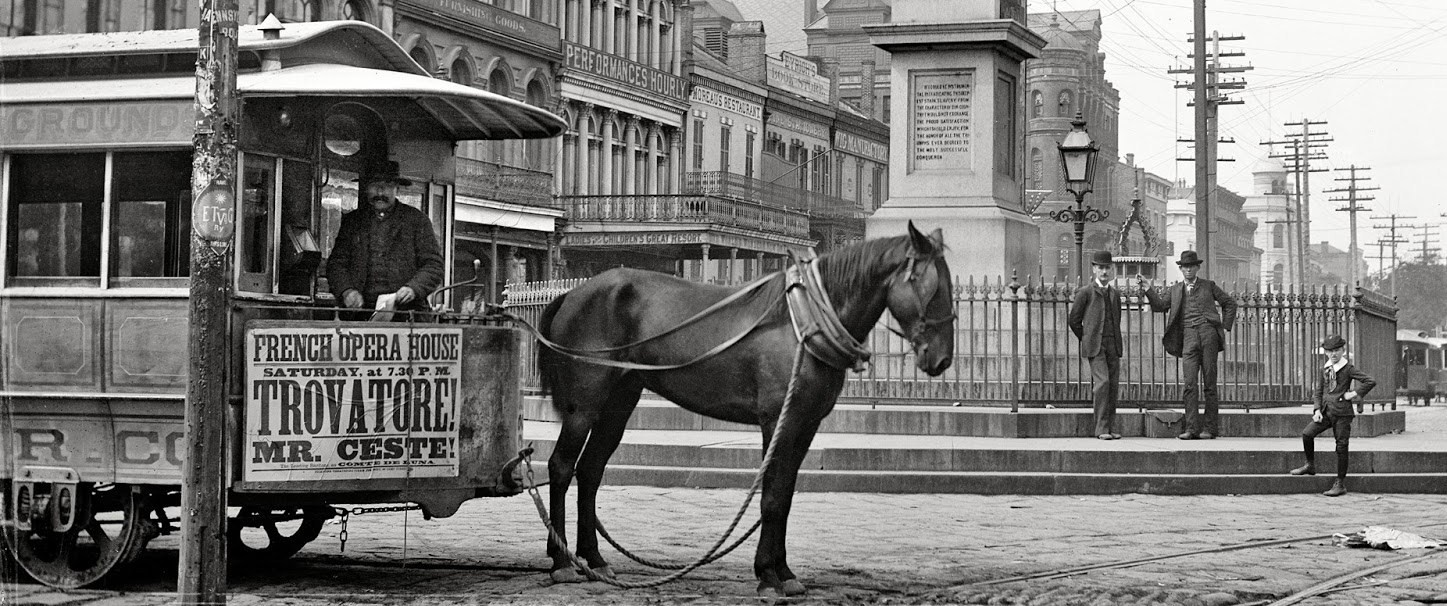
Who are you, world, that you terrify me so? – asked Gertrud von Le Fort, the author of the novella The Song at the Scaffold, from which everything began. The German writer was a woman full of existential angst, which is said to be an essential prerequisite for true faith. She lived in this anxiety for a long time, ninety-five years, until her death on All Saints’ Day in 1971. She was a Catholic, but born in a Protestant family whose members – as her father, a Prussian army officer used to say – participated in history wherever they could. Her paternal ancestors came from the Duchy of Savoy-Piedmont and bore the surname Liforti. They were Waldensians, members of one of Christianity’s oldest pre-Reformation movements. In the mid-sixteenth century they converted to Calvinism and fled to Switzerland. There they adopted the surname Le Fort, associated etymologically, like its Italian variety, with strength and courage. In the period directly preceding the action of the novella one of the Le Forts co-organised Louis XVI’s failed attempt to escape to Varennes and two others died at the hands of the revolutionaries.
Gertrud von Le Fort wrote The Song at the Scaffold in the form of a letter from an eyewitness to the events, an exiled French aristocrat. The narrative focused on a fictitious figure of a young Carmelite nun, Blanche de la Force, another mutation of the author’s own surname. However, the story described by von Le Fort did indeed happen. The Compiègne convent was closed by the revolutionary authorities in 1792; for the following two years the nuns lived as “laypersons” in several adjacent houses. In 1794 Fouquier-Tinville, the first public accuser of the Revolutionary Tribunal, delivered an indictment against the Carmelites, arguing that despite official prohibitions they had managed to create a monastic community of sorts. In June the women were transported to the infamous “vestibule of the guillotine”, that is the Conciergerie prison at the former royal palace on the Île de la Cité in Paris, and were subsequently sentenced to death. The Carmelites were executed on 17 July, barely ten days before the end of the Reign of Terror. On their way to the execution site they sang the Salve Regina. After the execution truly deathly silence fell among the crowd. But the last nun to be beheaded was not Blanche de la Force but Madame Lidoine, the prioress, whose dowry to enter the convent had been paid years earlier by Marie Antoinette no less.
The literary Blanche is von Le Fort’s alter ego, a character reflecting her own grief over the values squandered by the Great War, her own fear of the consequences of the October Revolution and the rise of a radical mood in Germany. “Fear is a great emotion,” wrote Gertrud von Le Fort in The Song at the Scaffold, “The nation should know fear. (…) The terrible events I am going to write of have really taken place and may be repeated at any moment”. The short novella, showing not only the horror of history, but also the possibility of inner transformation of people participating in it, caused quite a stir among the intellectual and artistic elites of the day. Interest in von Le Fort’s work continued also after the Second World War. In 1948 the French Dominican Léopold Bruckberger persuaded Georges Bernanos to adapt the novella for a film script. However, he was not pleased with the adaptation. Bernanos died a year later, and his manuscript – markedly different from the original in several respects – was unearthed by his publisher and published as Dialogues des Carmélites, the title having been changed at von Le Fort’s request. Bernanos’ work began a new life on theatrical stages, first in a German translation (as Die begnadete Angst, “Blessed anxiety”) and then, after the 1952 Paris premiere, in the French original.
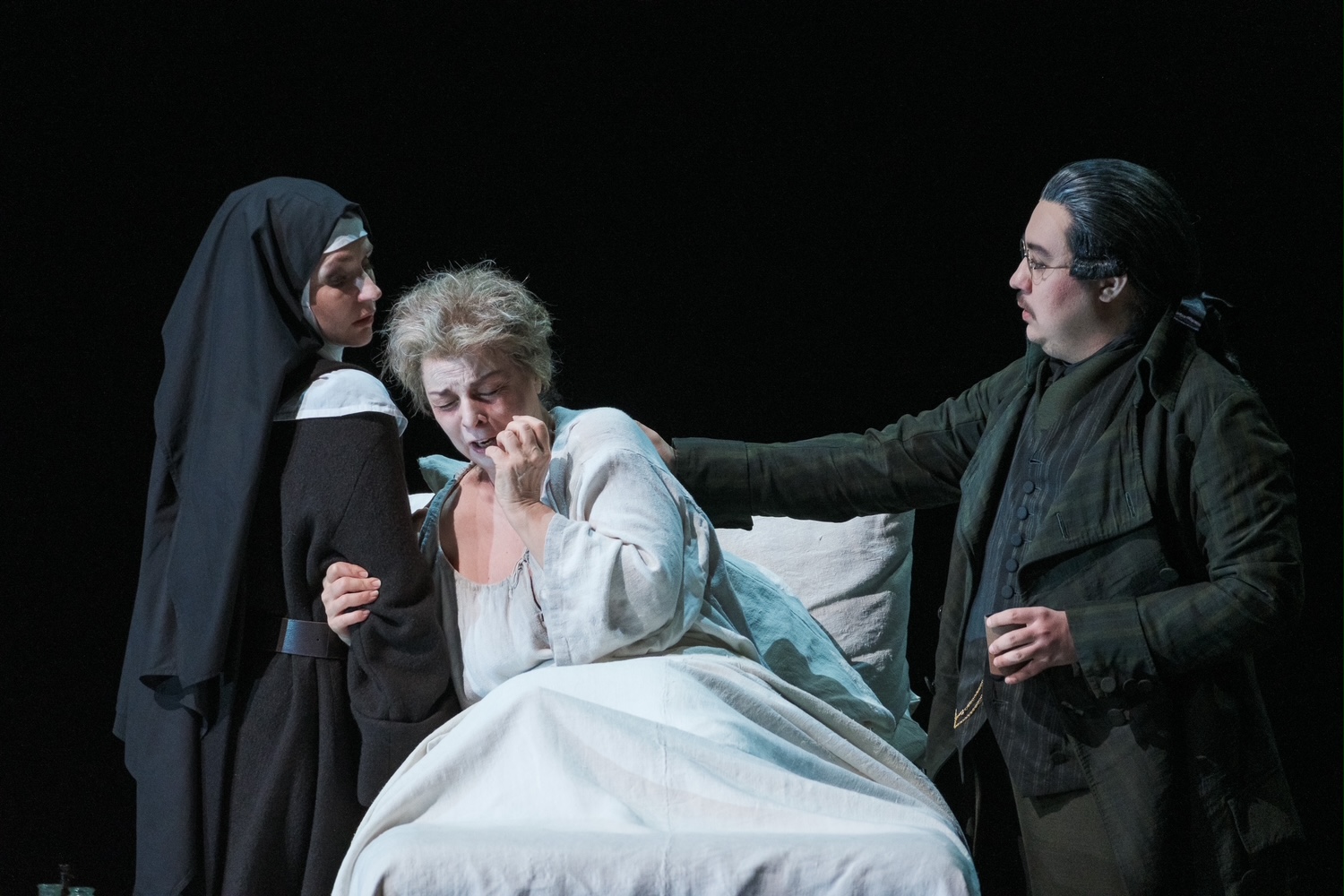
Photo: Mattia Gaido
Following Bruckberger’s suggestion, Bernanos enriched the portrayal of Blanche with elements borrowed from the biography of Constance, Blanche’s younger “soulmate”. It was Constance who had a brother who, amidst the turmoil of the Revolution, tried to rescue her from the convent – and thus the narrative of the Dialogues gained the character of Chevalier de la Force. In addition, Bernanos put a stronger emphasis on the horrific agony of the old prioress, Madame de Croissy, most likely motivated by his own fear of looming death. The drama became more human than Gertrud von Le Fort’s novella, suffused with mysticism – this may have been the reason why it immediately became hugely successful.
It also struck a chord with Poulenc, deeply anxious at the time about the fate of his partner, Lucien Roubert, who was dying of cancer. However, it was Margarete Wallman, an Austrian dancer, choreographer and director, who finally persuaded the composer to adapt Bernanos’ play for an opera – through her husband, head of the Ricordi publishing house. Poulenc transformed the play into a libretto almost without any interference in its content and form. He worked two years on the music, creating a score that did not go beyond tonality, was full of references to modal scales in its harmony, and limited in its use of chromaticism. His Dialogues is a magnificent continuation of the French tradition, including Pelléas and Mélisande – with Debussy’s characteristic, unobvious treatment of leitmotifs – as well as the vocal fluency of Massenet’s operas, not to mention other sources of inspiration, from Monteverdi’s recitative and expressive style to the dramatic intensity of the work’s climactic scenes worthy of Mussorgsky.
In Poland Dialogues des Carmélites did not attract much attention until the beginnings of the political transformation. However, the brief popularity of Bernanos’ play ended already in the mid-1990s and Poulenc’s opera was staged only once, over a quarter of a century ago, at Teatr Wielki in Łódź. Yet there are avowed fans of the masterpiece in Poland, usually agreeing that in purely theatrical terms no one has presented it in a more compelling way that Robert Carsen, author of the legendary 1997 production for De Nederlandse Opera. Carsen’s staging has been seen in nearly twenty opera houses across the world. I only managed to catch up with it in Turin – and with good reason, for after nearly three decades of its stage travels it had come full and significant circle. The Dialogues at the Teatro Regio di Torino was prepared by the same conductor who had been in charge of the Amsterdam performances: Yves Abel, a Canadian of French origin, who has been devoted to the popularisation of the musical tradition of his ancestors all his life.
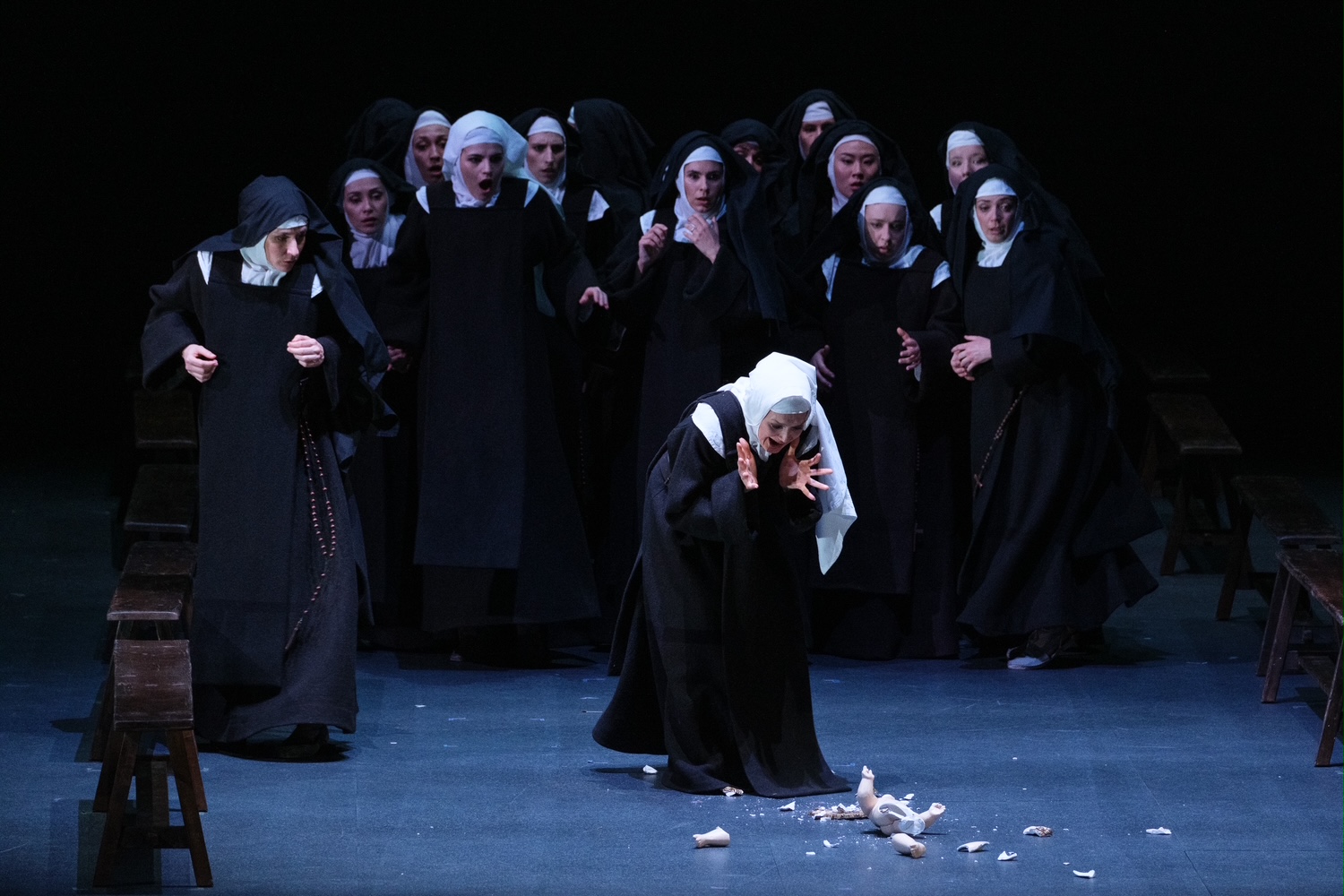
Photo: Mattia Gaido
I have seen plenty of stagings revived without the involvement of the original directors, by assistants unaware of the context and disregarding the timeless significance of gestures that had ceased to be meaningful to them. Nothing of the sort happened in Turin, where Carsen’s original concept was meticulously reconstructed by the experienced director Christophe Gayral, and lighting – which is key to this staging – by Carsen himself, in collaboration with Cor van der Brink, who had gained his experience by working on productions by true giants of opera theatre, like Robert Wilson and Pierre Audi. Carsen’s vision unfolds on a nearly empty stage, on which every solitary prop – a bench, an armchair, a bed, a grave – plays a significant role (sets by Michael Levine, costumes by Frank Baer). Carsen cleverly plays with colour: for example, in Act One, when Blanche wears a white robe, with Marquis de la Force wearing red and his son parading in a blue costume. However, this is not an anachronistic reference to the allegedly revolutionary symbolism of the French flag, but more to the colours associated with the ancien régime: the white of the clergy, the heraldic red of the aristocracy and the blue of the rising bourgeoisie. The duet of Blanche and her brother takes place on both sides of a symbolic cloister wall, represented on stage by a row of nuns with their backs turned to the audience. The wall proves to be an illusion – at some point the protagonists start to pass through this porous partition and every word they utter only serves to emphasise the power of their transgression. The famous final execution scene – phenomenally highlighted by Philippe Girodeau’s evocative choreography – eschews literalness. There is no blood and no guillotine: the sisters announce their death one by one with a sequence of symbolic gestures and then fall prostrated on the stage, with their arms outstretched – but with their faces turned upwards, as a sign of faith, hope and trust in the unknown.
Blanche was portrayed by Ekaterina Bakanova, who has a rounded, ringing and expressive soprano – which was evident especially in the episodes of extreme dilemma and terror, when the artist would sometimes sacrifice the beauty of sound in favour of an almost tangible expression. A perfect counterbalance to the emotional Blanche was provided by Francesca Pia Vitale as Constance, sung with a radiant voice full of girlish ardour. I was less impressed by Sally Matthews as Madame Lidoine – her beautiful, mature soprano is still very sonorous, but has too much vibrato, which, unfortunately, affects the delivery of the text. In this respect Matthews was clearly inferior to the rest of the female cast, including Antoinette Dennefeld, a moving and intensely human Mother Marie, and, above all, Sylvie Brunet-Grupposo, a phenomenal Madame de Croissy. The alto part of the old prioress, like the part of the Countess in Tchaikovsky’s Queen of Spades, is usually entrusted to eminent singers who are also excellent actors, but who have their best years way behind them. Brunet-Grupposo went against this trend, demonstrating that a sense of theatre and impeccable vocal technique could support interpretation regardless of age. The intensity of her portrayal overshadowed Bakanova already in the first dialogue, in which she explained the order’s rule in sentences sharper than the blade of the guillotine. In the death scene, when her entire world of values had collapsed like a house of cards, she rose to the level of Shakespearean tragedy. Faced with such acting and such musicality, a critic remains helpless with admiration: even occasional lapses in intonation seem to be a conscious tool of communication with the listeners.
The men have very little to do in this opera. All the more credit should, therefore, go the baritone Jean-François Lapointe, an undisputed master of the French repertoire, who, in his brief role as Marquis de la Force, dazzled the audience not only with his spot-on sense of style, but also with his superb diction and outstanding stage presence. Valentin Thill as Chevalier de la Force was more than decent, although his handsome lyric tenor loses some of its power of expression because of awkward transitions between registers. I cannot fail to mention Krystian Adam, who sang the Chaplain in impeccable French, with a warm and beautifully open voice, at the same time creating a nuanced portrayal of a man torn between fear and duty.
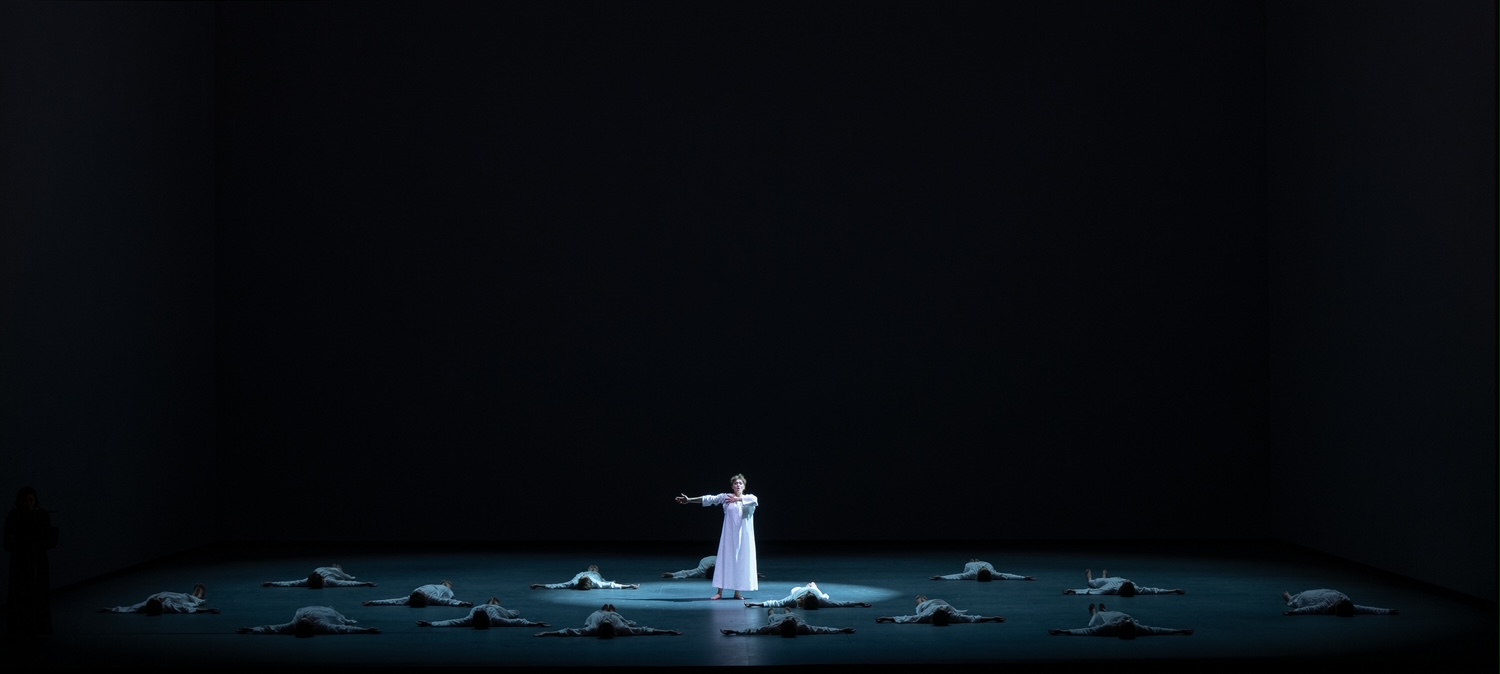
Photo: Daniele Ratti
Yves Abel conducted the Turin Dialogues in a highly stylish manner, in wisely measured tempi, skilfully balancing the proportions between the shimmering, colourful orchestral layer, and the wealth and weight of the words uttered on stage. It should be said at this point that the conductor had to cope with the untypical acoustics of Teatro Regio di Torino, where the orchestra’s selective and resonant sound can get out of hand and overwhelm the singers. Nothing of the sort happened. The conductor was in control of everything, including the chorus, superbly prepared by Gea Garatti Ansini, whose members also joined the soloists in the final scene, complementing the musical image of the tragedy of the sixteen Carmelites of Compiègne.
And once again we experienced the power of a nearly thirty-year-old staging and the power of artists believing in Poulenc’s masterpiece. For evil truly has no power other than the helplessness of good – to refer to Gertrud von Le Fort’s words again.
Translated by: Anna Kijak