I never cease to be amazed by the Czechs, and the grace as well as ease with which they bring back to life underrated operas from their national repertoire. True, it can be argued that Czech composers’ masterpieces have long been present on the world’s stages and that audiences craving for something new – not only in their homeland – will welcome any dusted-off piece with open arms. Yet this argument is false: first, not all of these operas deserved to be banished from theatrical stages, second – even if they are inferior to the more distinguished achievements of their authors, the Czechs usually know how to hide their flaws and highlight their strong points. This is primarily due to the fact that they have never broken with their operatic tradition; they know how to make it fit it into the framework of modern theatre, to look at it with detachment and, when necessary, to approach it somewhat tongue in cheek.
This has recently been the case of The Devil’s Wall, Smetana’s last completed opera and, at the same time, one of the four he wrote to Eliška Krásnohorská’s libretti, including the romantic opera Viola, based on Shakespeare’s Twelfth Night and abandoned after several hundred bars. Krásnohorská, a writer, translator, editor of Ženské listy and activist in the women’s emancipation movement, was much younger than the composer. They met in 1864, before Eliška turned seventeen. Their true friendship began unusually – with an article in which Krásnohorská, whilst making no secret of her admiration for Smetana’s musical talents, pointed out his errors in the prosody of the Czech language, using The Bartered Bride as an example. Instead of taking offence, Smetana took her comments to heart. Krásnohorská was the composer’s muse, collaborator and unfulfilled love in the final decade of his short life, when he was battling increasing deafness, soon compounded by vertigo, hallucinations and sudden rage outbursts – according to Smetana, these were symptoms of madness that brought him to the brink of suicide several times. In spite or perhaps because of that, their first joint operas (The Kiss and The Secret) were bitter-sweet, lyrical comedies in which it is often hard to tell the difference between irony and melancholy, fiction and autobiographical themes.
However, work on The Devil’s Wall dragged on for longer than expected, also because of disputes over the nature of the work itself. From the very beginning Krásnohorská suggested something along the lines of a romantic opera, combining a historical theme with the legend of a devil trying to prevent the construction of the Monastery of Vyšší Brod, founded by Vok of Rožmberk as an expression of his gratitude to the Virgin May for saving him from the waters of the Vltava. Smetana wanted a lighter approach to the subject, to which Krásnohorská agreed, but their subsequent collaboration was a struggle. In the end Smetana removed more or less one-third of the original text from Krásnohorská’s libretto and did the whole his own way. He may have wanted to laugh and be moved a bit before he died.
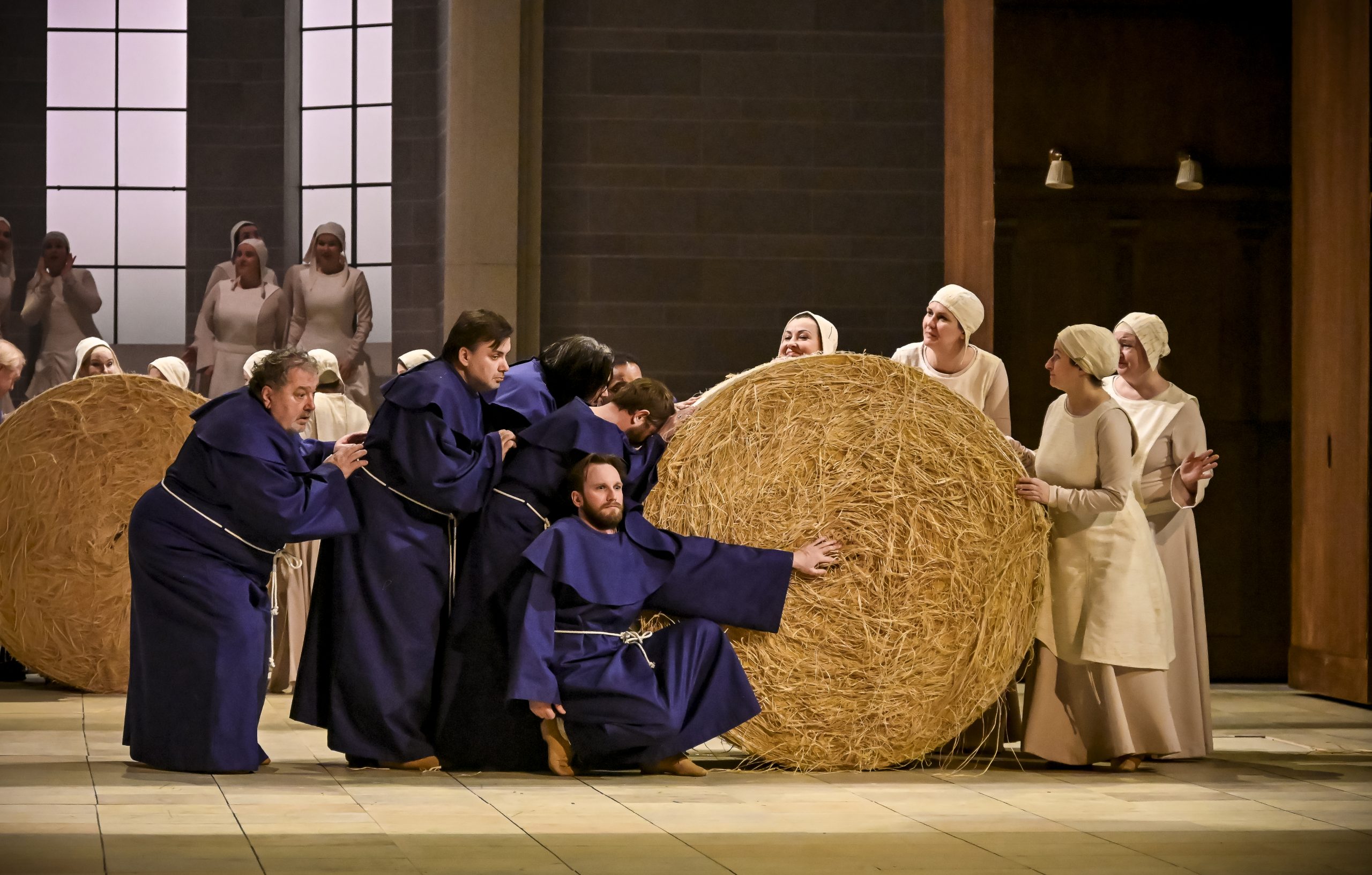
Photo: Marek Olbrzymek
The premiere in October 1882, at the now defunct Nové České Divadlo in Prague, was received with moderate enthusiasm. The wooden building, used as the summer base of the Temporary Theatre, had neither the technical facilities nor sufficiently talented creative team to properly stage an opera about devils, dreams full of phantoms, a thunderstorm and reversal of the Vltava course (suffice it to say that sheep were played by suitably trimmed poodles). Rarach, a role written for Karel Čech, was in the end sung by a different singer, shattering the illusion of a striking resemblance between the hell’s emissary and the hermit Beneš. Despite favourable opinions about the music, The Devil’s Wall was removed from the repertoire after just six performances. Bad luck continued to plague the the work: a performance in Prague on 28 June 1914 was interrupted by news of the assassination of Archduke Ferdinand. Smetana’s last opera did not make it beyond Czech theatres and still remains one of the composer’s least frequently staged works. Worse still, after a while it came to labelled a a work of declining years showing symptoms of the gradual disintegration of the composer’s creative powers.
The Devil’s Wall has not been seen in Brno for nearly half a century. Now the opera has returned in a staging that is so impressive with the richness of theatrical imagination and, at the same time, so irresistibly funny that I do not quite know whom to praise first. Let me, therefore, start unusually with Dragan Stojčevski, who, at the request of the director Jiří Heřman, designed the sets drawing solely on the architecture of the buildings and the interiors of the Vyšší Brod monastery, but making them an equal protagonist of the narrative. Although there is no Rožmberk Castle, nor a shepherd’s hut, nor a cliff on the bank of the Vltava, nor even the eponymous devil’s wall, that is a river dam – everything is there, in the sets organising the entire stage space, constantly moved, turned away, attracting the eye to strange nooks and crannies. Jarek, tormented by temptation, has a dream of an orgy involving smoking weed in the monastery library; Katuška is making out with her lover in the cloister garden; the Vltava River swells just outside the window of St. Anne’s Chapel.
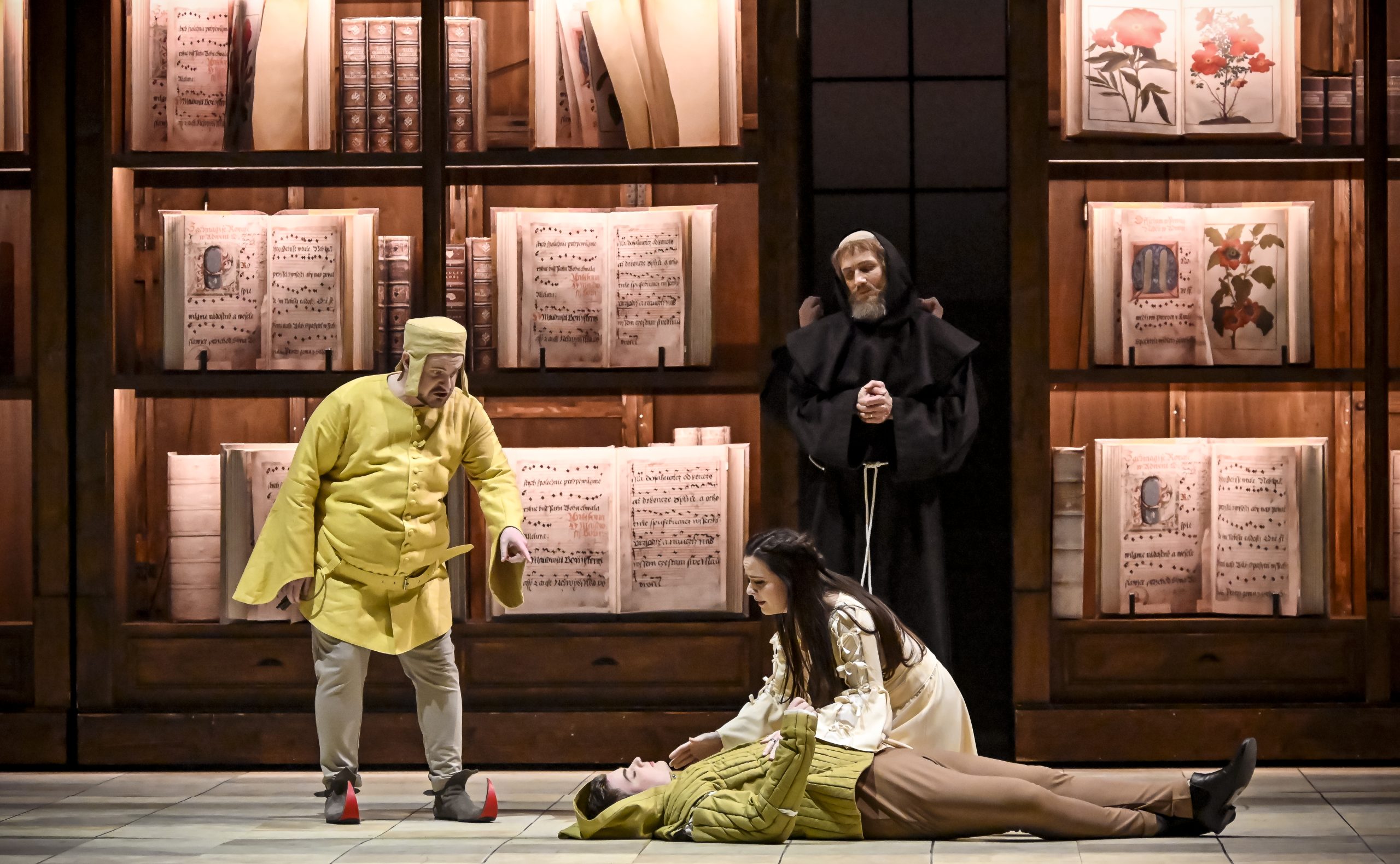
Photo: Marek Olbrzymek
The more our sense of the absurd grew, the easier it was to turn the narrative into a convincing whole – thanks to the brilliant direction of Heřman, who approached The Devil’s Wall with a panache worthy of the Salle le Peletier in Meyerbeer’s era. And with a sense of humour similar to that which must have characterised the authors of special effects of the French grand opéras. Heřman masterfully exploits the “alienness” of a detail or prop – the medieval setting (Zuzana Štefunková Rusínová’s superb costumes) is disrupted by a young monk in trainers; wheelbarrows from a DIY store roll onto the stage several times, and the peasant women push quite modern, neatly compressed bales of straw with their rakes. In addition, the director plays a hilarious game with symbols. The abundance of fish caught in the orchestra pit and swimming in the banked up Vltava, and, finally, the carp wagging its tail in a Gothic sculpture’s arms serve as a subtle (?) reminder that Vyšší Brod is a Cistercian abbey. The Rožmberks’ heraldic rose appears in a variety of contexts – for example, in Vok Vítkovic’s ceremonious entrée in full armour (I will not describe the scene, for if anyone is intending to go to Brno, I will spoil all the fun for them).
Some of Heřman’s ideas are so mad that I sometimes had the impression that I was watching the film Arabela, alternating with The Red Inn. However, wherever lyricism, horror or seriousness is needed, the spectator will find it. What deserves a special mention is the director’s collaboration with the choreographer Marek Svobodník, who has provided Rarach with a retinue of skeletons in black-and-white costumes, moving with the eerie grace of danse macabre figures (in scenes where Rarach is not parading in Beneš’s habit, but appears as a skeletal devil, the singer animates a hermit’s puppet in front of him). Add to this the superb crowd scenes, Dominik Žižek’s evocative projections and the lighting design overseen by Heřman himself, and we have a production that will captivate everyone – from a child taken to the opera by their parents for the first time, to a discerning music lover who has hitherto not believed in the power of Smetana’s work.
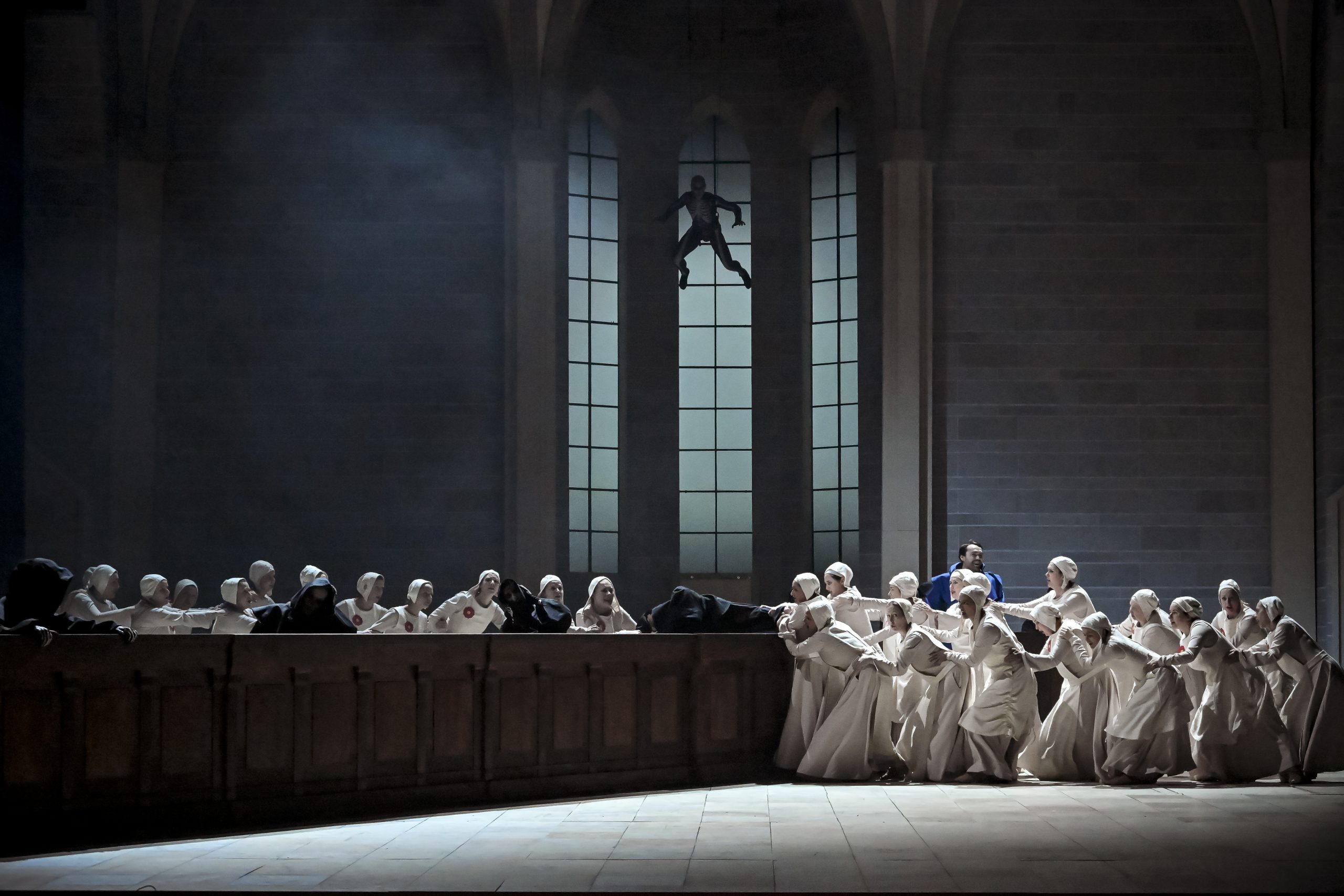
Photo: Matek Olbrzymek
For after what we heard in Brno, no one will believe that the opera is a work of declining years. Under Robert Kružík’s confident yet delicate hand the performance revealed not only obvious allusions to Wagner and Liszt, but also unexpectedly sophisticated and novel harmonic and colour structures bringing to mind Dvořák’s and Mahler’s late works. This was due to the disciplined and attentive orchestra, not to mention the phenomenal chorus of the Brno Opera, which I cannot praise highly enough in every performance. In the solo cast I saw a month after the premiere I was impressed the most by Pavel Švingr in the role of Rarach. He is a singer blessed with a powerful bass voice, yet one that is both exceptionally handsome and musical. Singing Beneš, David Szendiuch, with his considerably less distinctive voice, paled somewhat in comparison. On the other hand, an excellent performance came from Roman Hoza – a moving and human Vok Vítkovic, sung with a soft baritone with excellent breath control and beautiful middle range. The ever reliable Peter Berger was outstanding in the tenor role of the knight Jarek – no doubt aided by the soprano Lenka Máčiková, who gave a superb acting portrayal of Katuška with a mercurial voice. Romana Kružíkova lacked a similar stage presence; hers is a soprano light and girlish enough for the role of Hedvika, Vok’s beloved, but she still needs to work on her interpretation on the character. Záviš was convincingly portrayed by Václava Krejčí Housková, whose assured, steely mezzo-soprano is perfect for this trouser role. Finally, a round of applause should go to the tenor Petr Levíček in the character role of Michálek, the castle steward and Katuška’s father, a part that seems to have been taken straight from Die Meistersinger von Nürnberg.
Next year The Devil’s Wall will be presented at Prague’s National Theatre in a production by Ondřej Havelka, the first director that made me cry with laughter at the opera. A quarter of a century has passed since then and Havelka now has some stiff competition. If the Prague production turns out to be just as successful, Smetana will die of laughter in the beyond.
Translated by: Anna Kijak