This visit – at the invitation of the North Rhine-Westphalia’s Culture Secretariat, with an eight-strong group of international observers, including my former editor colleague Monika Pasiecznik – was for me like Odysseus’ return to his beloved Ithaca. For thirteen years I have been working almost exclusively as an opera critic. I sometimes forget how much of my professional career was devoted to contemporary music, for example, when I reported on the successive editions of Berlin’s MaerzMusik, a festival I accompanied throughout Matthias Osterwold’s tenure, eagerly following its ups and downs. Year after year I would immerse myself deeply for a week and a half in the latest works, sometimes for over ten hours a day – until the festival began to eat its own tail. After that I would come to Berlin only sporadically and none of the subsequent MaerzMusik curators managed to win me over to their concept. That is why I accepted without hesitation an invitation to two concurrent festivals: the ORBIT biennial of new music theatre, taking place for the third time in Cologne, and the Wittener Tage für neue Kammermusik, celebrating its ninetieth anniversary.
I would venture to say that the programmes of both events – ORBIT, still experimenting and groping its way, and the venerable festival in Witten, which, incidentally, has expanded the formula of its title to include orchestral works and music theatre presentations – if combined into one and spread over time, would produce a festival surprisingly similar to the “MaerzMusiks” from Osterworld’s best years. But these happened nearly two decades ago. If I were younger, this would sound like an complaint. But I am older and I really need something like this: an intense festival of contemporary music that would satisfy both elderly avant-gardist and concert hall regulars, and an audience that still has no idea what to do about it. Listeners and spectators who want to explore such music in the contexts of time, space and other abstract notions. Who prefer to treat new music as a fact of which we know nothing yet, and to set this fact against the harsh reality and the social behaviours associated with it. To listen in darkness, on the go, lying down and while eating. To experience music in the urban space or, on the contrary, to retreat with it into ever changing and less obvious interiors.
What a dream. Meanwhile, Cologne is almost a hundred kilometres away from Witten, and we, as privileged critics, managed to cover almost the entire programmes of both festivals solely thanks to the efforts of the NRW KULTURsekretariat, which enabled us to attend rehearsals and meet the authors of still unfinished projects. Our advantage over the “ordinary” audience was that we knew the aesthetics of many composers from previous encounters. Interestingly, these were not always consistent with our present impressions. “Of all my memories, the saddest are the happiest ones,” confessed Jean Genet, to whom I will return, in The Miracle of the Rose. Well, sometimes it is the other way round: the music of Chaya Czernowin, the focus of this year’s Wittener Tage, which two decades ago I found to be dreadful, albeit technically competent, waffle, this time had me completely engaged. Am I finally mature enough to understand that the various threads of sound in her work alternately intertwine and unravel, run backwards and across the narrative, sometimes disappearing into the fabric only to emerge from it again unnoticed? Or perhaps I was confined in the cocoon of the past and was not keeping up with the voice of the younger generations?
Let us begin at the beginning. Before the ORBIT Festival opened officially, we went to the Ensemble Musikfabrik studio to observe the general rehearsal of Mutants in Music: III. Dreamteam + Playlist of Deaf Dreams, a performance featuring musicians and dancers from the Cologne-based Ensemble uBu. It looked promising: the opening “symphony” of involuntary muscle twitches while falling asleep, enacted by the performers on beds laid out on the studio floor to the rhythm of sounds reminiscent of a children’s music box, failed, however, to develop into a coherent narrative about the art of dreaming together. The drama got stuck until it was carried away by the music, building up gradually from overlapping fragments of a playlist compiled by the deaf artist Matthias Ranner – sung, articulated through instruments, vibrating on low-frequency waves. Only then did I feel like dreaming together with uBu: when Schumann’s Mondnacht emerged from a cloud of clangs, shouts and hums, when Schubert’s Notturno in E flat major began to murmur like a lullaby and when pop-culture texts began to mix gracefully with fragments of avant-garde classics.
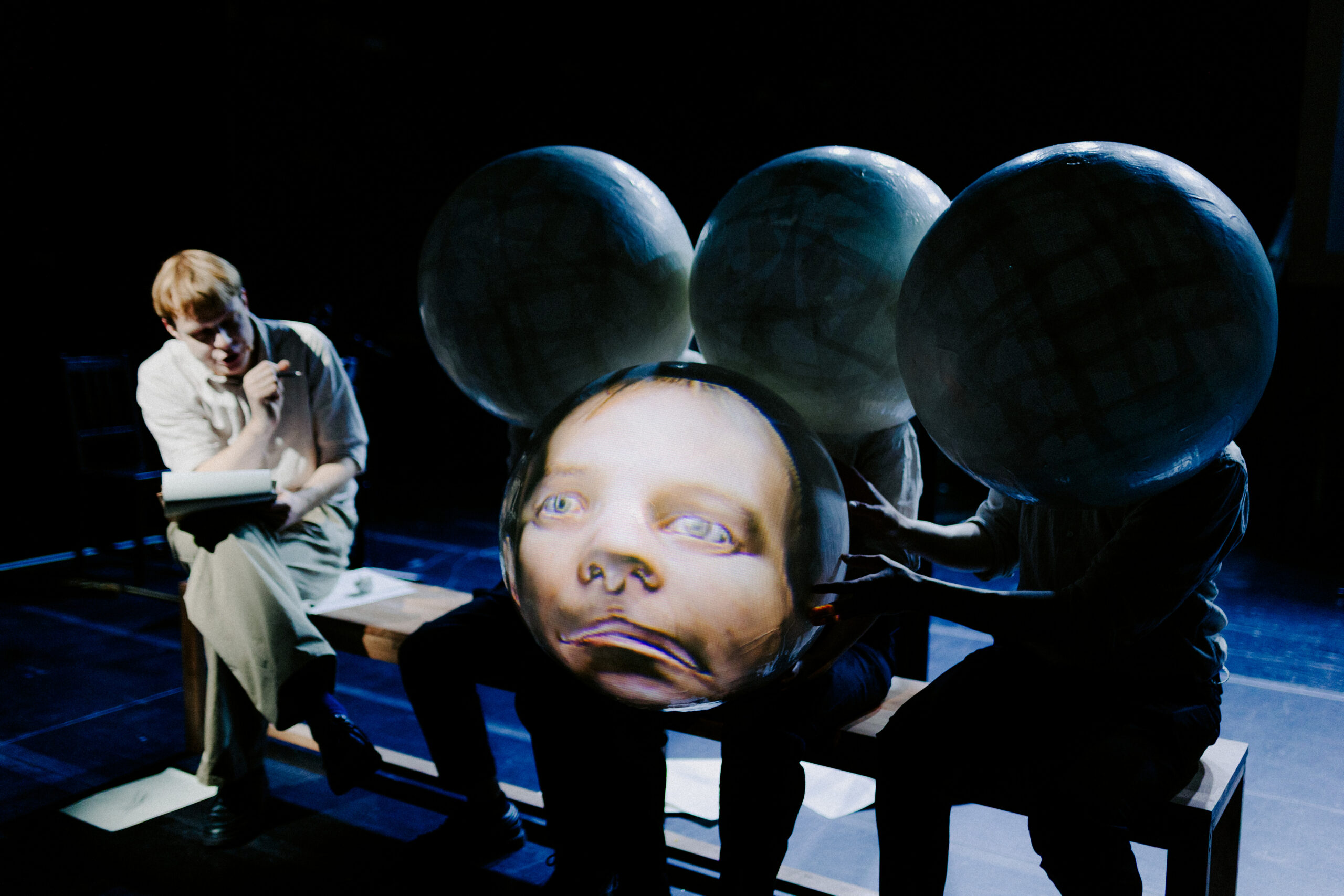
Gefängnis ohne Mauern, Schiff ohne Meer. Photo: Sophia Hegewald
The hidden structure of dreams – or rather nightmares – was explored many times by Jean Genet, for example, in his provocative Miracle of the Rose, a semi-autobiographical, non-linear narrative in which the writer loosely drew on his own experiences at the Mettray reformatory for juvenile offenders and his subsequent imprisonment at Fontevrault. The sudden leaps in time and the disorienting blurring of fantasy and reality, characteristic of Genet’s prose, have fascinated numerous composers, resulting in works like Bengtson’s opera The Maids and Eötvös’ Le Balcon, and, before that, Hans Werner Henze’s instrumental “imaginary theatre”, based on motifs from Le Miracle de la Rose. Philipp C. Meyer, a student of Isabel Mundry and Stefano Gervasoni, among others, has decided to use the same material in Gefängnis ohne Mauern, Schiff ohne Meer, a piece of music theatre for one actor (Max Kurth) and seven musicians from Ensemble Garage. Although the set designer Jan Patrick Brandt did indeed create a convincing vision of a supposedly “open” prison (a semi-transparent lightbox at the back of the Roter Saal at the COMEDIA Theater, which both shields the actor entering it and exposes him to public view; illuminated spheres in which the narrator’s distorted face is reflected), and director Miriam Götz intensified the atmosphere of oppression by scattering the musicians across the stage and making their performance seem like intrusive, obsessively repeated actions – the whole thing turned into a drawn-out monodrama with sparingly used background music. True, it was very interesting at times (I was particularly struck by the modulated train whistle, the dreamlike clamour of birds and the crunch of glass being gnawed at by one of the fellow prisoners), but it fell silent at key moments in the narrative, above all in the scene when the mystical rose was discovered at the bottom of the heart of Harcamone, the “holy murderer”. It is a shame, because Meyer is undoubtedly a talented composer and deserved to work with a dramaturge who would have radically shortened the spoken text and woven it more effectively into the musical fabric of the piece.
By contrast, the final performance of Sombre. In the Shadows of Our Time was excellent. It was a moving tribute to Kaija Saariaho, who passed away less than two years ago, made by her husband, the composer Jean-Baptiste Barrière, her son, the director Alexi Barrière, and the composer and sculptor Cécile Marti. The musical material of the production was made up of four chamber pieces by Saariaho (Caliban’s Dream to fragments of Shakespeare’s The Tempest; NoaNoa to a text from Paul Gauguin’s journal; Ciel étoilé; and Sombre to excerpts from Ezra Pound’s Cantos). Marti “replied” to the first two with a composition entitled ‘ŌVIRI to a text by Aleksi Barrière, while Jean-Baptiste Barrière followed Ciel étoilé with Un Tempo di Lampi Senza Tuono to the poem Attesa by Primo Levi. The whole, surprisingly uniform stylistically, was a convincing tale of the fatal consequences of idolatry: in private and artistic, as well as political life. Once again, I was reminded of Maerzmusik and a conversation from twenty-one years ago, after the staged concert Italia Anno Zero, when we fulminated that if we were shown a film featuring Mussolini one more time, we would not be answerable for our actions. In the world we are living in now projections of photographs from concentration camps and filmed speeches by the Duce – interspersed with images of the heavenly beaches of the Hiva ‘Oa island – again make an electrifying impression. Another thing is that this time we were dealing with a very well-produced, if slightly conservative, theatre, which suited the small stage at the Alte Feuerwache perfectly, and, above all, was superbly performed by four instrumentalists (Eija Kankaanranta on the kantele, the flutist Camilla Hoitenga, the double bassist Aleksander Gabryś, the percussionist Fritz Hauser) and the outstanding bass-baritone Robert Koller. The Swiss singer, adding rainstick to the sound layer of the piece, also demonstrated exceptional acting talent. Every one of his portrayals – from Gauguin to Pound – was equally convincing; every word was rich in meaning, every gesture essential. Right up to the final tearing of the projection screen, behind which stood a sculpture by Marti: a primeval stone idol that could represent anything from the painter’s fourteen-year-old mistress, the leader of the Italian fascists, to today’s objects of idolatrous worship.
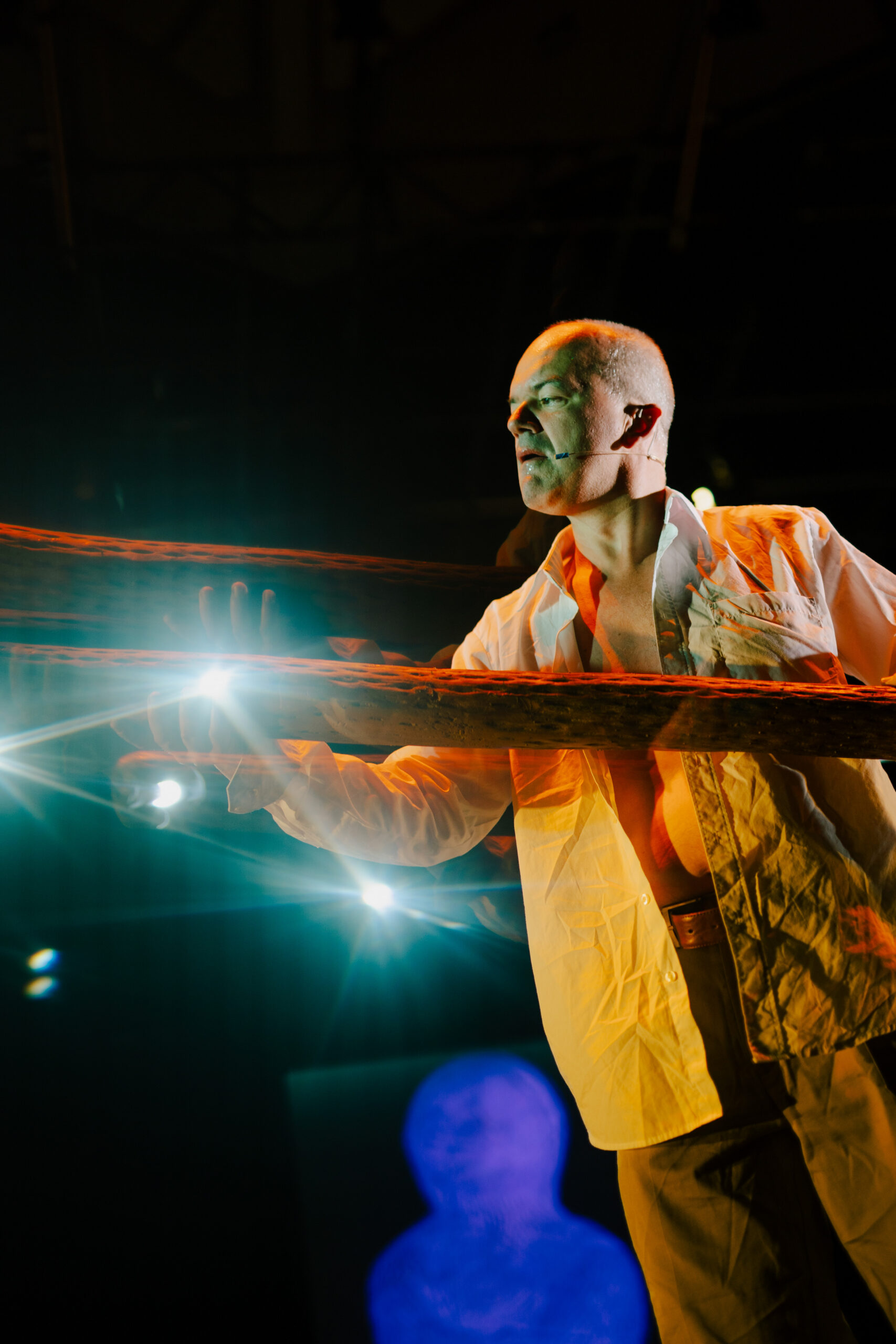
Sombre. In the Shadows of Our Time. Photo: Sophia Hegewald
I wish we had been able to see Samu Gryllus Host_Opera – based on a documentary novel about the abduction of a dozen or so girls in the Hungarian town of Balassagyarmat, carried out by the sons of local apparatchicks and hushed up by the communist authorities. I am glad that the encounter with the Cologne-based experimentalist Rochus Aust and his Deutsches Stromorchester gave us the chance to explore the still-deserted spaces of the port mill in the revitalised Deutz district, wearing helmets and protective clothing, just like the future audience of the cosmic performance Die Dualen/Grand Jury. We missed out on a few other ORBIT events, including a Symposium and a Speaker’s Corner featuring representatives from the independent arts scene. The Cologne festival is brimming with youthful energy, at times discovering something new, on other occasions reinventing the wheel. One day it will probably become established and thus less interesting.
The Wittener Musiktage are certainly well-established, which in the context of the previous sentence may again sound like a complaint, but the matter is more complicated. ORBIT is still searching, the Witten festival has already found what it was looking for: at least that is how its regulars see it, enamoured as they are with the great avant-garde of the third quarter of the twentieth century and greeting every hint of tonality with a consternation not unlike that which Wagner’s Tristan caused Clara Schumann. The tentative attempts to persuade the audience to embrace a slightly different kind of music, made during the brief tenure of Patrick Hahn, the festival’s former curator, fell on deaf ears – the oeuvre of Cassandra Miller, the face of last year’s Musiktage, who specialises in musical recycling, got a frosty reception. The helm was taken over from Hahn by Anselm Cybinski – together with the majority of the programme already planned for 2026 and focused on the oeuvre of Chaya Czernowin. We will have to wait and see what happens next.
I feel that, given my experiences to date, I am sitting on the barricade dividing the experimentalists and the advocates of the museum avant-garde. I have been quite happy to see the festival’s programme being expanded to include music that is decidedly “non-chamber” music. I was excited to discover the aptness of this year’s motto of the event: Gegenwart. Unentrinnbar (“The Present. Inescapable”). The present played a trick on us. It made us put greater emphasis on the context when assessing the works presented – often at the expense of a detailed analysis of the artists’ compositional technique.
Forty-eight hours of music in three days. That is why I will focus on delights, surprises and disappointments. Above all, on a radical change in my attitude towards Czernowin’s oeuvre, in which I finally began to recognise pain, unresolved trauma and opposition to the actions of tyrants. Surprisingly, her oeuvre sounds the least convincing when it engages directly in contemporary discourse (the underdeveloped NO! A Lament for the Innocent, featuring Sofia Jernberg’s strangely detached amplified soprano part, at a concert by the WDR Orchestra conducted by Yalda Zamani). I definitely find myself more in tune with Czernowin’s sensibility when she uses delicate musical means to evoke the scent of biblical hyssop, that ambiguous plant used by the Israelites in the Passover ritual to ask God to spare them, while slaying the firstborn of Egypt (a phenomenal performance of Ezov by Quatuor Diotima). I was equally struck by the performance of the Cologne-based band hand werk in a music theatre production, Red-Headed Man, based on the modernist poetry of Daniil Kharms: those who realised that a poem about a red-haired man who had no hair no eyes, no ears, no lips, no nose, who had absolutely nothing at all – and, therefore, it was better not to mention him – was a terrifying metaphor for Stalinist terror, turned a blind eye to Chernowin’s unsuccessful directorial debut in staging her own work, which was saved by the spectacular musical and acting performance of the cellist Niklas Seidl.
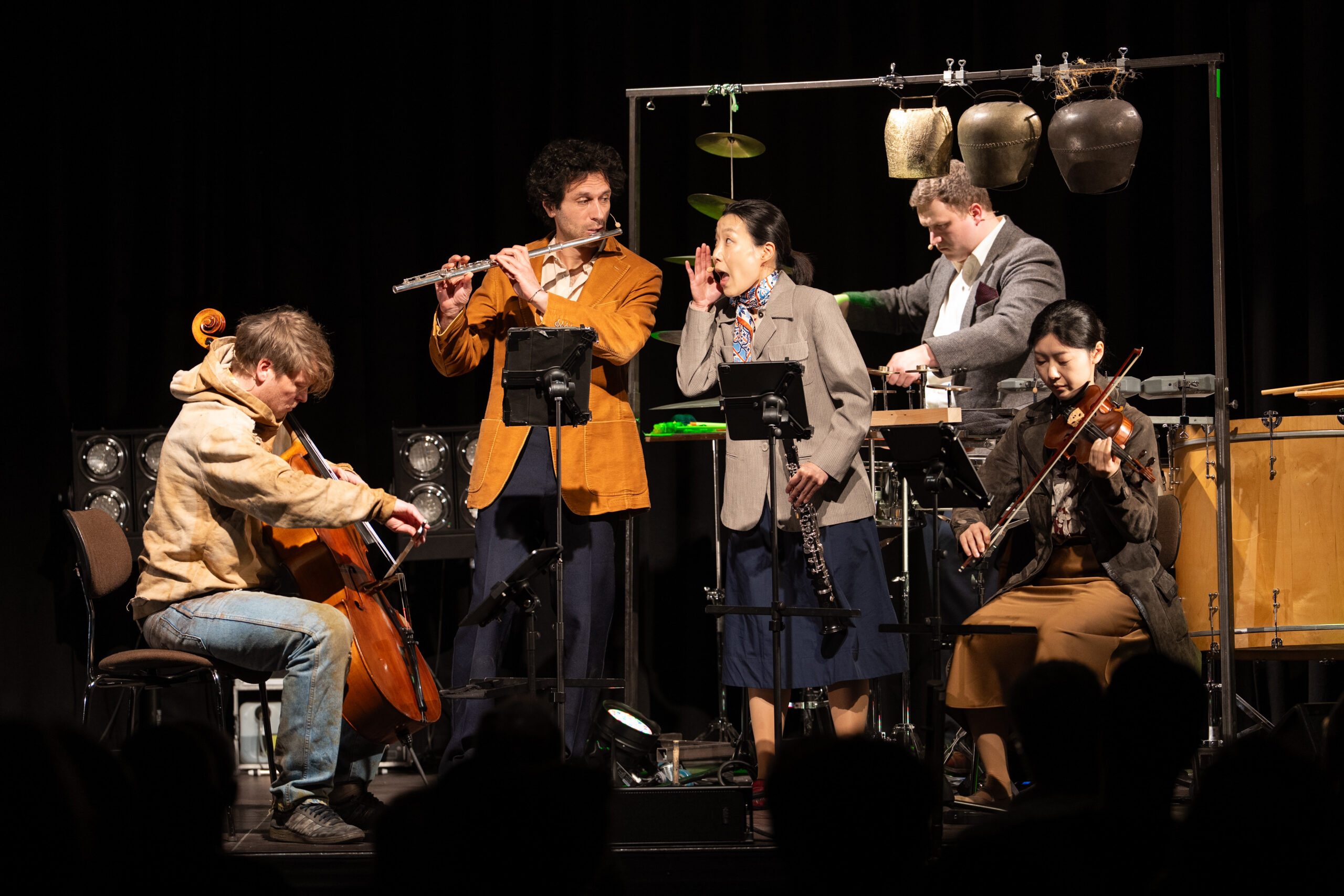
Red-Headed Man. Photo: Claus Langer
Another highlight from the Wittener Tage for me was Mártón Illés’ Four Sketches from the opening concert, in which vibrant live electronics merged seamlessly with an equally vibrant performance by Klangforum Wien, conducted by Elena Schwarz, clattering, chirping and shouting against a backdrop of fragmented czardases and Romani rhythms, bringing to mind a torn map of neural connections in the human brain. I was moved by Dmitri Kourliandski’s Partially Restored Landscapes, performed by the Diotima Quartet, and described by the composer as a musical deconstruction of encoded radio signals, but which I perceived as an inability to articulate and express the simplest human emotions, a manifestation of a desperate longing for the irretrievably lost land of childhood. I still cannot quite make sense of the concert by Basel Sinfonietta conducted by Titus Engel, during which the audience gave a warm reception to the technically accomplished, seductively Orientalising piece Untamed River by the Iranian composer Amen Feizabadi (with the superb Noa Frenkel in the solo part), and booed the naive Seven Valleys of Love by his compatriot Golfam Khayam, a clumsy composition, but one that remains touchingly faithful to the aesthetics of the classical Persian dastgāh system.
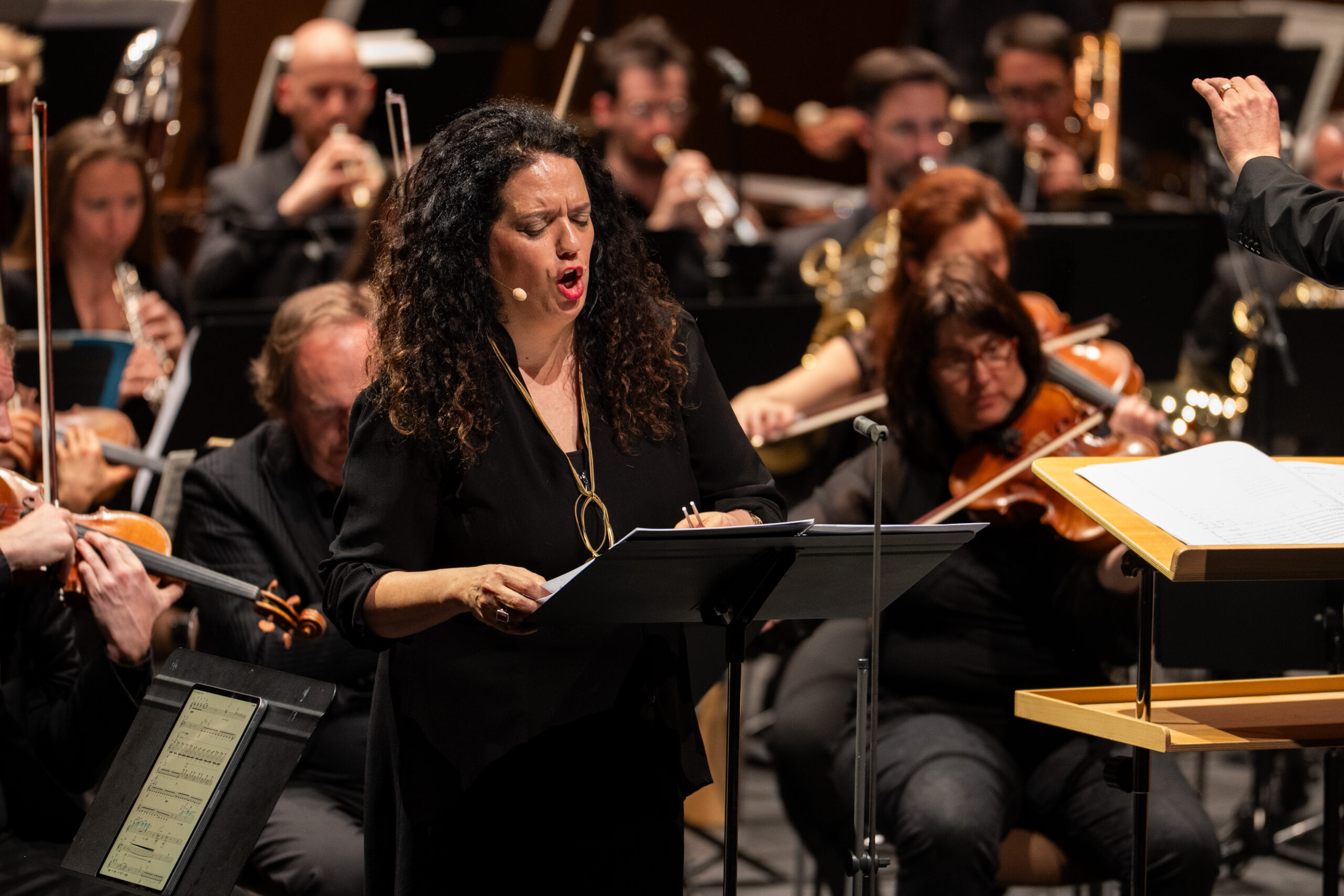
Noa Frenkel. Photo: Claus Langer
I will not hide my admiration for Øyvind Torvund’s Two Pieces for Orchestra and Electronics, performed by the WDR Orchestra under Zamani. Torvund has always thrown listeners off the scent, branched off down different paths and drawn the audience into an intriguing discussion about the blurred boundary between nature and civilisation – this time he put shreds of inspiration from the music of Wagner, Bruckner and Sibelius into the muzzle of wolves howling in the wilderness and other strange creatures.
There are many things I have not written about and I do not regret it. This trip has transported me back to a beautiful past, when I would immerse myself in the music of the day for weeks and would pick out only what was essential. This trip has thrown me into the inescapable present. I am happy to be able to experience it not only in the existential dimension, but also in the aesthetic dimension, filtered through the sensibility and unbridled imagination of contemporary composers.
Translated by: Anna Kijak