Krystian Lada does not like to separate the audience from the symbolic performance space. All his productions begin with the curtain raised – long before the first sounds of the opera are heard. Before the Mainz staging of Missy Mazzoli’s Breaking the Waves a dozen or so women slowly make their way onto the dark grass of the rocky hills of the Isle of Skye; they are unassuming, modestly dressed, young and old, beautiful and ugly. They are soon joined by a group of men in costumes bringing to mind not only the traditional dress of the Free Church of Scotland elders and the workwear of the Hebrides fishermen, but also the glistening blackness of oil from the drilling platforms scattered across the North Sea. The women introduce themselves and say a few words about their origin and religion. Not all of them are allowed by the men to finish. One by one, they are all pushed off the stage. Just one of them manages to say her name, Bess. This is enough for the men. The community dresses the girl in a wedding gown and has her “try on” various symbols of virginal martyrdom.
The gesture, which at first appears to contradict the doctrine of the Presbyterians – who reject the veneration of saints, their relics and images – is, in fact, an apt reflection of the worldview of the Danish artist Lars von Trier, the director of the 1996 film, which became the basis of Mazzoli’s opera, composed to a libretto by Royce Vavrek. Breaking the Waves, the winner of the Grand Prix at the Cannes Film Festival, was released just over a year after the announcement of the famous Dogme 95 manifesto and is still regarded as the seminal work of the movement. It was precisely at that time that von Trier, raised in a family of atheists, decided to convert to Catholicism, although he later abandoned the idea and chose agnosticism. He never hid his fascination with the oeuvre of his compatriot Carl Theodor Dreyer, primarily his Passion of Joan of Arc (1928), as well as the 1943 Day of Wrath and the post-war The Word. With time the iconoclast Dreyer came to be hailed as a master of religious cinema and Lars von Trier found his successor in himself. In Breaking the Waves he mused over dilemmas similar to those explored by Dreyer. From Joan of Arc he took Bess’ martyrdom; from Day of Wrath – the ambiguous bell motif; from The Word – the theme of his protagonist’s madness or mental disability. However, he did not manage to shake off his reputation as someone who liked to cause scandal, partly because, even in his later films, he continued to point to patriarchal religion as a source of harm and suffering, exposing its inherent mechanism of the community using sexuality to exercise control over the individual.
Mazzoli’s three-act stage work was written twenty years after the film’s premiere, having been commissioned by Opera Philadelphia. Vavrek had the idea even before that, but the composer refused to be persuaded to adapt Breaking the Waves until she discovered the immanent “operatic nature” of von Trier’s work. His tale of Bess has the obsession and sacrifice of Wagner’s Senta, the vastness of the sea from Britten’s Billy Budd and Peter Grimes, and the hell paved with good intentions, like in Janáček’s Jenufa. The libretto of the opera follows the original text quite closely, a decision followed also in theatrical terms by the authors of most previous productions, maintaining a classic, linear narrative structure.
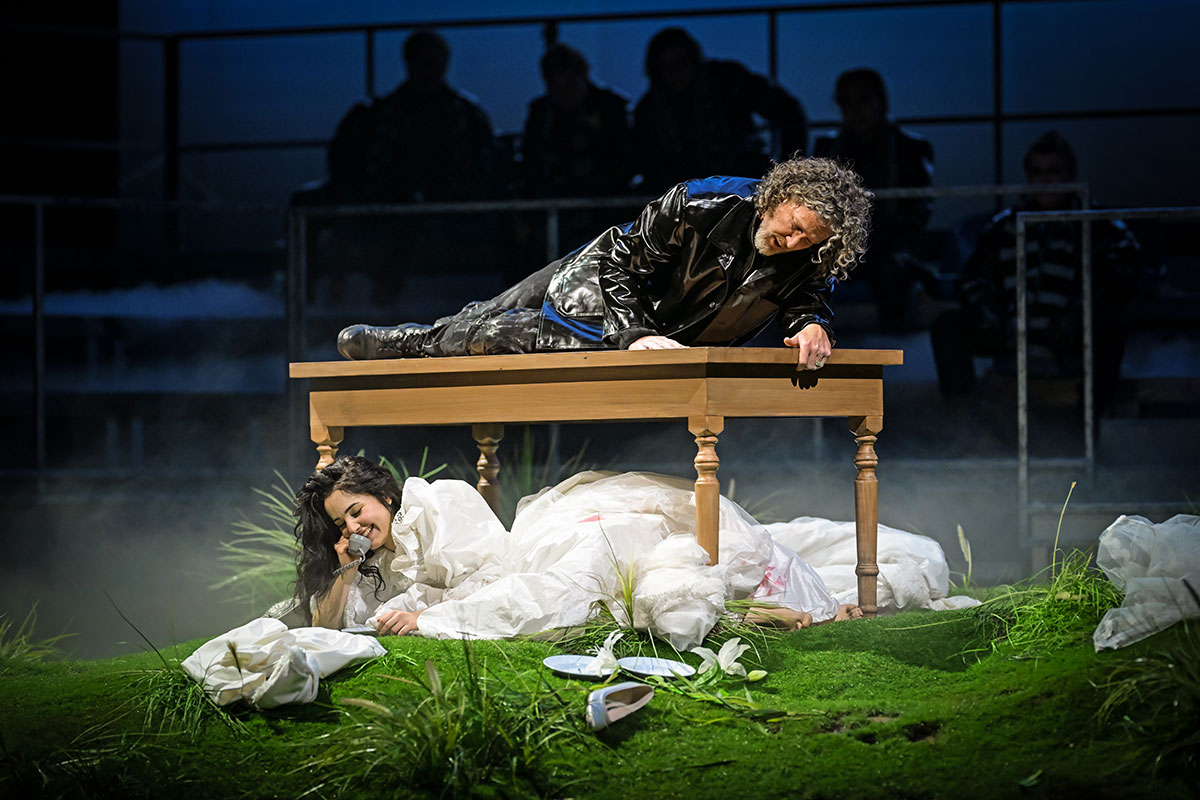
Julietta Aleksanyan (Bess) and Brett Carter (Jan). Photo: Andreas Etter
Krystian Lada has opted for a different approach: against the backdrop of an almost unchanging sets (designed by Annette Murschetz), masterfully organising the space, he stages a morality play about presumed guilt and ambiguous redemption, bringing to mind the tradition of medieval Passion plays. On the rocky grassland mentioned earlier there grow white lilies, usually not to be found in this environment. Jan, a Norwegian oil rig worker, will use them to make a wedding bouquet for Bess. They are both dressed in white: the groom in a suit, the bride in a gown with an enormous train, which she will hardly take off until the very end of the performance (costumes by Adrian Bärwinkel). There is no nard, no saffron or calamus here, but we cannot help but feel that this patch of land is supposed to satisfy all the needs of the community, both physical and spiritual. That is why it is an area that is closely watched – from the platforms surrounding it behind which a different world stretches: a world of boundless seas, distant oil rigs and rights rejected by the community.
In this enclosed garden Bess will lose her virginity; this is where she will say goodbye to Jan setting off for an oil rig, this is where she will have sex with him via phone, still in the same white dress, stained with the blood of their wedding night. When the news of Jan’s tragic accident arrives, the dark grass will be replaced with the steel grey floor of a hospital ward, reminiscent more of a mortuary than of an intensive care unit. Half-naked and bloodied, Jan, with his loins covered by a white cloth, brings to mind the tortured Christ just as strongly as he evokes the suffering Amfortas. Paralysed and unable to have sex, he slowly loses his will to live. When he finally manages to persuade his wife to have sex with other men, this will begin the Bess’ painful transformation into a holy harlot. New bloodstains appear on the dress. Bess “will finish the job”, giving herself to sailors from a red ship the presence of which we can only guess at from the flood of vermillion light at the back of the stage (as always, excellent lighting design by Aleksander Prowaliński, this time in collaboration with Frederik Wollek).
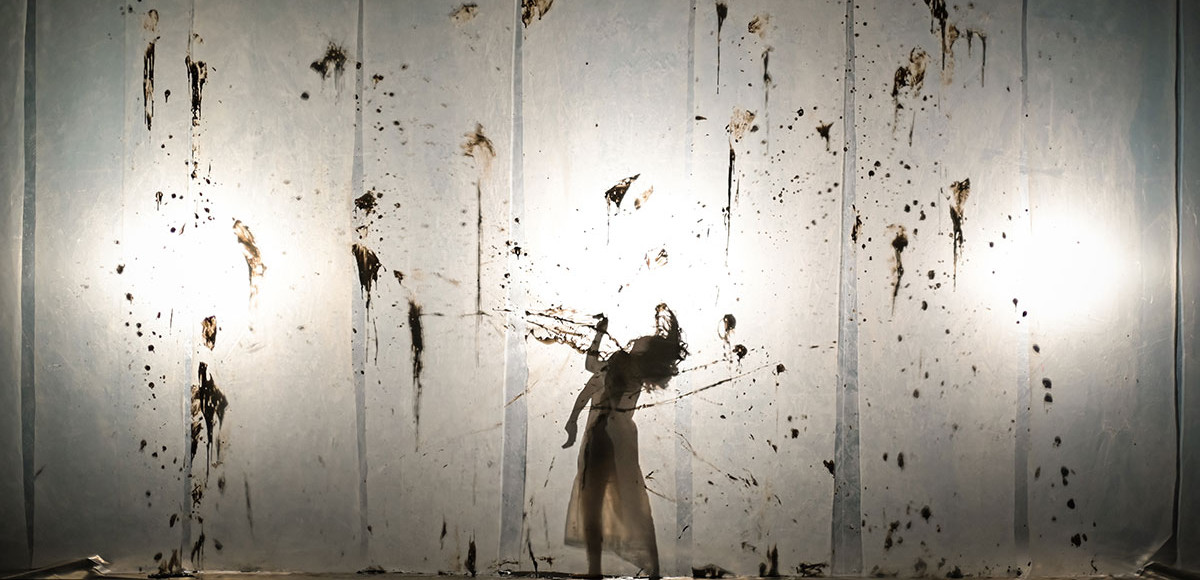
Julietta Aleksanyan. Photo: Andreas Etter
The rape scene takes place behind a semi-transparent curtain, with streams of terrifying filth pouring down on it. Blood mixed with oil? Faeces? Or perhaps disembowelled entrails? After the gruesome climax the narrative slowly comes to a close. Bess dies in the arms of women, Jan regains the use of his legs and returns to the stage in his wedding attire – splattered with dirt and blood like the white train of the dress, which now covers the woman’s coffin. Soon a purifying rain will fall from the flies. In the depths of the invisible sea we will hear the sound of non-existent bells, the sound Jan longed for on his wedding day.
Lada has served the operatic version of Breaking the Waves well. He has distanced it from the cinematic original and introduced it to the world of theatrical symbolism – much to the benefit of the audience and without detracting from the music, which has earned Mazzoli a reputation as one of the brightest stars in the firmament of twenty-first-century American opera. Critics often label her oeuvre as post-minimalist: indeed, Mazzoli organises most scenes around a vivid, repetitive pattern, not necessarily rhythmic – however, the main asset of her music is its harmonic language, which vaguely brings to mind Schönberg’s fluid tonality and polytonality. Mazzoli beautifully tints chords with dissonances, recasts instruments, and breaks up the colour of the orchestra with the sound of electric guitar and synthesiser. In addition, she has an extraordinary feel of the human voice, as is evidenced by the truly Brittenesque choruses and the poignant and, at the same time, surprisingly melodious part of Bess.
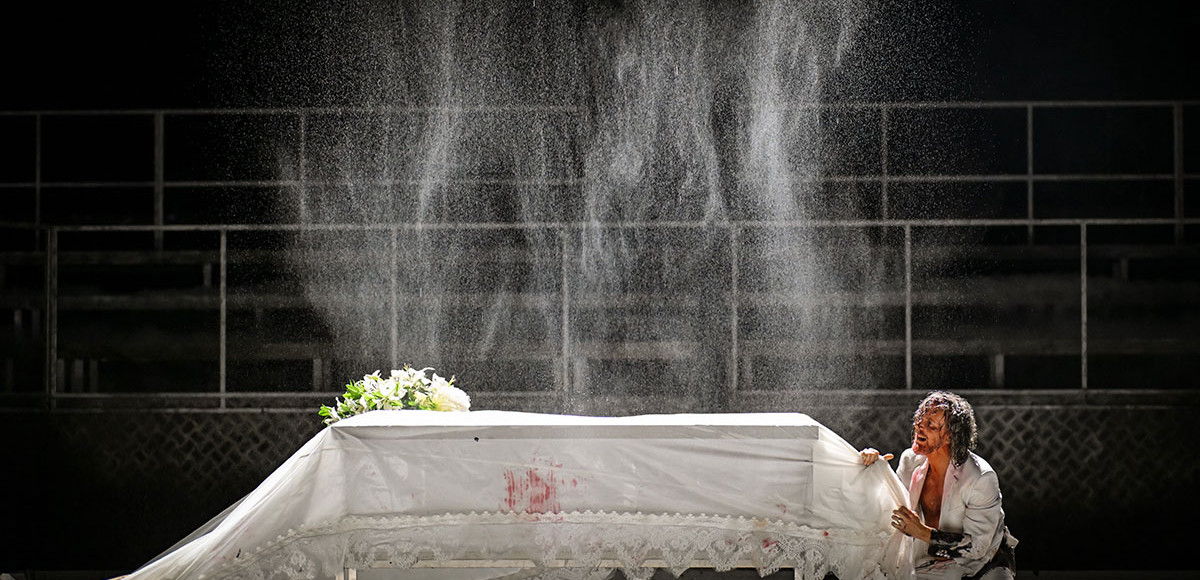
Brett Carter. Photo: Andreas Etter
A part with which Julietta Aleksanyan coped splendidly. She is a soprano with a very handsome voice, uncommon sense of phrasing, and admirable ability to build such a complex and tragic character. The fragile Bess was perfectly partnered by the imposing Jan of Brett Carter, who has a healthy, flexible baritone with a bright, almost tenor-like timbre. I was really taken by Karina Repova as Dodo, Bess’ sister-in-law: her velvety mezzo-soprano possesses both soothing tenderness and strength essential to the role – they were well contrasted with the merciless severity of the Mother (sung by Nancy Weißbach, a reliable dramatic soprano). Among the male cast the Ukrainian bass-baritone Daniel Semsichko as the Councilman stood out as well, but I was disappointed by Yoonki Baek as Dr. Richardson, whose tenor was quite frail and whose intonation was uncertain. Other roles were competently performed by the baritone Tim-Lukas Reuter (Terry) as well as the bass Doğuş Güney and the tenor Frederik Bak as the two rapists. A fine performance also came from the male chorus directed by Sebastian Hernandez Laverny – rough, at times brutal in its sound, particularly convincing in fragments styled as Presbyterian hymns and psalms. The whole, featuring the Philharmonisches Staatsorchester Mainz, was conducted by Dirk Kaftan – with remarkable verve and attention to every detail of this highly complex score.
However, the Mainz staging of Breaking the Waves ended differently from the earlier productions of the opera. A dozen or so “Mainzer Frauen”, the women from the prologue, came back on stage with Bess in order to sing a simple song, “My body is a map”, composed by Mazzoli to a paraphrase of the text of the main protagonist’s aria from the beginning of Act III. Perhaps it was a nod to librettists from the past, who were able to end every opera with a well-put-together lieto fine? If so, it was untimely. Every single day over one hundred raped women die, with their bodies proving to be a map to nowhere.
Translated by: Anna Kijak