
To this day it is still unclear why, on 8 June 1972, the US and South Vietnamese air forces dropped napalm on the village of Trảng Bàng, near Saigon, which had previously been captured by the Vietcong forces. The reason may have been the same as the one used to explain the “collateral damage” in recent and ongoing wars – the hiding of militants and terrorists among the civilian population. According to the official version, a pilot of the Republic of Vietnam Air Force mistook a group of people fleeing from a local temple for enemy soldiers, as a result of which the aircraft changed course and launched an attack on defenceless civilians. One of the bombing victims was a girl my age: nine-year-old Phan Thị Kim Phúc, who miraculously survived, having torn off her burning clothes.
The photograph of the naked “napalm girl”, screaming in pain, went viral around the world and soon became a symbol of the brutal Vietnam War. It also reached Poland. I’m not quite sure whether my memories of those days have merged with what I saw later. However, I seem to remember that a news report by the Polish Television’s infamous Dziennik Telewizyjny programme featured not only Nick Ut’s legendary photograph, but also clips from the footage shot by reporters from NBC and the independent British broadcaster ITN. Suffice it to say that I keep hearing the scream of the anguished nine-year-old and I keep seeing her running past me, revealing her bare, burnt back.
We were children of the Cold War, instructed from the very beginning of primary school by the sombre men from the security services as to whose side we should take in the event of a conflict. However, this did not dulled our sensibility. We were brought up on the records of Bob Dylan, Jimi Hendrix and Black Sabbath, smuggled from behind the Iron Curtain. This was also how we got to know Galt MacDermot’s musical Hair – in the original Broadway recording – and then rooted for our elder brothers who turned up for their mandatory military medical exam with defiantly long hair. We naively believed that we would live to see a world without violence and divisions, a world in which no one would have nightmares about children burnt with napalm.
One grows out of one’s illusions. Some of the flower children of the day turned radically right, others abandoned their youthful ideals for peace and quiet, many did not survive the attempts to augment their consciousness by means of hard drugs. And yet Hair became not only a manifesto of a generational rebellion, but also a symbol of universal quest for freedom, for the right to determine one’s own life, for the right of every human being to respect, love and security. Even if it did not influence the course of the Vietnam War, it certainly contributed to the difficult process of its re-evaluation. The premiere of the musical in London, in September 1968, marked the end of theatrical censorship, which had existed in the UK continuously since 1737. The film version of Hair, directed by Miloš Forman, reached Poland in the memorable year 1980, shortly after the signing of the August Agreements.
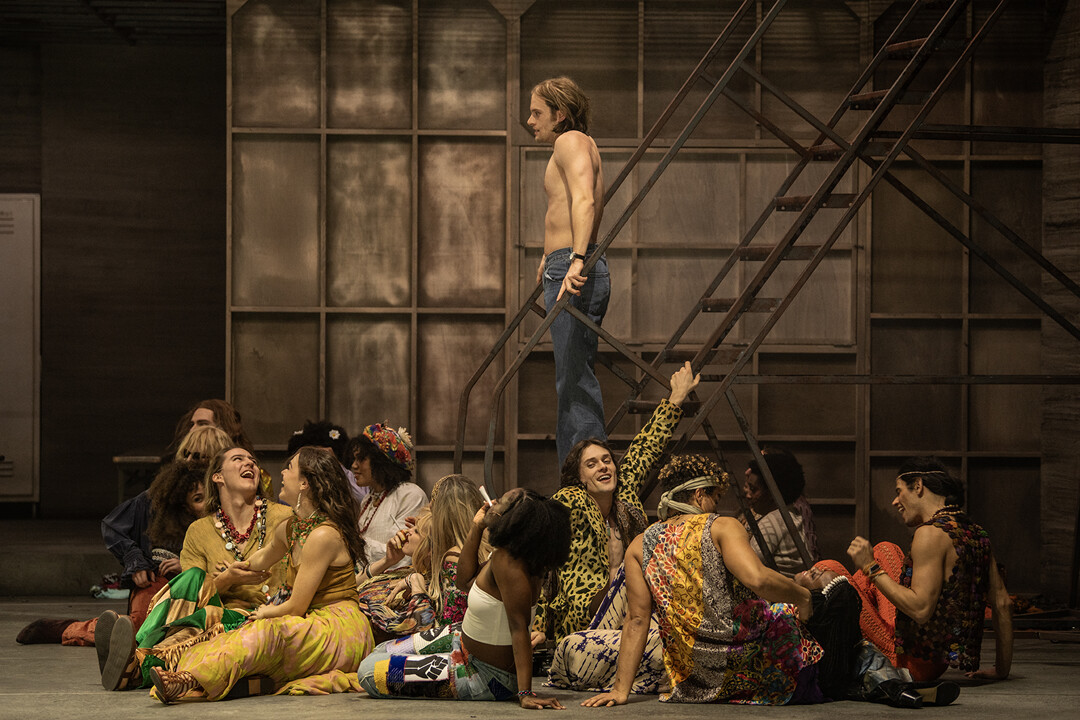
Photo: Edyta Dufaj
The musical will soon turn sixty and it might seem that it has long become part of venerable classics of the genre. However, a few years ago something strange began to happen. Nearly every new production is now accompanied by comments that Hair has never been as relevant as it is today. I thought about it, setting off to see the premiere of the Theater St. Gallen staging directed by Krystian Lada. I don’t think anyone expected an American-Israeli attack on Iran to begin on that very day. Before the performers came on stage, over twenty people had died in the air raids. The highest death toll resulted from three missiles that struck a school in Minaba. The incident was subsequently attributed to the target having been mistakenly identified as a military facility – which is all the more astonishing given that the nearby military base had been demilitarised fifteen years earlier. The attack killed 168 primary school girls, who were roughly the same age as Phan Thị Kim Phúc.
It has been a long time since I experienced such intense cognitive dissonance. The fourth anniversary of the invasion of Ukraine had just passed; five thousand kilometres from St. Gallen the nightmare of yet another war was beginning, and I was strolling through the foyer of the Swiss theatre, surrounded by an audience dressed in bell-bottoms and patterned dresses, with garlands of flowers around their necks. An audience of all ages: from young people who had heard about the hippies from their grandparents to eighty-year-old flower children leaning on their grandchildren’s shoulders. What the hell is it that makes Hair relevant? That every rebellion will be in vain? Where do I go?
I calmed down only when the lights went out in the auditorium. Fortunately, the heirs of the musical’s creators insist that the original context of the work be preserved and that no references to current events be included in new productions. Fortunately, Lada respects their will. Better still, he does it in his own way. The production begins with a stylish projection set in the aesthetics of the late 1960s and featuring American commercial shown on a television screen in which a smiling housewife marvels at the silky softness of Kleenex tissues spread out on her child’s lap, while a white couple, wading through white snow, flash their white teeth, brushed with Macleans toothpaste, at the camera. The vision of happy suburbs will soon vanish, giving way to images of a dirty and bloody war raging somewhere far away.
The projections – by the Columbian dancer and video artist Rubén Darío Bañol Herrera – will return many more times, also generated in real time. Meanwhile, however, the screen rises, revealing a room shrouded in semi-darkness, which is to become the setting for this strange rhapsody from the life of a New York hippie commune: an abandoned East Village warehouse or factory, with a dingy bathroom, characteristic flights of iron fire escapes and a tiny room upstairs, where a small instrumental ensemble is hidden behind a “glass” partition made of opaque film (excellent set design by Sotiris Melanos, well lit by Lukas Marian). This is where the flower children will celebrate the dawn of the Age of Aquarius; this is where Claude Bukowski, George Berger and their flatmate Sheila Franklin will grapple with their fear of war, the dilemmas of their own identity, and their quest to find genuine feelings amidst the anarchy of free love. This is where the great psychedelic trip will take place; this is where Claude will have to decide whether to continue his rebellion or sacrifice his ideals – and, most likely, his life – on the altar of conservative America.
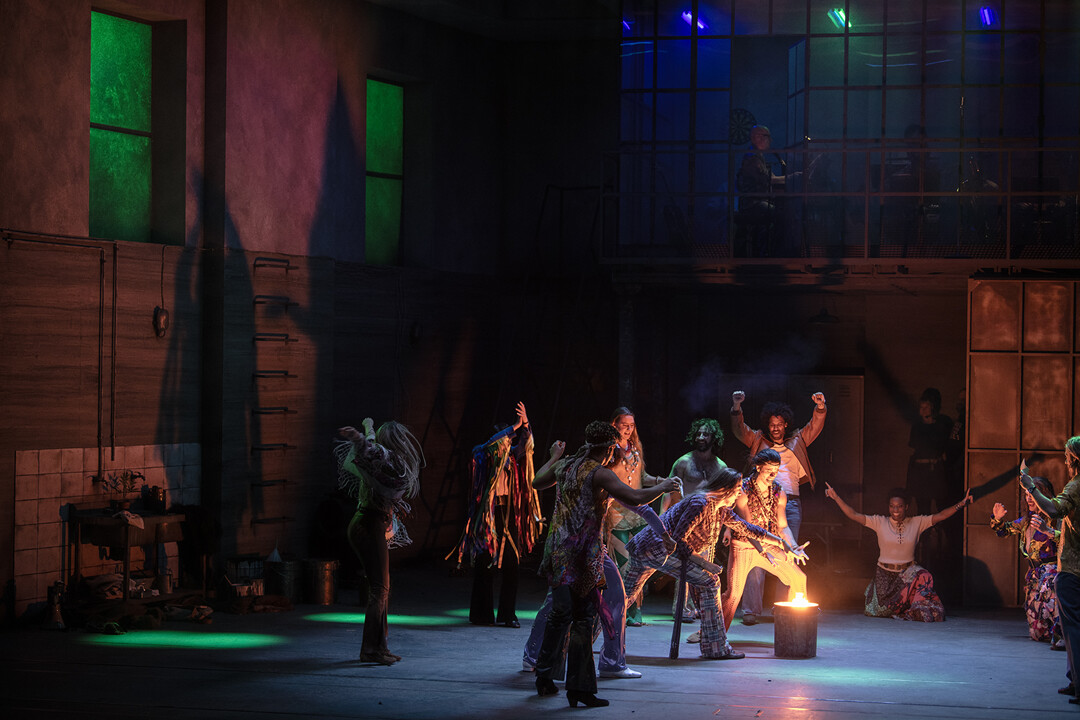
Photo: Edyta Dufaj
Hair has basically no plot to speak of. It is a string of rhapsodic, interrupted narratives, fierce protest songs interwoven with scathing satire, fragments of drug-fuelled visions, and very serious songs about dreams, feelings and loneliness. Lada – greatly assisted by the choreographer Jess Williams and the costume designer Wojciech Dziedzic, whose varied designs perfectly capture the spirit of the era – has preserved the frenetic energy of the work, at the same time making every effort to bring out the individual characteristics of each protagonist within the collective portrait of the commune. The most impressive performance comes from Dante Sáenz in the role of George Berger – wild, untamed, and, at the same time, terrifying in both his singing and his acting. Mack Walz was phenomenal as always, convincingly portraying Sheila’s difficult transformation from a hysterical activist manipulated by Berger into a mature woman who tries to bridge the gap between her beloved George and the doubt-ridden Claude. The latter, portrayed by Maciej Pawlak, singing with a soft, melodious voice, was at times overshadowed by the other two charismatic characters. This, however, is not a criticism, for this is precisely what Bukowski is like: a sensitive young man from the provinces, perhaps too prone to self-reflection and thus doomed to failure from the outset. Steffen Gerstle gave a beautiful performance as the good-natured Woof, a bisexual man with a heart of gold he is ready to offer to anyone in need of his affection. Outstanding among the other soloists were, especially, Nichole Cherrie, a silky-voiced Ronny; the incredibly expressive Masengu Kanyinda as Jeanie; and Daniel Dodd-Ellis singing Hud with his magnificent rich bass. The entire ensemble, including the eleven-strong chorus, was brilliantly led by Tobias Cosler, who gave the musicians not only freedom but also the essential sense of security.
They were treated with equal empathy by Lada, who often entrusted them with difficult acting tasks, but never against their bodies, voices or personalities. Despite the limited stage space of the Theater St. Gallen, he did not try to stifle their need to move. What I find the most winning in Lada’s craftsmanship is his attention to detail: a snowstorm conveyed by the simple techniques of shadow theatre; the “warped” reality of the first manned mission beyond Earth’s orbit, viewed by the commune from a television set propped upright on a metal supermarket trolley; the modest yet brilliantly enacted and truly hilarious hallucinatory vision of paratroopers landing in the Vietnamese jungle.
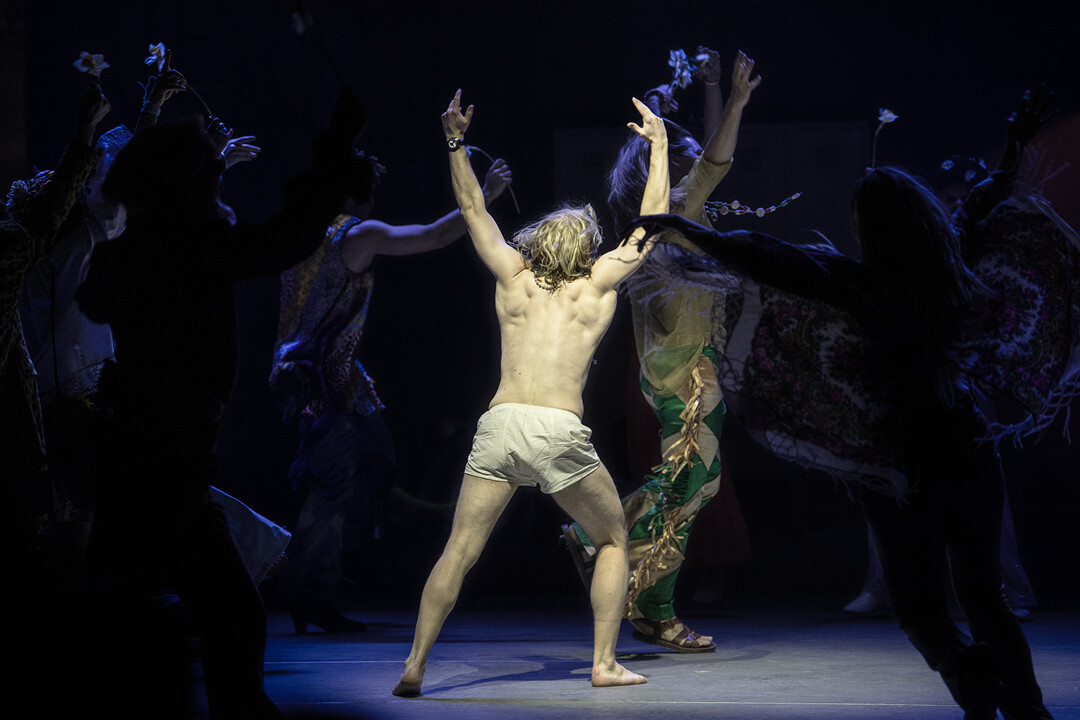
Photo: Edyta Dufaj
In the Swiss production a sense of unease seeps into the narrative gradually, almost imperceptibly, through, among other things, the successive projections – including material documenting one of the US government’s most dreadful ideas, the “draft lottery”, and excerpts from speeches by Martin Luther King and Richard Nixon. Especially the latter, who utters slick platitudes with the diction of a Shakespearean actor and the composure of a Roman orator, making the speeches of the current President of the United States come across as ramblings of a crazed old man.
When Claude died just as imperceptibly and the tribal anthem “Let the Sunshine In” rang out from the stage, there was no holding back the tears. We did not go on stage to join the actors, like in the old productions of Hair. But we did sing. Until we were out of breath and lost all hope that someone would finally pluck up the courage to let the sun in.
Translated by: Anna Kijak