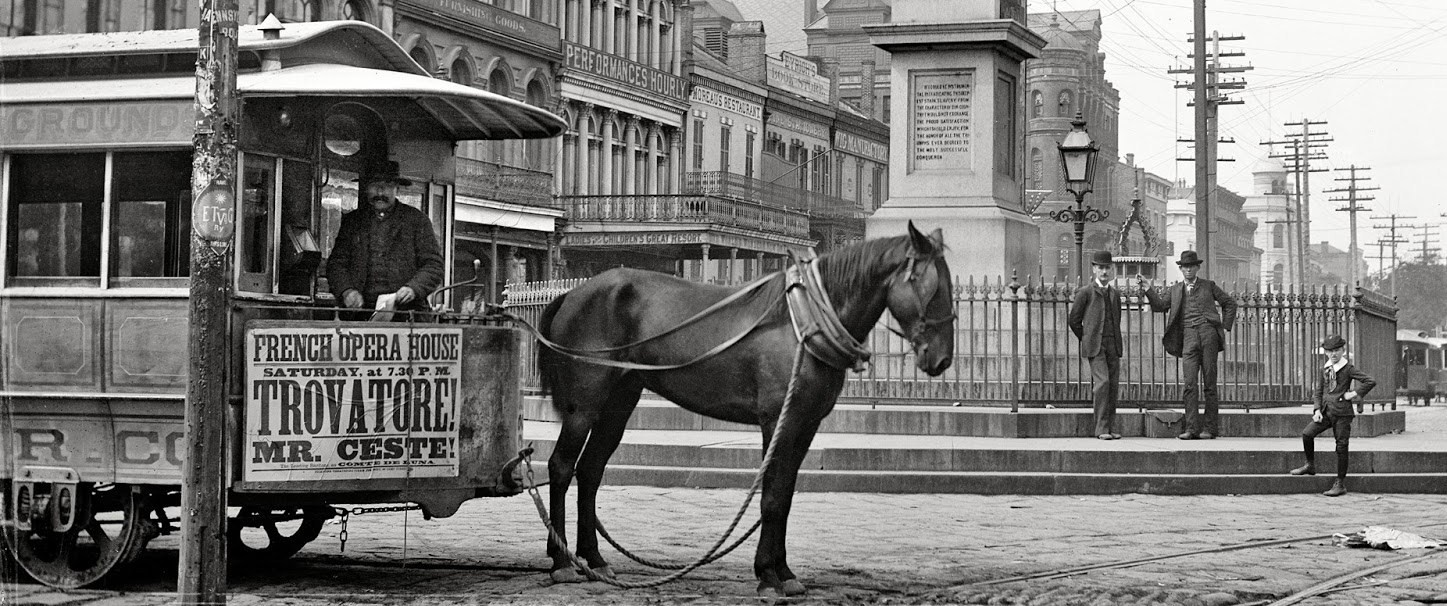
I won’t deny that my attitude towards Hansel and Gretel is exceedingly personal. The last Warsaw staging of the opera – by two legends of Polish puppet theatre, the director Jan Wilkowski and the set designer Adam Kilian – was premiered at Teatr Wielki in 1979. It was the last Warsaw premiere for myself and a bunch of my girlfriends, because at the ripe old age of fifteen we had to say good-bye to the children’s choir. We were still quite childish, but accustomed enough to Wagner’s music – thanks to, among other things, our participation in dozens of performances of Tannhäuser, and recent guest appearances by another company presenting the Tetralogy – to be able to spot in Engelbert Humperdinck’s shimmering score not only popular German folk songs, but also verbatim quotes from the Ring and a tangle of leitmotifs organising the narrative like in the works of the Bayreuth master. Nor were we surprised at all that the musical direction of Hansel and Gretel was in the hands of the company’s boss and eminent Wagnerian Antoni Wicherek.
We were, therefore, all the more disappointed that the premiere received only a handful of reviews, most of which were scathing. The attacks were targeted mainly at Humperdinck, called by one critic a “Wagner for the poor in spirit”, and his “long outdated music”. The conductor and man behind the whole project was criticised as well: for setting in motion the huge machine of “Poland’s pre-eminent musical stage” just to show “two brans” throw a witch into the fire. Since then no one has dared to stage Hansel and Gretel in Warsaw, although elsewhere the opera is hugely popular and in some countries it is a regular feature of the Christmas season. However, it has to be said that music lovers are yet to treat it completely seriously; a tentative proposal, made a few years ago, to present the work – composed, after all, by an assistant to Wagner and teacher of his son Siegfried – at the Bayreuther Festspiele came up against fierce resistance by the guardians of tradition.
Fortunately, it did not take long for the step to be taken by the “English Bayreuth”, that is Longborough Festival Opera. There were serious arguments in favour of the decision: Humperdinck’s opera was admired by the greatest musicians of the period, including Richard Strauss, who conducted the premiere in Weimar on 23 December 1893. More triumphs came with the subsequent stagings in Munich and Karlsruhe, under the batons of, respectively, Hermann Levi and Felix Mottl, two great Wagnerian conductors. They were in no doubt that the composer had produced a brilliant synthesis of a children’s fairy tale with the loftiness of the Wagnerian myth, of references to German folklore with mastery of orchestral technique learned from Wagner.
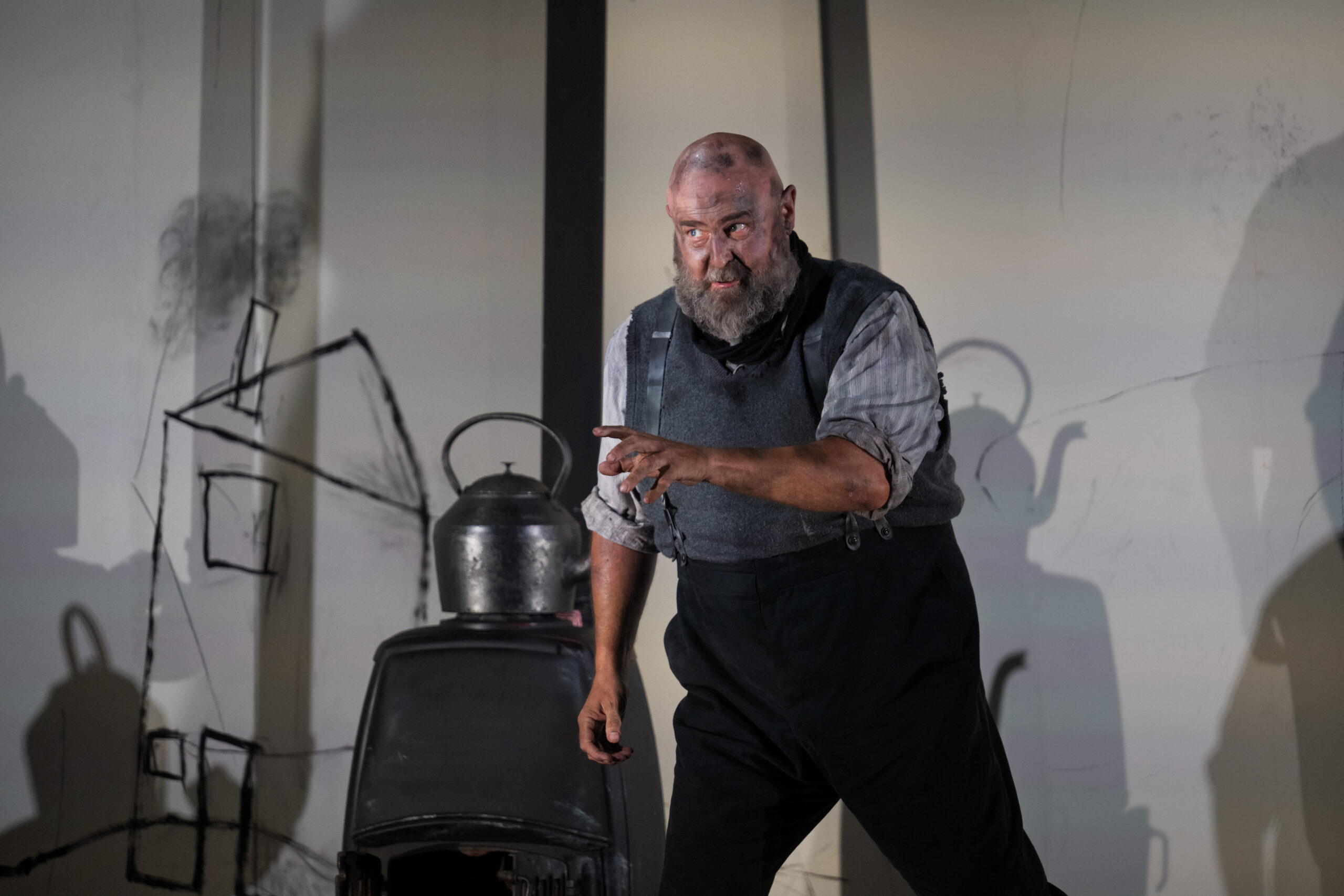
Darren Jeffery (Father). Photo: Matthew Williams-Ellis
The whole thing started innocently enough: from an adaptation by Adelheid Wette, Humperdinck’s younger sister, who in 1889 had the idea of putting on a Christmas puppet show of Hänsel und Gretel for her daughters. Her brother was supposed only to write music to four songs accompanying the play. The home show was such a hit with the guests that the siblings expanded it into a substantial singspiel with piano. Two years later Humperdinck completed a true three-act opera, Hänsel und Gretel, to a libretto by Adelheid, who in her version omitted the most drastic scenes from the fairy tale, adding instead several good-natured characters helping the protagonists on their way to a happy ending.
Yet whatever was sugar-coated in the libretto retained its original horror and mystery in the score. After all, the roots of the Brothers Grimm’s famous fairy tale go back to the great famine, the first of the disasters that struck fourteenth-century Europe. A series of harsh winters was followed by cold springs and rainy summers. The earth refused to dry, to warm up or, even less so, to bear fruit. People started to eat dogs and draught animals. They would grind the remains of seed grain to make flour. They would hunt frogs, boil tree bark, pick out larvae from rotten tree trunks. Desperate, they would get rid of weaker children, abandoning them to their fate and wild animals in the wilderness, as far from their homes as possible, to prevent them from finding their way back. Just like in the fairy tale about siblings abandoned at the behest of their stepmother, but with the consent of their father, a woodcutter, who had been persuaded that otherwise he would have to make coffins for all four of them.
Lucy Bailey, the director of LFO’s Hansel and Gretel, decided to restore at least some of that frustration and darkness to Humperdinck’s opera. Before coming to England I feared that she might not be able to restrain herself, that in the end she would not resist the cruelty of the original. The name Bailey, one of the most important figures of modern British theatre, immediately made me think of her famous Titus Andronicus, presented at Shakespeare’s Globe exactly twenty years ago – in a staging so harrowing that spectators would faint at every performance. It was only when I arrived in Longborough that I realised that Bailey’s career began with a fascination with opera, that she learned her trade not only in drama theatres, but also in Glyndebourne and that she made her debut at Wexford already in the 1980s.
This is most likely why she did not cross any boundary in Hansel and Gretel. She saw, both in the libretto and in the score, that what remained of the original literary work was mainly a story about becoming mature enough to accept responsibility and learning from one’s mistakes, yet a story still marked by the anxieties of the period – lest children’s rebellion against parental authority turn permanently into hatred. In the Longborough production the role of the Witch is performed by the same singer as that of the Mother – a practice often followed in performances of Hansel and Gretel, mainly for practical reasons. However, Bailey followed the Grimm brothers, who in every edition of the fairy tale would suggest more and more emphatically that by killing the Witch the children, in fact, killed their evil stepmother. Yet in the fairy tale the story unfolds over a longer time-frame. In Humperdinck’s softened version the twins are found by their parents after an all-night search of the forest. This did not prevent Bailey from transferring the matricide motif to the sphere of children’s fantasy, which must have been fuelled by fear and hunger.
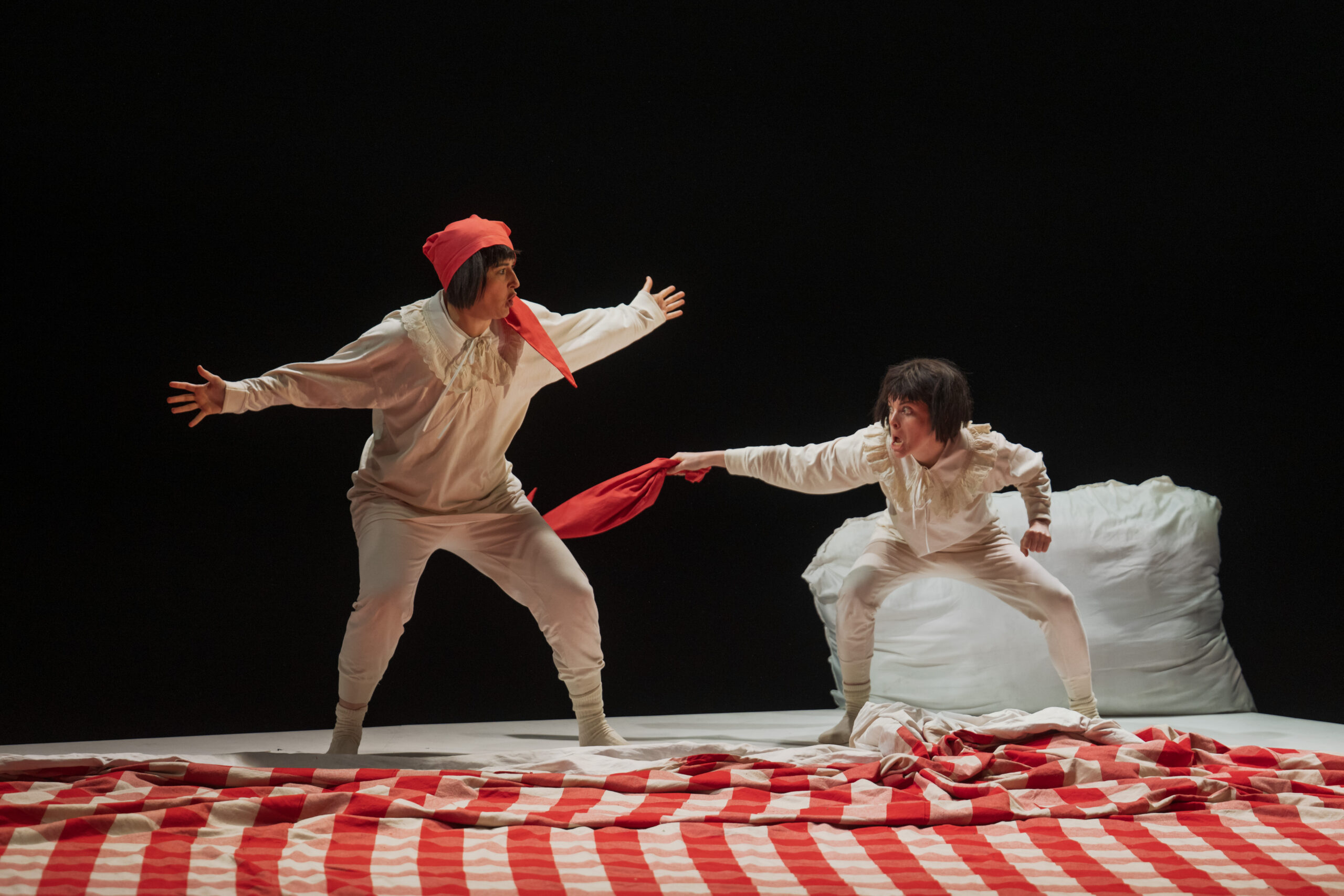
Joanna Harries (Hansel) and Rosalind Dobson (Gretel). Photo: Matthew Williams-Ellis
The director skilfully builds an atmosphere of horrifying poverty from the very beginning. The first two acts take place in a monochromatic space (the sets are by Anisha Fields, who designed the costumes for last year’s excellent staging of Pelléas et Mélisande at LFO, with the whole being lit – brilliantly, as usual – by Ben Ormerod). Act One is dominated by the dirty white of the broom-maker’s cottage interior, with the floor soiled with soot and walls scrawled over with charcoal by the children. In Act Two crooked drawings of puny leafless trees replace a forest – in a space very similar to that of the previous act, though depicted in negative; this time the dominant element is black, against which greyish-white branches loom. Colours, with intense red dominating, appear only in Act Three, the action of which takes places in the Witch’s house.
Bailey builds an atmosphere of horror from what is unseen, lurking at the back of the stage or underneath it. The Witch looks like the Mother, but in rich garments: a red dress as if straight from the set of the film Cruella, just as red stilettos and a white wig of the evil queen from illustrations of Victorian books for children. There is no gingerbread house, no oven in which the old hag will be burned; the entire third act resembles a hallucination in which images as if straight from Alice in Wonderland are mixed with fragments of the children’s memories. Hansel and Gretel wake up under a huge duvet irresistibly bringing to mind a red-and-white chequered tablecloth used for special occasions; the imprisoned Hansel, only whose head is peeking out above the stage, is fattened by the Witch with thick rice pap, which the twins would have eaten the previous day, if the jug of milk had not got broken. When all is finally over, the red will disappear, but no other colour will replace it: the gingerbread children, freed from the spell, the saved siblings and their parents – still as poor as before but happy – will sing the joyous finale in the darkness of the gloomy forest and will probably return to their soot-stained huts. They will, however, be wiser, having learned that it is better to stick together in these terrible times.
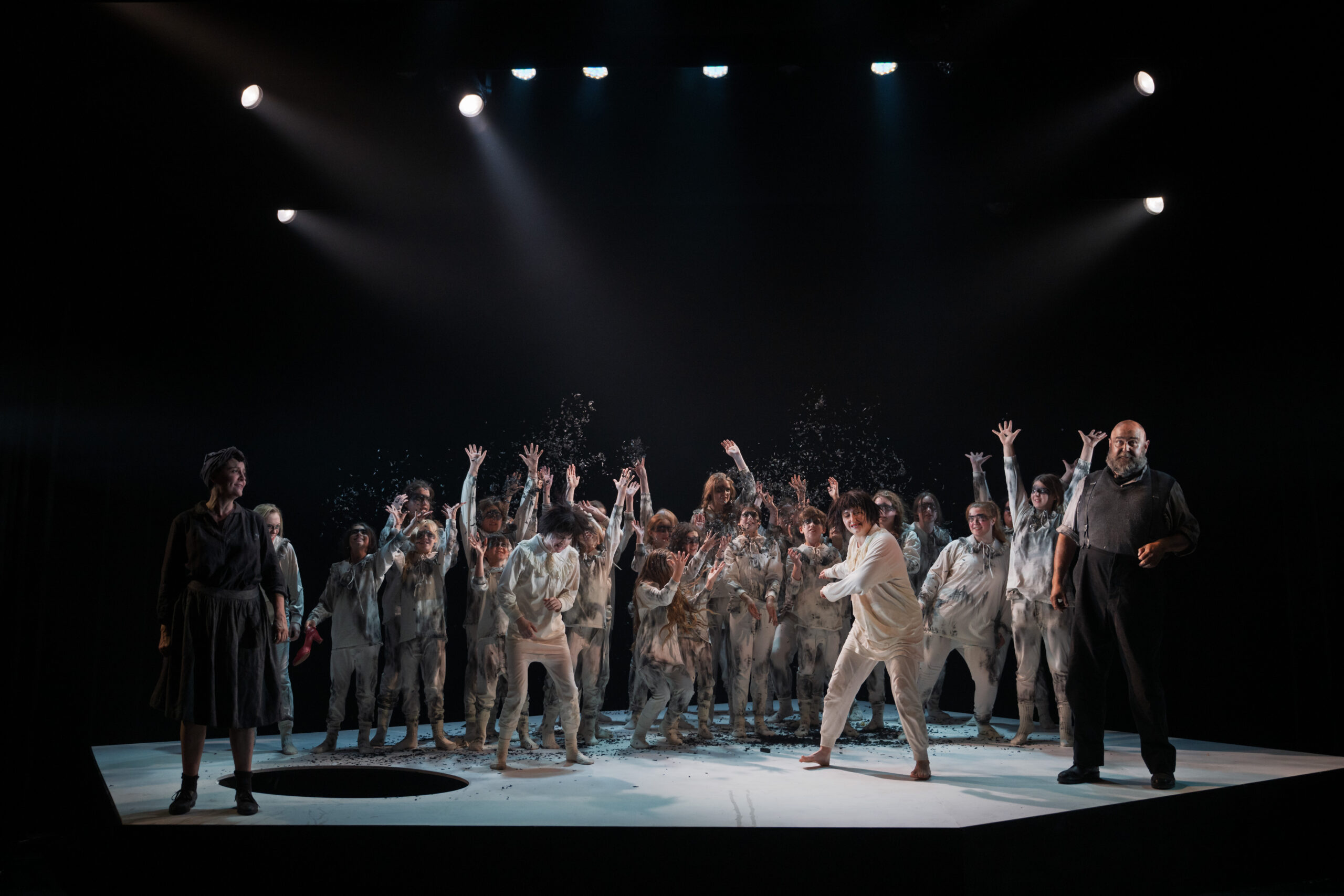
Lee Bisset (Mother), Rosalind Dobson, Joanna Harries, Darren Jeffery and the Longborough Youth Chorus. Photo: Matthew Williams-Ellis
Karen Kamensek brought out many hidden treasures from this score, conducting the fifty or so strong festival orchestra with verve, a spark of humour and, whenever necessary, appropriate solemnity. She firmly yet sensitively highlighted all “Wagnerisms” of the work – all the more effectively given that less than two weeks before the LFO ensemble played the final chords of Tristan under Anthony Negus. Kamensek was also excellent in leading the singers, most of whom are at the beginning of their careers, which also applies to the two main protagonists, perfectly matched in terms of both character and voice (Rosalind Dobson’s beautiful lyric soprano in the role of Gretel and only slightly heavier, though suitably “twin-like”, soprano of Joanna Harries singing Hansel). Emerging artists also did well in smaller roles (Laura Fleur as the Sandman, and Kelli-Ann Masterson, also brilliant as an actress, in the role of Dew Fairy). After her local Wagnerian triumphs, especially as Isolde and Brünnhilde, Lee Bisset took on the dual mezzo-soprano role of Mother/Witch, stealing the show primarily as a phenomenal actress, as her handsome voice is already showing clear signs of fatigue. Darren Jeffery proved to be a magnificent Father. He is an exceptionally refined artist with a soft and warm bass-baritone, perfectly even across all registers. David Eaton, too, deserves praise for preparing the Longborough Youth Chorus, made up largely of children from the local community.
There was just one thing that surprised me – that there were very few children in the audience, despite the fact that the opera was performed in English, in a very skilful and accessible translation by David Pountney. Did the parents thought that the fairy tale was too cruel? Or were they ashamed of their own emotions, for this is, after all, a story of not just hunger but also a sense of security that has been undermined – a nightmare that is all too relevant in today’s world?
Translated by: Anna Kijak