Czech music lovers are just as unlucky when it comes to Dialogues des Carmélites as Poles. As I have recently pointed out, when reviewing the premiere or, in fact, reconstruction of Robert Carsen’s Amsterdam production at Teatro Regio di Torino, the first and so far the only Polish staging of Poulenc’s opera took place in 2000 at Łódź’s Teatr Wielki. Dialogues had to wait seventy years for its Prague premiere. It finally happened this year in May, at the Prague Spring, an event marked by several other round anniversaries.
Dialogues des Carmélites finds its hard to get onto the operatic stages in the former Eastern Bloc, even after the political transformation. The work’s long absence in Czechia is all the more understandable given that shortly after the war the country introduced one of the most restrictive models of fighting the Catholic religion in this part of Europe – in line with the instructions given by Zhdanov, who held up the Soviet experiences in the battle against the Orthodox Church as a model for the USSR’s satellite countries. The repressive measures also affected monasteries. The night of 13–14 April 1950 saw the launch of the so-called Operation K, preceded by show trials of a dozen or so monks, some of whom received life sentences. Over 200 male congregations were dissolved, a few thousand members of monastic communities were interned, monasteries were left to their fate or deliberately vandalised, property was confiscated or plundered. August was marked by the launch of Operation Ř (from the Czech word řeholnice, meaning a nun), carried out in stages and more selectively, targeting mainly “non-useful sisters”, which for the communist authorities meant those involved in education and care of the sick. The victims of that persecution included Magdalena Anna Schwarzová, a Carmelite postulant, who was accused of high treason a few years later, sentenced to eleven years in prison and deprived of her public rights. In the 1980s, following another wave of repression, she was forced to renounce her citizenship before leaving for Kraków, Poland, where she spent the rest of her life as a cloistered nun.
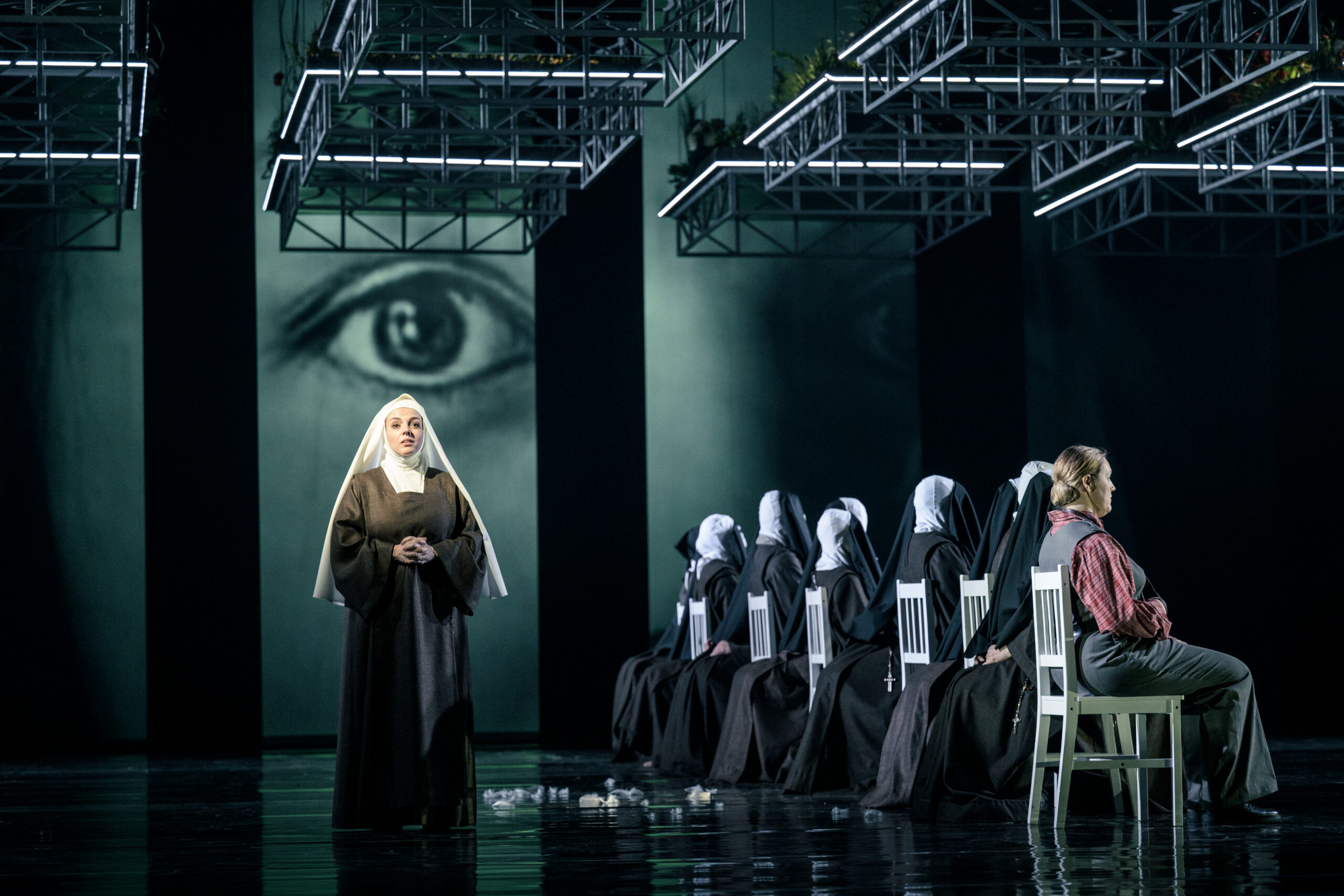
Photo: Petr Neubert
No wonder, therefore, that Barbora Horáková Joly, the director of Dialogues at Prague’s State Opera, saw this inglorious chapter in the history of Czechoslovakia as a parallel with the fate of the wretched Compiègne sisters, guillotined in July 1794. The bad thing is that she treated it too literally, forgetting that Poulenc’s opera was not a reconstruction of historical events, but an adaptation of Gertrude von Le Fort’s mystical novella drawing on these events, an adaptation featuring new elements added by Georges Bernanos and the composer himself. Horákova Joly’s entire concept is dominated by violence, conflict and humiliation, which blur the attitudes and motivations of the various characters. There is no existential fear, nor any inner transformation. For some unknown reason Marquis de la Force abuses his own son mentally and physically; the Old Prioress dies smeared with her own faeces, with her hair messed up, as if she were in a neglected care home and not in Mother Marie’s tender care; Chevalier de la Force arrives at the convent to say good-bye to Blanche covered in blood and barely able to stand – and yet he is supposed to pay her a visit as a potential guardian in her escape, convinced that he would be able to keep his sister safe in the turmoil of the revolution.
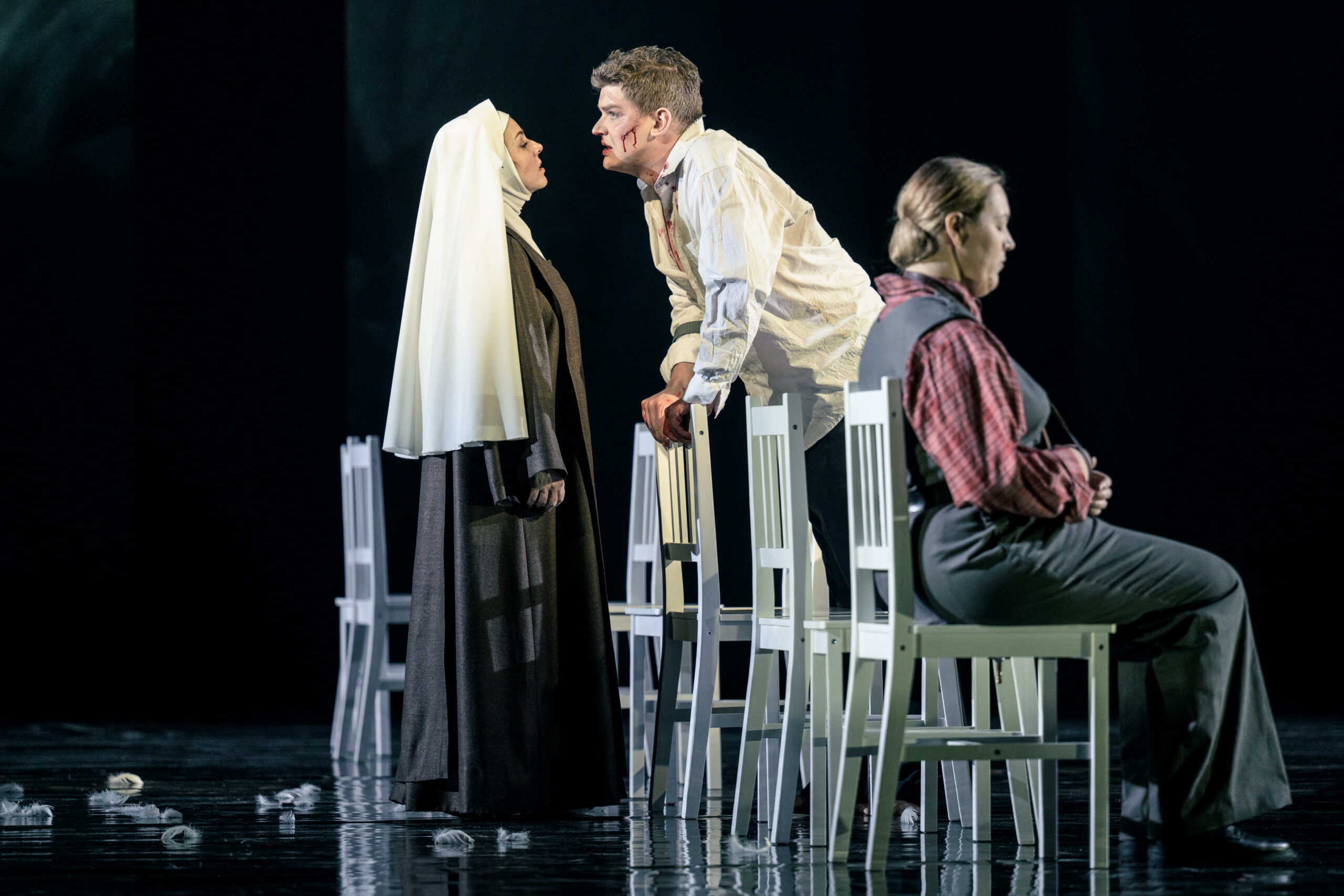
Photo: Petr Neubert
The list of absurdities is endless – which is a pity, because the production is presented in sparse and functional sets designed by Ines Nadler, well-lit by Sascha Zauner, complemented by Annemarie Bulla’s costumes that would have been quite sufficient as an allusion to post-war repressions: without the director’s excessive and ill-conceived ideas, without projections (by Sergio Verde) and fragments of documentaries overused to the point of tedium, not to mention Blanche’s child lookalike, as superfluous as in most opera productions à la mode. It is a pity, because had Horáková Joly reined in her vivid imagination and focused on the only clever, though perhaps not too original, idea of “assigning” to the sixteen nuns sixteen mobile metal structures, lowered from the flies and placed at various angles – which first get covered by the greenery of the vegetables and flowers cultivated by the sisters only to turn in the end into the condemned women’s graves – the rest would have told itself, in a simple reference to this clear metaphor. Like the final execution scene, in which the nuns stand on their own graves in beams of spotlight going out suddenly one by one after each strike of the guillotine.
This rather unsuccessful staging did not quite hold its own musically either. The weakest link was the orchestra, clearly not ready to tackle Poulenc’s shimmering, rhythmically relentless and, at the same time, inhumanly precise score. In Act I everything, including intonation, was off. Then things began to improve somehow – under the experienced baton of Hermann Bäumer, the new music director of Státní opera, whom I came to know during his excellent directorship in Mainz. This may have happened, because at some point the conductor abandoned any further attempt to bring out the sharp contrasts and wealth of harmonies in favour of sounds that were hard, harsh and powerful, but at least impressive. On the other hand, a fine performance came from the chorus, directed by Adolf Melichar, which has little to do in this opera, so I appreciate its commitment and clear articulation all the more.
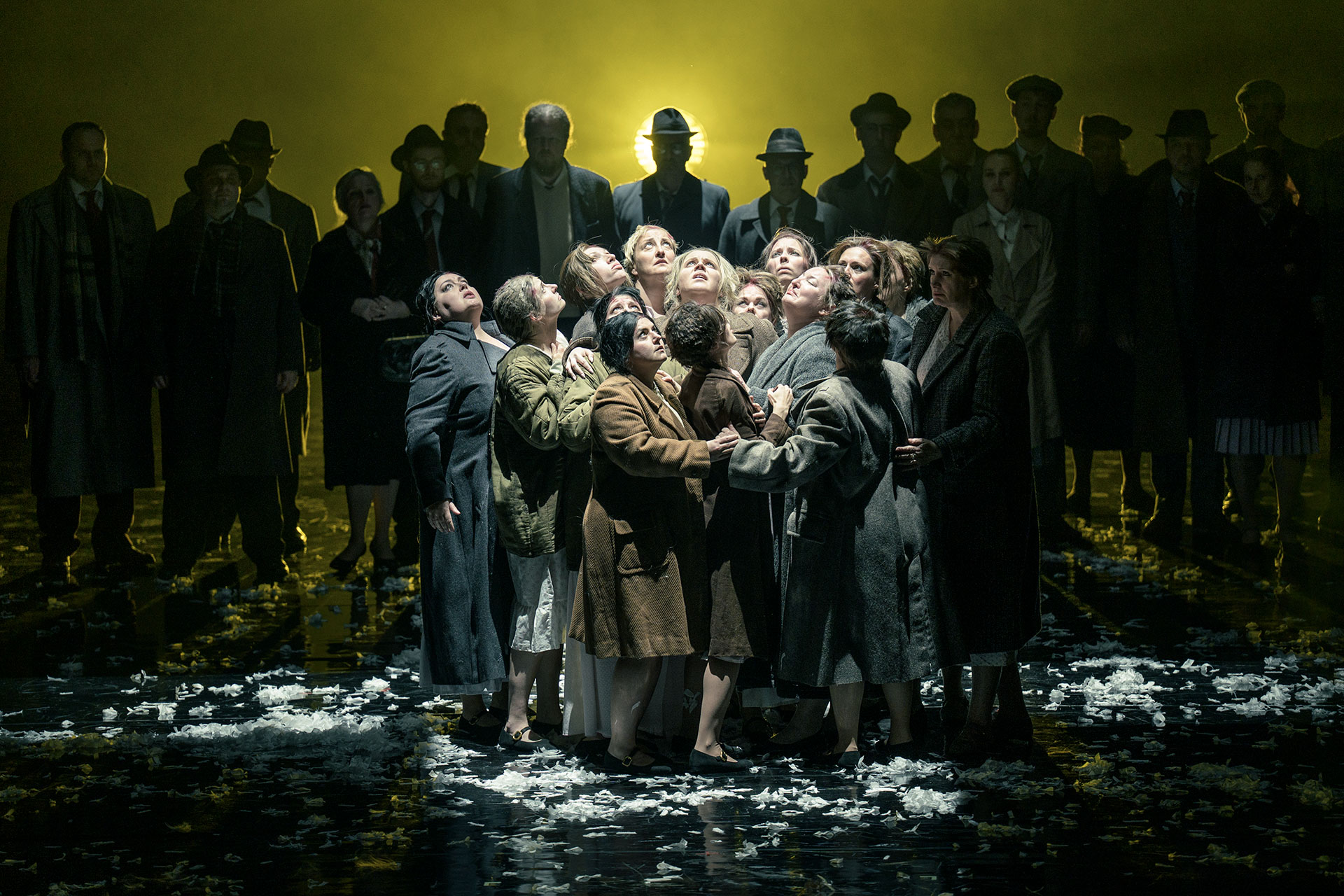
Photo: Petr Neubert
In an exceptionally uneven cast the soloist that stood out was above all Jana Sibera, who has a soft, girlish, beautifully rounded soprano, perfect for the role of Blanche. I was also very impressed by Mother Marie sung by the Norwegian mezzo-soprano Tone Kummervold, whose dense, technically impeccable voice I had admired a few years earlier in Schulhoff’s Flammen. The sharp, strained high notes of Tamara Morozova (Madame Lidoine) were not very pleasant on the ear and neither were serious intonation problems of Ekaterina Krovateva (Constance). Markéta Cukrova was completely miscast as the Old Prioress, a character she was unable to bring to life either with her acting or with her singing: as she ages, her mezzo-soprano is getting increasingly harmonically deficient and increasingly unstable owing to insufficient support. Daniel Matoušek has a lovely tenor, but it is definitely too light for the role of Chevalier de la Force; Paul Gay as Marquis de la Force was rather bland; Michael Skalický did his best as the Chaplain, although the role was too complex and big for his experience and skills.
Perhaps I should have gone to see some of the following performances. Perhaps the production will grow with time. I left the premiere, feeling that the Prague Dialogues des Carmélites did not do justice to either the “Compiègne Sixteen” or the thousands of Czech and Slovak nuns expelled from their convents, interned in camps, harassed by the security services, deprived of the remains of their human dignity.
Translated by: Anna Kijak