The motto of this year’s Innsbrucker Festwochen der Alten Musik is “Was feiern wir?” – and not without reason, as there is something to celebrate and someone to honour in 2026. The festival is celebrating fifty years of uninterrupted existence: it took place even during the pandemic, which prevented the organisation of Festival Oude Muziek in Utrecht, Avignon Festival and Bayreuther Festspiele, among others. Soon, it will be able to celebrate even more jubilees – of the Ambraser Schlosskonzerte, which were launched in 1963 and continue to take place during the Festwochen; of the Early Music Summer Academy, inaugurated in 1972, the predecessor of several educational projects run today; and of the Cesti-Wettbewerb, which has been accompanying the festival for sixteen years. This year Eva-Maria Sens and Ottavio Dantone managed to invite two previous artistic directors, René Jacobs and Alessandro De Marchi, to take part in the festival. In addition, they paid tribute to Alan Curtis, who initiated the tradition of staging forgotten Baroque operas in Innsbruck. Although the tenth anniversary of the death of the American harpsichordist, musicologist and conductor came during the previous Festwochen, this year’s commemoration may have been even more fitting given the staging of Cesti’s legendary opera Il pomo d’oro: after all, it was Curtis who presented two other reconstructed works of this extraordinary composer, the melodrama Il Tito and the dramma musicale La Semirami.
This is why I decided to include in my operatic visit to Innsbruck the “Tribute to Alan” event at the Spanish Hall of the Ambras Castle. It featured the mezzo-soprano Anna Bonitatibus as well as ten Accademia Bizantina musicians led from the harpsichord by Dantone. Bonitatibus was one of Curtis’ favourite singers. He heard her for the first time in 2001, at the Handel Festival in Halle, where she was portraying Irene in a Tamerlano production conducted by Trevor Pinnock. He immediately started working with her and that collaboration soon turned into close friendship. Bonitatibus mentioned “Carissimo Alan” among the people who had the biggest impact on her career. She worked with him until his death and their collaboration included an unfinished project of recording all of Handel’s operas. It was largely thanks to Curtis that she became involved with the Innsbrucker Festwochen, where she continues to conduct masterclasses and serves on the jury of the Cesti Competition.
The artists constructed their programme in such a way as to capture the listeners’ attention and, at the same time, pay tribute to Curtis in pieces marked by an emotional intensity and unbridled energy similar to that he himself brought to his own ventures. The concert at Schloss Ambras was thus brief but delicious. Bonitatibus’ voice may no longer be as fresh as it used to be, yet it still delights with its warm tone, characteristic rapid vibrato and complete control over phrasing, thanks to which her interpretations have gained even more intensity and expressiveness (especially in her phenomenal performance of Ulysses’ aria “No, quella beltà non amo” from Handel’s Deidamia and Anastasio’s endearingly lyrical “Sento in seno” from Vivaldi’s Il Giustino). The evening, which also featured two concerti grossi by Handel and Geminiani respectively (a standout performance among the instrumentalists came from Alessandro Tampieri, a violinist who combines incredible technical discipline with lightness and freedom of improvisation), was by no means a “musical monument” in honour of the great artist: rather, it brought to mind a well worked-through period of mourning for a departed friend, when one can finally allow oneself to return to joyful memories.
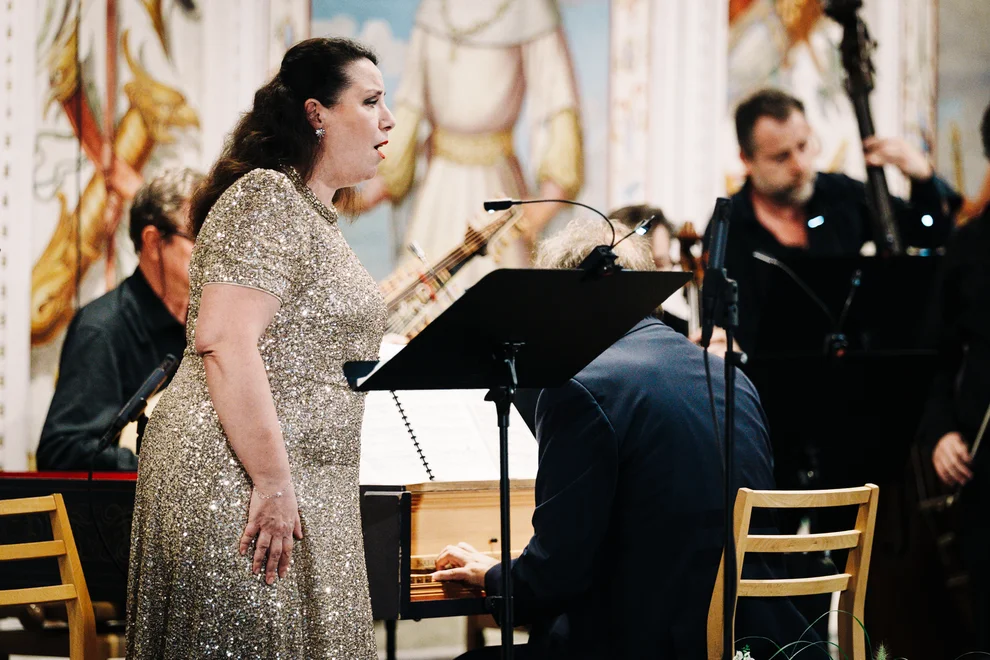
Anna Bonitatibus, Ottavio Dantone, and members of Accademia Bizantina. Photo: Amir Kaufmann
It is a pity that Curtis did not live to see the staging of Il pomo d’oro, rightly announced as the biggest event of this year’s Festwochen (also in the literal sense: according to accounts from the period, this monstrous festa teatrale lasted over ten hours). It was also announced – not quite so rightly – that it would be the first performance of the work since its premiere in 1668. The manuscript of Cesti’s five-act opera to Francesco Sbarra’s libretto has not survived in its entirety: Acts Three and Five disappeared from the score at some point. This was the form in which Il pomo d’oro was published in 1897 by Guido Adler, in the Denkmäler der Tonkunst in Österreich series he edited. Interest in the work was revived in 1982, when the American musicologist Carl B. Schmidt found fragments of the lost acts (including nearly twenty arias) in the library of the House of Este in Modena. However, a year before that a group enthusiasts staged Il pomo d’oro as part of an initiative so peculiar that it is worth mentioning it at least. A so-called chamber version of the surviving three acts with the prologue was directed by the twenty-four-year-old Eberhardt Harnoncourt, son of Nikolaus, in collaboration with the instrument maker and gambist Walter Waidosch. The premiere, featuring fifty amateurs, was held in the small town of Aidenbach near Passau. Eight years later in Vienna a “complete” version – that is, with the fragments discovered in Modena – was presented in a concert performance on period instruments conducted by Gerhard Kramer, a judge by profession and, at heart, a passionate Baroque opera lover. The cast, on the other hand, was made up of professionals, headed by Kurt Equiluz as Paride. The work impressed Martin Haselböck, the founder of the Orchester Wiener Akademie, so much that he decided to stage it. He even managed to put together a creative team, but the project did not go ahead due to logistical reasons.
Interestingly, the Boosey & Hawkes catalogue features a critical edition of the score of Il pomo d’oro – including the Modena fragments and a reconstruction of the rest of the music on the basis of other works by Cesti – by Alan Curtis himself. However, the edition is not available and it is not known if and when it will be published at all. Even more interestingly, Dantone became aware of the gaps in the score already when planning the staging for the festival anniversary season – which he openly admitted in a conversation with Paolo Scarnecchia for the Total Baroque magazine. He, therefore, decided to take the bull by the horns and create his own reconstruction, complementing a new critical edition he had prepared together with Bernardo Ticci. A very good decision, for in this version we cannot hear any “tacking”, although it lasts “only” just under eight hours. Conclusion? Either the witnesses’ accounts are inaccurate or the reconstruction could be expanded to include fragments composed in the style of Johann Heinrich Schmelzer, who composed music to numerous ballet scenes.
But it is just not quite clear whether it would be worth it, because staging this monumental celebration in honour of the House of Habsburg – albeit one loosely drawing on the myth of the Judgement of Paris, the prime cause of the Trojan War – is just as complex today as it was in the seventeenth century. Pietro Antonio Cesti apparently composed Il pomo d’oro for the wedding of Emperor Leopold I and Margaret Theresa of Spain, planned for mid-1666 in Vienna. Yet, first, the wedding was delayed, as was later the construction of the huge Theater auf der Cortina, and then the young empress had to recover after the death of her firstborn son. In the end the premiere took place to mark her seventeenth birthday, on 12 and 14 July 1668 – it was divided into two parts owing to the size of the work. The staging featured over one thousand performers, not to mention horses, elephants and lions. The architect Lodovico Burnacini – who also designed the theatre – prepared no fewer than twenty-three sets for the performance. The show had just about everything: shipwrecks, Venus descending from the night sky in a ball of fire, burning ruins surrounded by the waters of the Styx and vanishing into the monstrous jaws of the monster of Hades. In other words, a veritable theatre of miracles, which apparently overshadowed even Paris’ Salle des Machines.
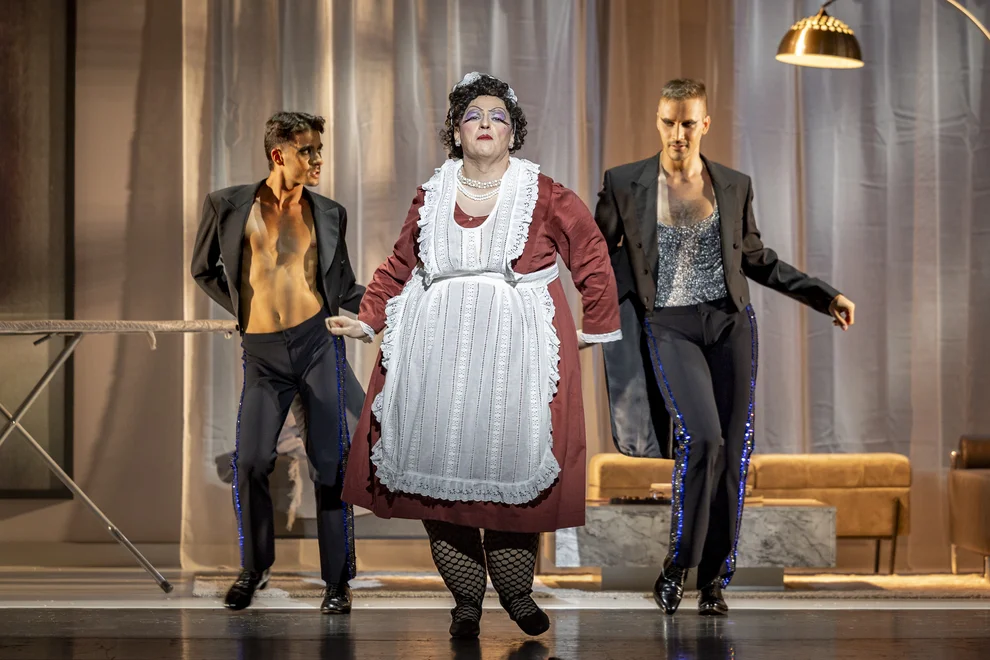
Il pomo d’oro. Alberto Allegrezza (Filaura), and dancers. Photo: Birgit Gufler
Fabio Ceresa, the director of the Innsbruck production, had much more modest resources at his disposal, but his theatrical imagination was just as rich and was, moreover, supported by his impressive knowledge of Baroque opera. First of all, he appreciated the surprisingly coherent narrative of Il pomo d’oro, which stemmed not only from the libretto, but, above all, from the musical structure of the work. As a result, he was able to create two clear main storylines, that is the ruthless rivalry of the Olympian gods and the romantic vicissitudes of the mortals unfolding in its shadow – combining the fairy-tale splendour of the former’s world with the conventional, stylised modernity of the latter’s (Giuseppe Palelli’s marvellous costumes and Nikolaus Webern’s sophisticated yet functional set design, precisely lit by George Tellos). He brilliantly highlighted two characters drawn from the comedy convention: the nurse Filaura, an en travesti role, and Momo, or Momus, the god of mockery, a former adviser to the inhabitants of Olympus, cast down to earth as punishment (in Cesti’s opera, Momo also serves as a commentator on the events, breaking down the symbolic barrier between the stage and the audience). Ceresa peppers some scenes – including the Prologue, featuring the allegories of the lands of the Holy Roman Empire, and the episode depicting the council at the residence of Eolo, the lord of the winds, at the beginning of Act III – with allusions to current political and social events, sometimes rather bluntly, yet never crossing the line of good taste.
Above all, however, he knows how to leave the modern audience speechless and full of childlike wonder – and this is a no mean feat in this era of ubiquitous projections and opera’s increasingly common forays into artificial intelligence and augmented reality. Ceresa resorts to tried and tested theatrical tricks, which we fall for like children, because we have long forgotten that it can be done that way. Who would have thought that a curtain with a simple image of a skyscraper suddenly pulled down from its batten would create such a poignant impression of a city falling into ruin? Who did not burst out laughing when Giunone showered Momo with a deluge of tacky gold tinsel? Who did not stare, mouth agape, at the black abyss of the stage, where the Milky Way, made up of light points on invisible poles, was dancing?
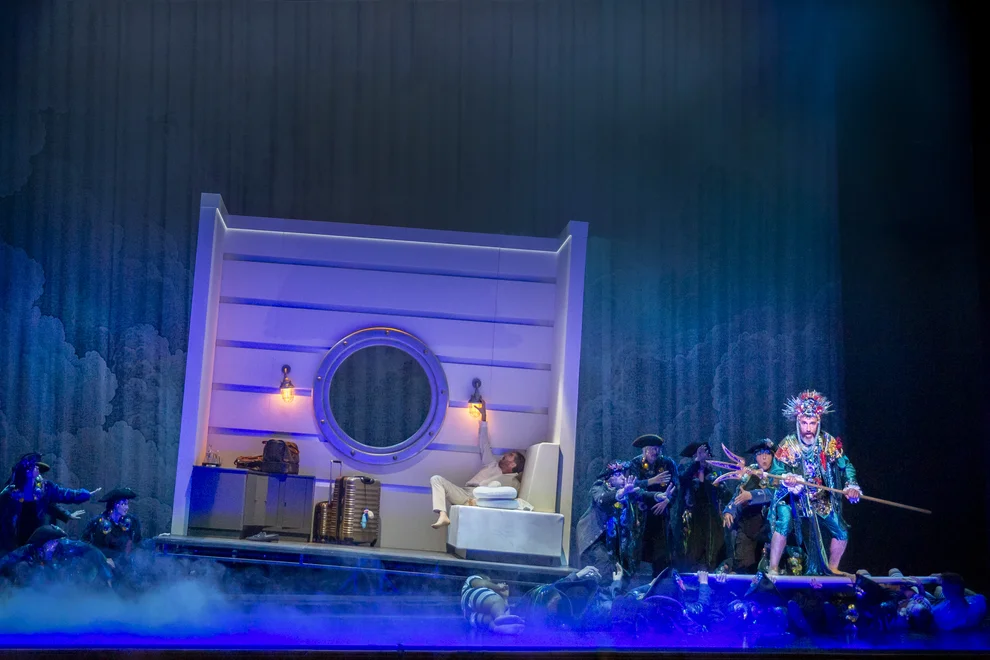
Mauro Borgione (Paride) and Federico D.E. Sacchi (Nettuno). Photo: Birgit Gufler
Dantone showed similar imagination, entrusting the over forty roles to twenty singers, sharing the stage with the NovoCanto vocal ensemble and two dance groups, Street Motion Studio and Compagna Fattoria Vittadini. The Innsbruck Il pomo d’oro cast would in any case be sufficient for at least three productions of works representing various types of Italian Baroque opera. Because that is precisely what this work is like, unique within Cesti’s oeuvre – contrary to appearances – making liberal use of all the styles and conventions of its day. There are surprisingly melodious recitatives, characteristic of the Venetian School; there are more or less elaborate arias, ariosos and laments; there are true arie di furore, ensembles of various kinds, group scenes composed in the traditional Roman style or with elements of the polychoral and concertante techniques. The mood changes constantly: pastoral fragments alternate with scenes straight from hell; passionate lovers’ duets are juxtaposed with comic episodes; outbursts of divine wrath are separated by a short distance from manifestations of triumph and glory.
The cast included artists with voices of various colours, very diverse temperaments and even more diverse stage experience. All did more than well, but I hope I will be forgiven for mentioning only those whose craftsmanship made the biggest impression on me. Let me start with the phenomenal Giunone of Sophie Rennert, a mezzo-soprano that attracted my attention a few years ago, but it is only now that I have heard her in a role seemingly tailor-made for her. She played with it in a manner bordering on nonchalance, displaying a whole range of demeanours and emotions – from the imperiousness of a goddess of the heavens to unholy fits of rage, worthy of Sophia Loren in Matrimonio all’italiana. I was captivated by two red-blooded, passionate altos – Margherita Maria Sala, especially in the role of Alceste, and the young Mathilde Ortscheidt, winner of the Cesti Competition three years ago, convincing in the role of the nymph Ennone abandoned by Paride. Both of Ennone’s partners came trumps: Mauro Borgione singing Paride, a role nominally written for a tenor, but, in fact, from the point of view of today’s Fach classification, just as indefinable as the roles of Orpheus and Ulysses from Monteverdi’s operas, requiring a flexible voice with a broad range and clearly baritonal colour; and Rémy Brès-Feuillet, who has a dark, velvety alto countertenor, perfect for the role of the melancholic shepherd Aurindo. However, in many scenes in which he appeared the show was stolen by the brilliant Alberto Allegrezza, a versatile singer actor in the bravura role of Filaura, Ennone’s nurse. Rocco Cavalluzzi increasingly won me over with each act, in the big role of Momo, written for a high bass; another excellent performance came from Federico D.E. Sacchi, just as experienced in this repertoire, in the bass roles of Nettuno and Cecrope. I should also mention fine performance of two young singers freshly discovered by Dantone: the tenor Žiga Čopi as Marte and the bass Balázs Bán as Bacco.
Despite the fact that Dantone had at his disposal a much smaller number of musicians than the Viennese orchestra in 1668 – which was made up of five ensembles playing, it would seem, every instrument used in opera at the time – he nevertheless managed to bring out everything that matters in this score. Also thanks to a large and very nimble continuo section, constantly engaging in a lively dialogue with the soloists and the chorus.
There is just one thing that keeps me awake at night: the finale, where, in the original version, Giove presents the golden apple to the young empress, while Fabio Ceresa chose to bestow the fruits of the Hesperides’ garden on all the performers – replacing the obsequious message of Il pomo d’oro with a contemporary allegory of the unity of the European Union. The golden-haired infanta from Velázquez’s Las Meninas gave birth to three more children, only one of whom reached adulthood, and had two miscarriages. She died at the age of twenty-one, during her seventh pregnancy. Perhaps it is better not to tempt fate?
Translated by: Anna Kijak